
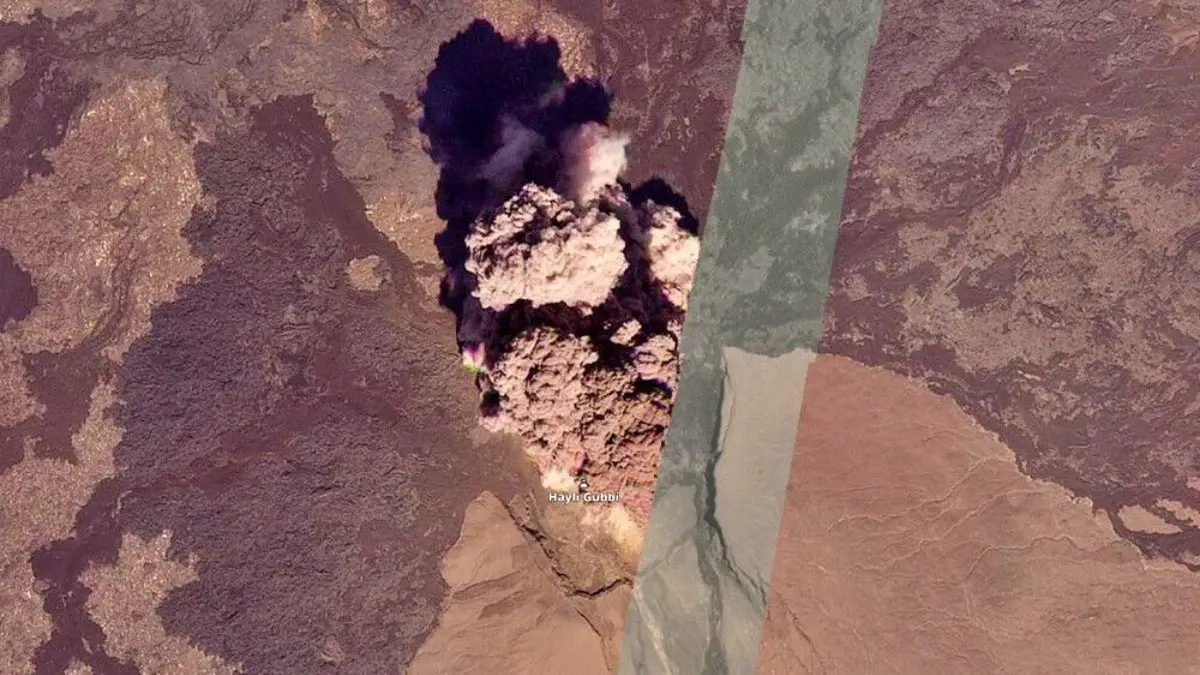
Hayli Gubbi is a shield volcano found in Ethiopia’s Afar Region. It is the southernmost volcano in the Erta Ale mountain chain. For thousands of years, this volcano was believed to be quiet, with no known eruptions during the past 12,000 years. This long period of silence ended in November 2025.
Location of Hayli Gubbi
Hayli Gubbi is a shield volcano located in the Afar Region of Ethiopia, in the northeastern part of the country. It lies in the Erta Ale Range, a famous volcanic area known for its active landscape. Hayli Gubbi is the southernmost volcano in this range. The region is very remote, with hot deserts and rocky terrain, which makes it difficult for scientists and visitors to reach the volcano easily.
A Previously Quiet Volcano
Because the Afar Region is remote and difficult to access, scientists do not have many historical records of volcanic activity there. However, until 2025, Hayli Gubbi had not shown any signs of eruption since the start of the Holocene era, making the November 2025 eruption a surprising event for researchers.
The 2025 Explosive Eruption
The 2025 explosive eruption of Hayli Gubbi was a sudden and powerful event, sending a huge ash cloud high into the sky and surprising scientists.
How the Eruption Began?
On 23 November 2025, the Toulouse Volcanic Ash Advisory Centre (VAAC) announced that Hayli Gubbi had suddenly erupted. Satellite images showed a large ash cloud rising into the sky.
The eruption began around 08:30 UTC, sending ash up to 45,000 feet (14,000 meters)—high enough to affect air travel.
Nature of the Eruption
The activity was strong enough to be described as a sub-plinian eruption, meaning it produced a tall, powerful ash column. Photos taken during the event showed a tall, bright plume rising above the volcano.
By 20:00 UTC, the explosive part of the eruption had mostly ended.
Movement of the Ash Cloud
After the initial explosion, winds carried the ash cloud across parts of the Arabian Peninsula, including areas of Yemen and Oman. This raised concerns about possible visibility problems and air pollution.
Concerns and Impact
- Air Quality: People were worried that the drifting ash might reduce air quality in some regions. However, no major health or environmental problems were reported.
- Air Travel: Volcanic ash can be dangerous for airplanes, so authorities monitored the situation closely. Thankfully, there were no significant disruptions to flights away from the eruption area.


 Top-10 Largest Oil Consuming Countries i...
 What is the National Fruit of Malaysia? ...
 What is the Difference Between LPG and P...











