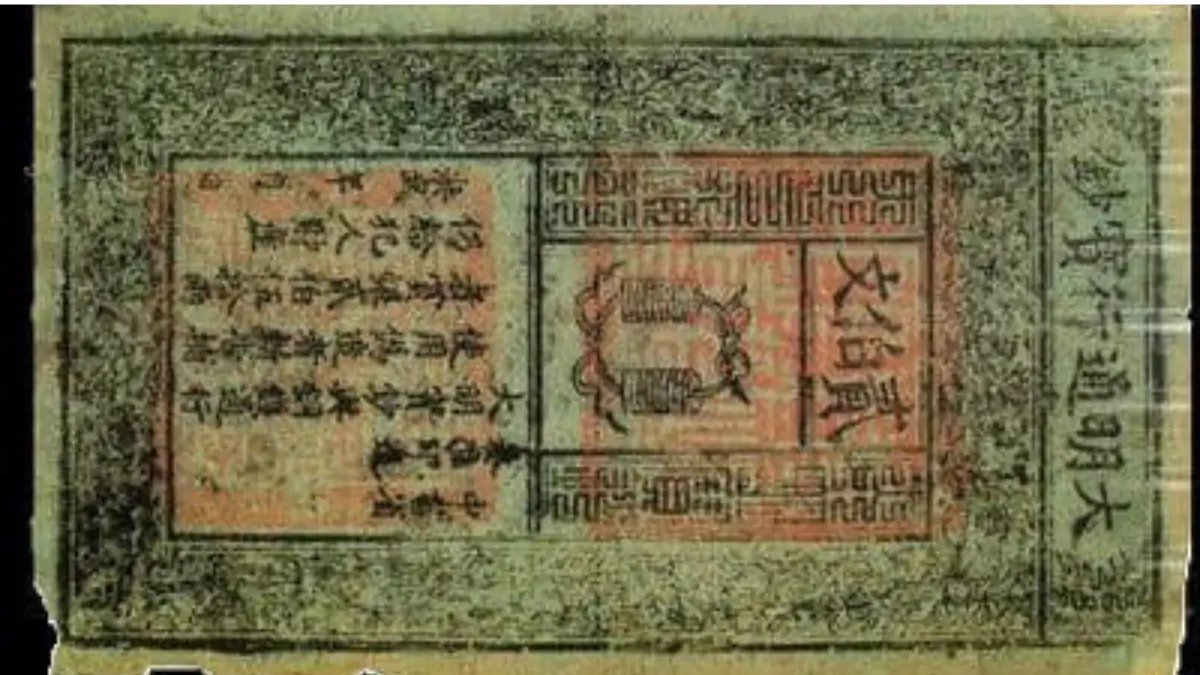
For centuries, people used coins, shells, and other forms of money to trade goods and services. Carrying large amounts of metal coins was heavy and difficult, so people needed a simpler and lighter way to make payments. Over time, a new form of money was invented that made trade faster, easier, and more convenient, changing the way people handled wealth across long distances and different regions.
The Birth of Paper Money in China
Paper money was first invented in China during the Song Dynasty around the early 11th century. At that time, carrying large metal coins for trade was inconvenient. To solve this problem, merchants in the Szechwan region started using paper notes called Jiaozi instead of heavy coins.
Later, the Chinese government noticed their usefulness and began issuing government-backed paper money, making it an official way to buy and sell goods. This marked the beginning of the world’s first national currency system.
What was the First Paper Money Called?
The first paper money was called Jiaozi. These notes were initially created by merchants, but soon the government took control. Jiaozi notes had strict rules: they could be used only for a certain period, and their value was regulated through deposits. This ensured that paper money was reliable and safe for trade.
Expansion Under the Yuan Dynasty
During the Yuan Dynasty, Kublai Khan expanded the use of paper money. He made it mandatory for everyone in his empire to use these notes. This standardization helped China manage trade and taxes more efficiently. The Chinese system became a model for other countries around the world in later centuries.
How Paper Money Spread to Europe?
Paper money reached Europe through travelers and traders who visited China. Famous travelers like Marco Polo wrote about China’s paper money in the 13th century. At first, Europeans were skeptical and did not trust paper as money.
However, by the 16th century, as Europe faced shortages of metal coins, countries began to adopt the idea. In the 17th century, Sweden became the first European country to issue its own paper money. Soon, other European nations followed, and paper money became widely accepted.
The Global Impact of Paper Money
China’s invention of paper money changed the world. It made trade easier, reduced the need to carry heavy coins, and helped economies grow. Today, paper money is used globally, forming the basis of the modern monetary system.


 Which Chemical is known as the King of C...
 CNG vs LPG Explained: Differences, Benef...
 What is LPG Gas? Uses, Benefits, and Int...