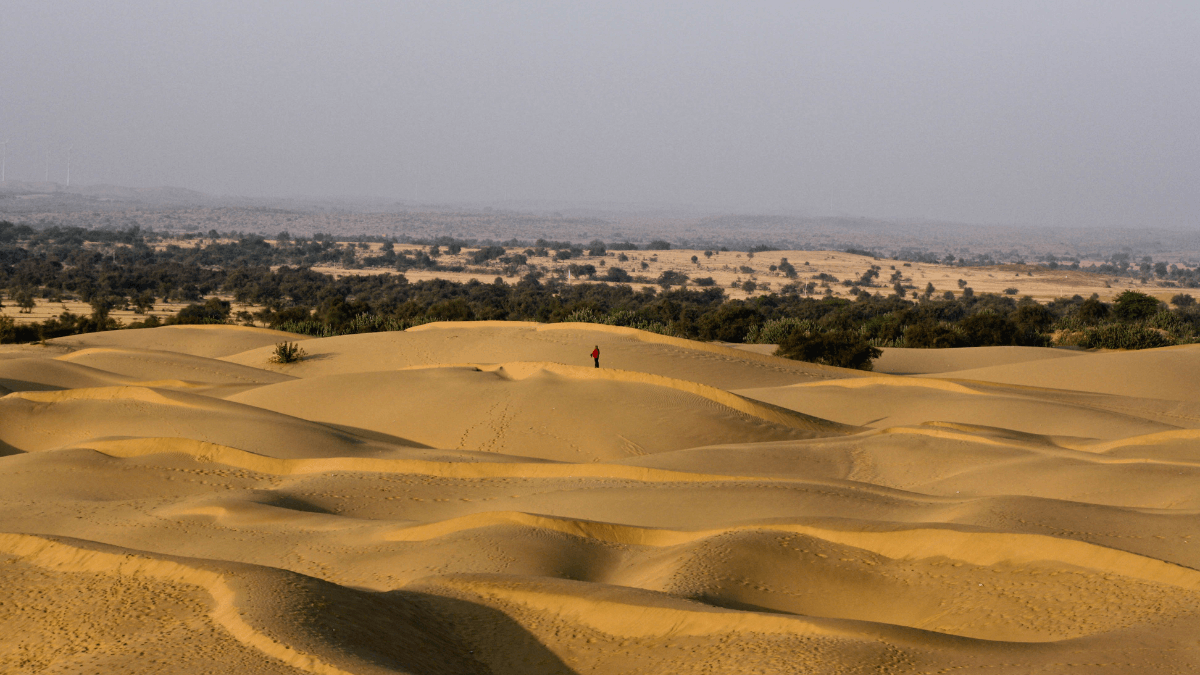
India is a land full of wonders, not just in its culture and history, but also in its natural heritage. Some places here are so unique that they tell us stories from millions of years ago. Among them is a special district, often called the “Desert of Fossils”, because it preserves remains of plants and animals from prehistoric times, making it a treasure for scientists and travelers alike.
District Known as the Desert of Fossils
The Jaisalmer district of Rajasthan is known as the “Desert of Fossils” in India. Located in the Thar Desert, it is home to sites like the Desert National Park and the Akal Wood Fossil Park, where fossils of ancient plants and animals have been preserved. A major discovery here includes a 200-million-year-old phytosaur fossil, making Jaisalmer a treasure for scientists, historians, and nature lovers.
Why is Jaisalmer Known as the Desert of Fossils?
Jaisalmer in Rajasthan is called the “Desert of Fossils” because of the rich fossil discoveries found in the Thar Desert. Scientists have unearthed remains of ancient wood, marine life, and even dinosaurs, proving that this dry desert was once covered with forests, rivers, and a sea. Remarkable findings include 180-million-year-old fossilized wood logs and 167-million-year-old dinosaur fossils, which highlight Jaisalmer’s importance as a window into India’s prehistoric past.
Key Fossil Sites in Jaisalmer District
Jaisalmer district in Rajasthan is home to some of India’s most remarkable fossil sites. These places preserve traces of ancient plants, animals, and even dinosaurs, offering a rare glimpse into the prehistoric life of the Thar Desert.
Desert National Park
- One of India’s largest national parks.
- Protects not just the desert’s plants and animals but also its fossil-rich land.
- Researchers and tourists visit to learn about the biodiversity and history of the region.
Akal Wood Fossil Park
- Declared a National Geological Monument.
- Preserves fossilized wood that dates back to the Jurassic period.
- Offers a glimpse into the kind of forests that once grew in this desert land.
Phytosaur Fossil Discovery
- In a village near Jaisalmer, scientists found a 200-million-year-old phytosaur fossil.
- Phytosaurs were crocodile-like reptiles that lived during the Triassic period.
- This discovery helps us understand more about prehistoric life in the Thar Desert.
Importance of Fossil Discoveries in Jailsamer
- Scientific Value: Fossils provide knowledge about ancient plants and animals.
- Tourism Boost: Fossil parks attract visitors, students, and researchers.
- Heritage Preservation: Protecting fossils helps maintain India’s natural and historical heritage.


 Which River is known as the Limpopo of I...
 Oscars 2026 Winners List: 25 Important M...
 Which Island is known as the Orphan of t...