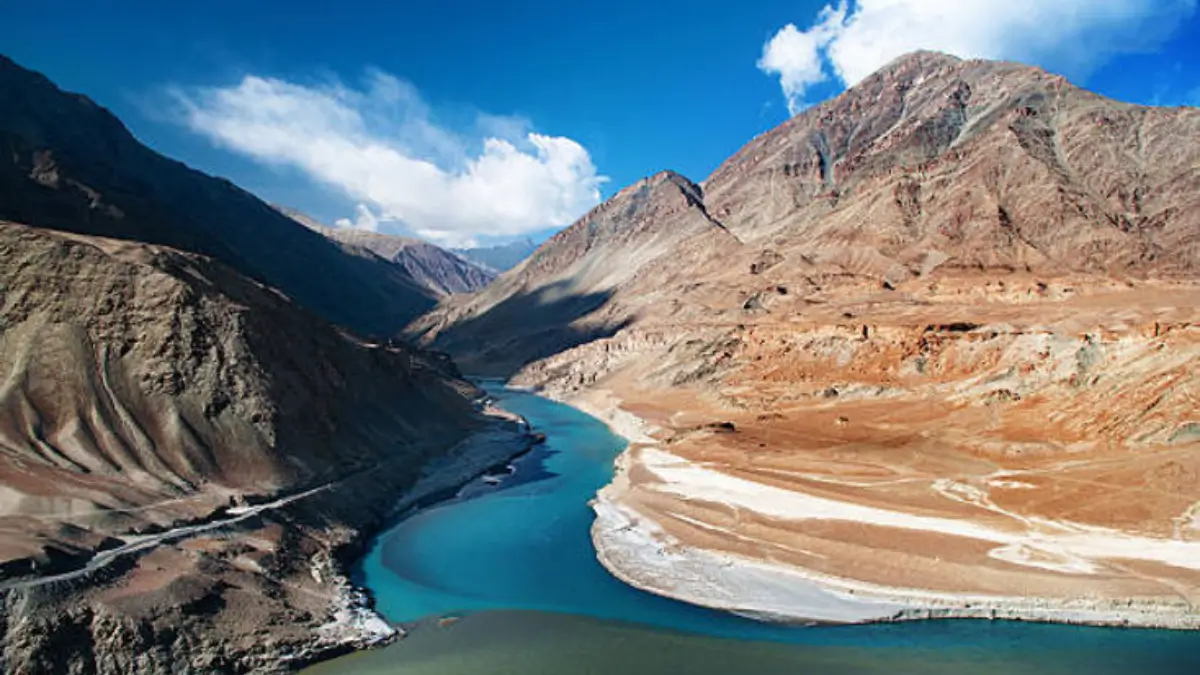
Rivers are the lifeline of civilizations, providing water for drinking, farming, and daily life. Some rivers start from high mountains where snow and ice slowly melt, creating streams that grow bigger as they flow. One of the most important rivers in South Asia begins its long journey in such a cold and remote region, supporting millions of people and shaping the land it passes through.
Which Glacier is the Source of the Indus River?
The Indus River starts from the Bokhar Chu Glacier. This glacier lies on the Tibetan Plateau near the sacred Mount Kailash. It is located at a very high altitude of about 5,180 metres above sea level. Meltwater from this glacier forms the first streams of the Indus River.
Early Name and Starting Region
In its early stage in Tibet, the Indus River is called Senge Zangbo, which means “Lion River.” The river begins its journey in Tibet, China, flowing through cold and dry mountain land.
Journey through Countries
After starting in Tibet, the river enters India, flowing through the Union Territory of Ladakh, known for its cold desert landscape. From there, it moves into Pakistan, where it travels through mountainous and plain regions such as Gilgit-Baltistan, Khyber Pakhtunkhwa, Punjab, and Sindh. Finally, the river empties into the Arabian Sea near Karachi.
Length and Significance of the Indus River
The Indus River is about 3,180 kilometres long, making it one of the longest rivers in Asia. It is extremely important for irrigation, especially in Pakistan, where it supports large farming areas. Many cities and villages depend on it for water.
Different Names of the Indus
Over time, the Indus River has been known by different names:
- Sindhu in ancient Sanskrit, meaning a large water body.
- Senge Zangbo in Tibet, meaning Lion River.
- Indos by the ancient Greeks.
- Mehran, a local name used in Sindh.
History and Ecological Importance
The Indus River supported the Indus Valley Civilisation, one of the world’s oldest civilisations. It is also home to the rare Indus River Dolphin. The river’s delta has rich mangrove forests, which protect coastal areas and support marine life.


 What is National Investigation Agency? C...
 Which State is the Largest Petroleum Pro...
 Largest Crude Oil Supplier Countries to ...