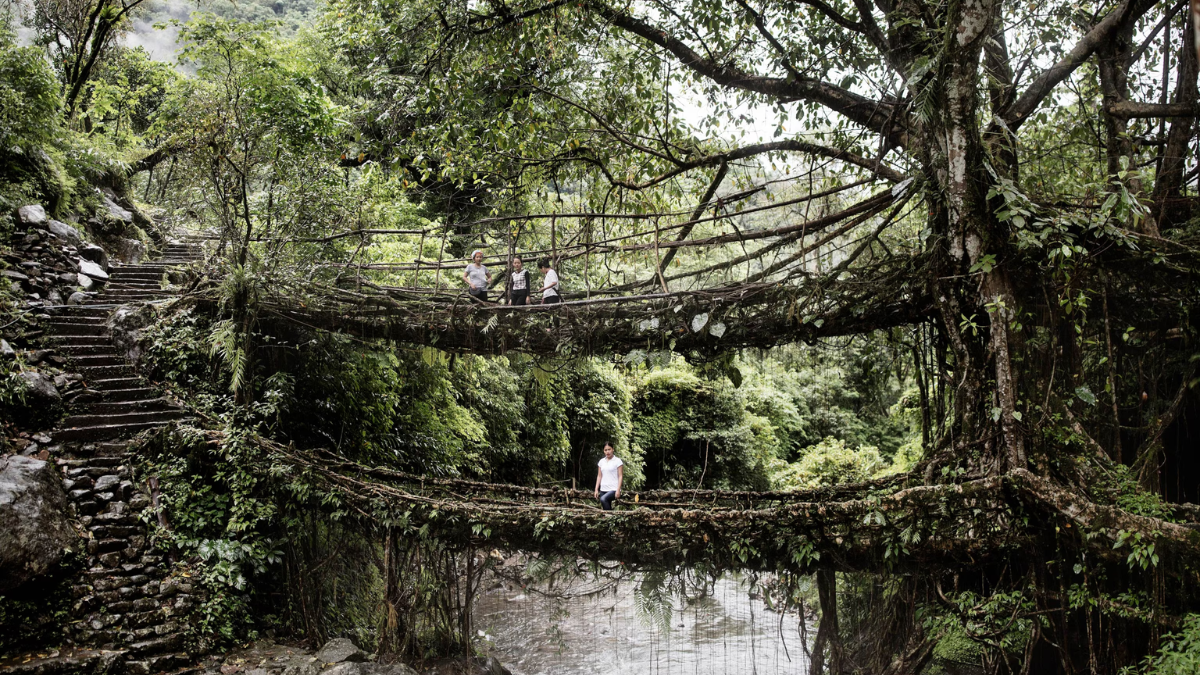
India is a land of diverse cultures, natural wonders, and unique traditions. From snow-covered mountains to tropical forests, every region has something special to offer. Among these wonders are rare creations where nature and human skill come together in harmony. In one town of northeast India, a truly amazing example of this bond can be seen in the form of natural bridges grown from tree roots.
An Overview of India
India, officially the Republic of India, is a South Asian country and the seventh-largest in the world by area. Since 2023, it is also the most populous nation and the largest democracy since independence in 1947. Bordered by Pakistan, China, Nepal, Bhutan, Bangladesh, and Myanmar, it is surrounded by the Indian Ocean, Arabian Sea, and Bay of Bengal, with nearby neighbors like Sri Lanka, Maldives, Thailand, and Indonesia.
Number of Districts in India
India has nearly 800 districts, with the latest official number being 787. These districts are distributed among different states and union territories. Each district plays an important role as an administrative unit, helping the government manage local governance and development more effectively across the country.
The Town of Living Root Bridges
The Indian town called the “Land of Living Root Bridges” is Cherrapunji, also known as Sohra, in Meghalaya. Famous for being one of the rainiest places on Earth, Cherrapunji is home to these rare bio-engineered natural bridges. They are found in and around the region, especially in nearby villages like Nongriat and Mawlynnong.
Why is Cherrapunji known for Living Root Bridges?
Cherrapunji is known for its living root bridges because the local Khasi people skillfully weave and guide the roots of rubber trees across streams. Over time, these roots grow into strong, natural bridges that last for generations.
Here are some reasons why Cherrapunji is famous for Living Root Bridges:
Ingenious Natural Construction
The local Khasi tribes have mastered the art of guiding the aerial roots of the rubber fig tree (Ficus elastica) across streams and rivers. Using betel nut trunks as support, they weave the roots until they reach the other side and take hold in the soil. Over time, the roots grow stronger and form sturdy bridges.
Living and Growing Structures
Unlike normal bridges made of wood or steel, these bridges are alive. The roots keep growing and thickening with age, which means they become stronger as the years pass. Some bridges are over a hundred years old and still in use.
Eco-Friendly and Sustainable
Living root bridges are a brilliant example of sustainable engineering. They do not harm the environment and use only natural resources. Instead of cutting down trees, the Khasi people have found a way to work with nature to build lasting pathways.
Part of Khasi Culture
For the Khasi community, these bridges are not just practical solutions for crossing rivers but also a symbol of their deep connection with nature. They reflect traditional wisdom passed down through generations.
Tourist Attraction and Natural Beauty
Today, these bridges attract visitors from across the world. The most famous one is the Double-Decker Root Bridge in Nongriat, which has become a highlight of Meghalaya tourism.


 Which Place is known as the Glass Capita...
 Who is known as the Father of Census of ...
 Which Continent is known as the White Co...