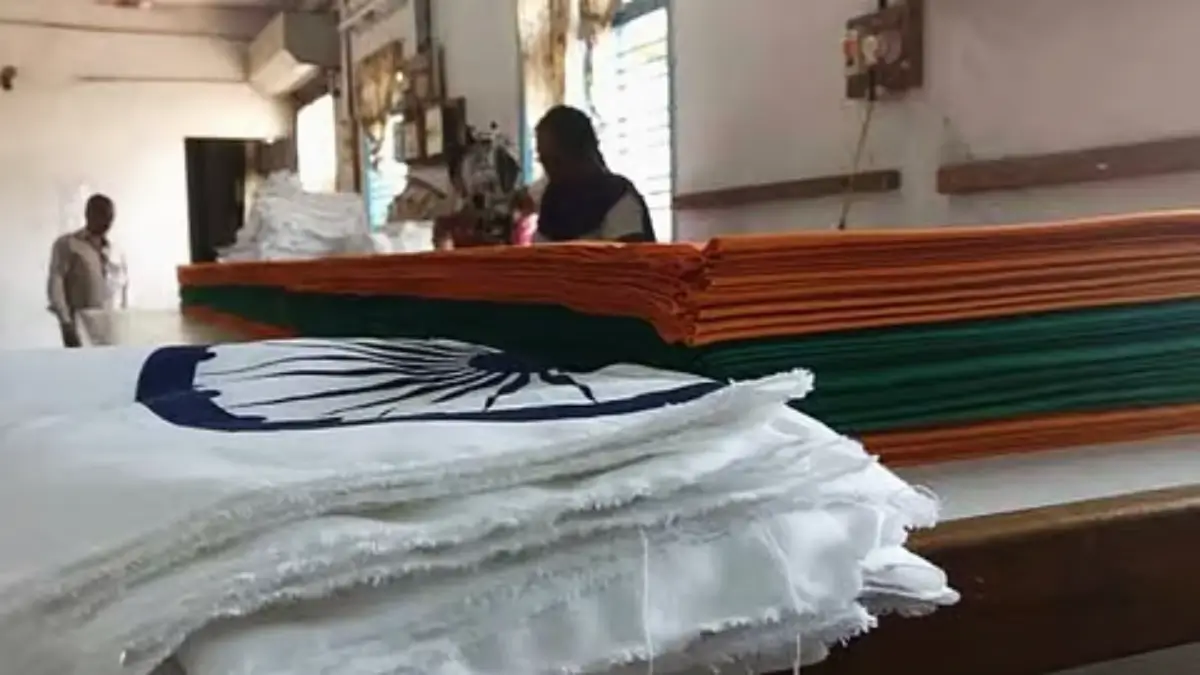
Did you know that every Indian National Flag you see on government buildings, schools, and national events follows very strict rules of making? From the cloth to the stitching, everything is carefully checked to keep the respect of the Tricolour.
There is a special place in India where people have been making the national flag for many years. For the families living there, it is not just a job but a matter of pride and honour.
Workers in this village follow exact measurements, colours, and fabric standards fixed by the government. Even a small mistake means the flag cannot be used officially.
Generations have grown up learning this skill from their elders. Children watch their parents carefully weave, cut, and stitch the sacred fabric with dedication.
Because of this unique tradition, this village holds a very special identity in the country and plays an important role in keeping the dignity of the Tiranga alive.
Which is India’s Only Village that makes the National Flag?
Bengeri village near Hubballi in Karnataka is famous as India’s only authorised place that makes the Indian National Flag according to government rules. The flags are produced by the Karnataka Khadi Gramodyoga Samyukta Sangha using hand-spun and hand-woven Khadi cloth. Each flag follows strict standards for size, colours, and the 24-spoke Ashoka Chakra. Thousands of flags made here are supplied across the country for national celebrations and official use.
Where is Bengeri Village Located?
Bengeri is a small village situated near Hubballi (Hubli) in Dharwad district of Karnataka. Though it looks like a normal rural settlement, it holds a national-level responsibility.
Here, the Karnataka Khadi Gramodyoga Samyukta Sangha (KKGSS) manufactures the Indian National Flag following government rules. Because of this work, Bengeri has earned recognition across India.
Check This: Which Country is known as the Tear Drop of India?
Why Only Bengeri is Authorised?
The Indian government allows only certified organisations to manufacture the national flag. The Bureau of Indian Standards (BIS) has approved the unit in Bengeri for large-scale official production.
The reason is simple — the Indian flag must be made exactly as described in the Flag Code of India. Every detail, from cloth to stitching, must match the prescribed design. Bengeri’s unit has the trained workers and traditional equipment needed to maintain this precision.
Significance of Khadi in the National Flag
One of the most important rules is that the Indian flag must be made from Khadi fabric. Khadi can be:
- Khadi cotton
- Khadi silk
- Khadi wool
Khadi is hand-spun and hand-woven cloth. Mahatma Gandhi promoted Khadi during the freedom movement as a symbol of self-reliance and Swadeshi. Using Khadi in the flag keeps that spirit alive even today.
Workers in Bengeri spin yarn on traditional charkhas and weave cloth manually before the flag is stitched.
How the Flag is Manufactured?
Making the Indian flag is a long and careful process. It involves many steps:
1. Spinning the Yarn
Cotton fibres are spun by hand into thread using a spinning wheel.
2. Weaving the Cloth
The thread is woven into Khadi fabric on handlooms.
3. Dyeing the Colours
The cloth is coloured in three exact shades:
- Saffron (top)
- White (middle)
- Green (bottom)
4. Printing the Ashoka Chakra
The navy-blue Ashoka Chakra with 24 spokes is printed or embroidered precisely at the centre.
5. Stitching and Finishing
The cloth is stitched in a 3:2 ratio and inspected carefully before approval.
Quality Check and Certification
Every flag produced in Bengeri must pass strict testing by the Bureau of Indian Standards (BIS). Officials check:
- Exact size and proportion (3:2 ratio)
- Colour shades
- Fabric strength
- Correct Ashoka Chakra design
- Stitching quality
Only after approval can the flag be supplied to government offices, schools, and public institutions.
Key Facts About Bengeri Village
- The flag must always be made from Khadi — no synthetic cloth allowed.
- The Ashoka Chakra always contains exactly 24 spokes.
- Every official government flag in India follows BIS specifications.
- The production process still uses traditional hand-weaving methods.
- The village is often called the “Tiranga Village of India.”


 Where is the Strait of Hormuz Located?
 Best Airlines in the World 2026: Best Fu...
 Who Invented the QR Code? Check Here