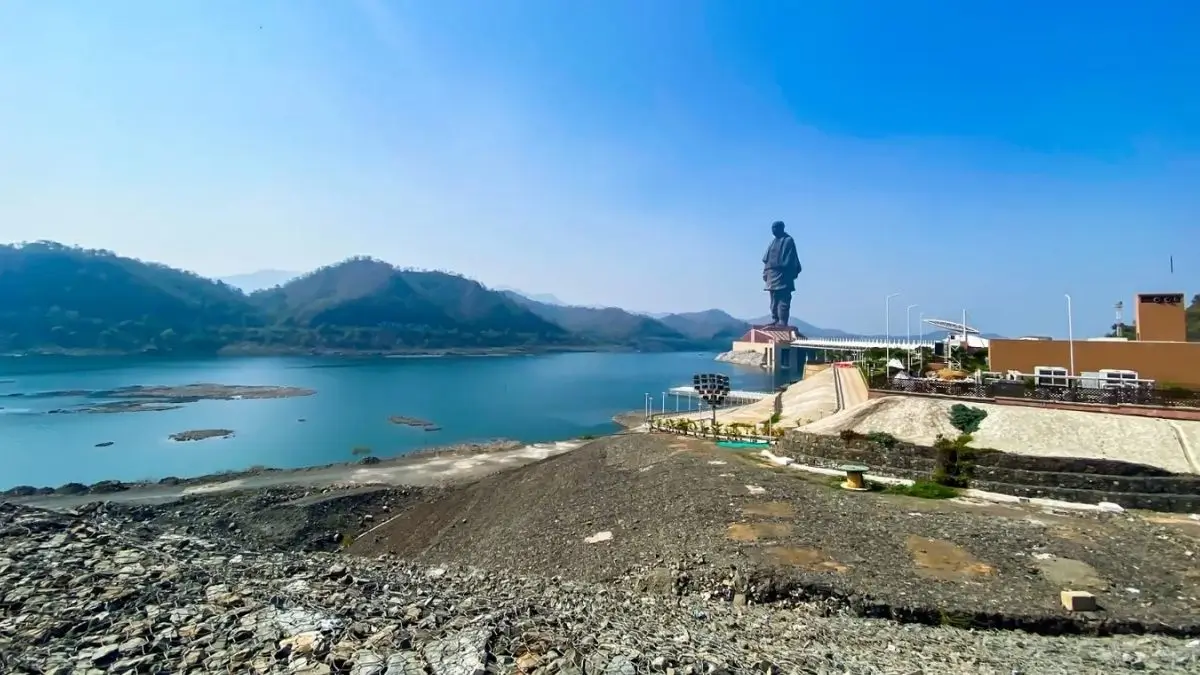
Several of the world’s significant river systems can be found in India, where all the major rivers originating from peninsular India normally drain into the Bay of Bengal by flowing eastwards. The Narmada River is special as it does not follow this trend. It flows westwards from Madhya Pradesh and drains into the Arabian Sea via the Gulf of Khambhat.
There are other rivers in India which flow from east to west. For instance, the Tapi River is another large river which flows in the same direction as the Narmada River. However, the Narmada River is special owing to its length, geological and cultural significance.
Origin of the Narmada River
The Narmada rises in Amarkantak in Madhya Pradesh and stretches for about 1,312 kilometers before draining into the Arabian Sea. Along the way, it crosses Madhya Pradesh and Gujarat states.
While many major rivers flowing through the Indian Peninsula have their courses directed towards the east coast of the country, the Narmada takes a westward course. Its entire journey occurs in a special geological formation sandwiched between the Vindhya and Satpura ranges.
Why Does the Narmada River Flow from East to West?
The peculiar course of the Narmada is directly related to the geological features of this place. The river flows through the rift valley, which is a geographical feature formed as a consequence of some processes occurring in the earth’s crust.
Usually, the rivers flow following the gradient of the land surface. Geological composition of the Narmada Valley influenced the direction of the river’s flow.
Thus, the Narmada doesn’t defy any principles of river flow. The peculiar direction of the Narmada is explained by the geological composition of the central part of India.
Is Narmada the Only West-Flowing River in India?
Not necessarily. This description about Narmada being the only river in India flowing towards the west is not quite true.
There are several rivers flowing towards the Arabian Sea in India. Tapi (Tapti) is another major west-flowing river which flows through the central and western parts of India.
However, the peculiarity of the Narmada River is mentioned in General Knowledge for the reason that it is one of the major west-flowing rivers of India.
Religious Significance of the River Narmada
In addition to being geographically significant, the Narmada is considered a religiously sacred river.
Various holy places are located along the course of the Narmada. Some of them include such sites as the famous Omkareshwar in the state of Madhya Pradesh, which is built on the banks of the river and includes Omkareshwar Jyotirlinga, one of 12 Jyotirlingas associated with Lord Shiva.
The river is also related to the traditional pilgrimage route Narmada Parikrama when pilgrims make a long journey along the course of the Narmada.
Mythological Explanation of Its Course
In addition to its geographic peculiarities, there is a popular mythological explanation for the course of the Narmada.
It says that according to legend, the Narmada had to marry Sonabhadra, or simply Son. However, Narmada found out about Sonabhadra’s intention to marry her maid, named Juhila. Having been offended, she decided to leave and change her course.
The story is usually associated with the river. However, it should be distinguished between mythologies and geographic facts since the explanation of the course of the river is a scientific one and is connected with the geography of the area.
Significance of the Narmada River
The Narmada River is of great importance for the economy and living of people in the states of Madhya Pradesh and Gujarat. The river’s waters are used for irrigation, agricultural activities, provision of drinking water and for electricity production.
There are several dams and water projects that have been built on the Narmada River. These projects are important in the provision of water and power to the neighboring regions.
Thus, the river basin is of great importance from environmental, geographical and agricultural perspectives.








 Who Is Navi Pillay? Nobel Peace Prize 20...
 Vande Bharat vs Amrit Bharat Express: Ke...
 Asian Games to LA28: Which Sports Earned...