
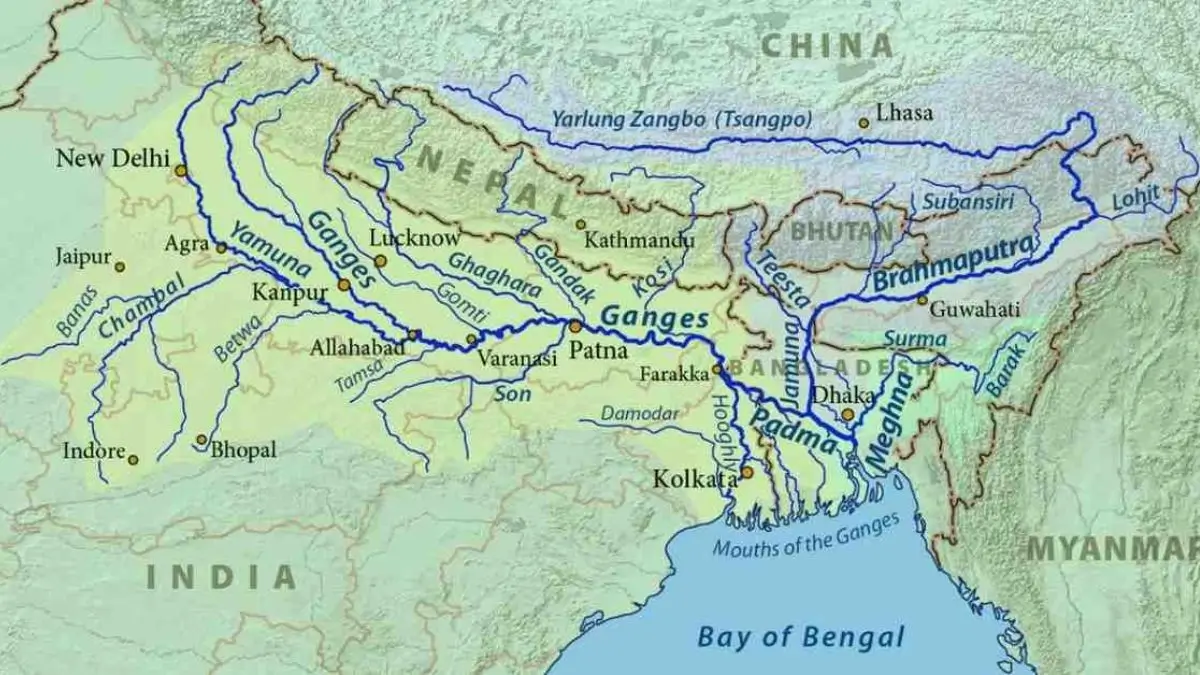
Ganga River of India is more than a just waterway, it is the cultural, spiritual and economic lifeline of India. It stretches over the 2,500 kilometers from the Himalayas to the Bay of Bengal and the Ganga supports the millions of people and it nourishes one of the world’s most fertile river basins.
But do you know this river does not flow alone, there is a vast network of the tributaries that feeds the Ganga throughout its journey, supplying water, sediments and nutrients that sustain the agriculture, ecosystems and human settlements.
From the snow-covered Himalayas to the plains of the northern India, these rivers plays the crucial role in shaping the country’s geography and history.
What Are Tributaries of the Ganga River?
A tributary is the river or stream that flows into a larger river instead of directly entering into a sea or ocean. The Ganga receives water from the numerous tributaries that are originating in the Himalayas, Nepal, Tibet and central India.
These tributaries are generally classified into two categories,
- Left-bank tributaries, which join the Ganga from the north.
- Right-bank tributaries, which join from the south.
Together, this form the extensive Ganga River Basin, which covers more than 26% of the India’s geographical area.
Major Left-Bank Tributaries of the Ganga
Ramganga River
The Ramganga originates in the Dudhatoli Hills of the Uttarakhand and it flows through Uttarakhand and Uttar Pradesh before merging with the Ganga near Kannauj.
It is considered as the first major left-bank tributary of the river.
The river plays the important role in irrigation and supports agricultural activities across the western Uttar Pradesh.
Gomti River
Originating from Gomat Taal in Uttar Pradesh’s Pilibhit district, the Gomti flows entirely within Uttar Pradesh. It passes through major cities such as Lucknow before joining the Ganga near Ghazipur.
The Gomti is one of the most significant rivers of the Gangetic plains and serves as a crucial source of water for the region.
Ghaghara River
The Ghaghara is among the largest and most important tributaries of the Ganga. It originates from the Mapchachungo Glacier in the Tibet and it flows through Nepal, where it is known as the Karnali River.
After entering in India, it traverses towards Uttar Pradesh and Bihar before meeting the Ganga near Chhapra. By water discharge, the Ghaghara is often considered as the largest tributary of the Ganga system.
Gandak River
The Gandak originates from the Himalayas of the Nepal and it enters Bihar before joining the Ganga near Hajipur.
Gandak river waters supports the extensive irrigation networks and agricultural production across the northern Bihar and making it economically significant for the region.
Kosi River
This river is known as the “Sorrow of Bihar” due to its frequent flooding and changing course, the Kosi originates in the Himalayan region of the Tibet and Nepal.
It eventually enters in the Bihar and joins the Ganga near Kursela. Despite the its flood-related challenges, the river contributes enormous volumes of the water and fertile sediments to the Gangetic plains.
Major Right-Bank Tributaries of the Ganga
Yamuna River
The Yamuna is the longest tributary of the Ganga and it is one of the India’s most famous rivers.
It originates from the Yamunotri Glacier in the Uttarakhand and it flows through several states which includes the Uttarakhand, Haryana, Delhi and Uttar Pradesh.
This river finally merges with the Ganga at the sacred Triveni Sangam in Prayagraj. It stretches approximately 1,376 kilometers, the Yamuna contributes significantly to the Ganga’s flow and it supports the millions of people along its course.
Son River
The Son River originates from the Amarkantak Plateau in the Madhya Pradesh. It flows through Madhya Pradesh, Uttar Pradesh, Jharkhand and Bihar before joining the Ganga near Patna.
The Son is known for the its broad riverbed and it is an important source of water for irrigation and hydroelectric projects.
Understanding Left-Bank and Right-Bank Tributaries
The classification of the tributaries depends on the direction of the main river’s flow. If a person stands facing a downstream, in the same direction as the river’s flow,
- Rivers entering from the left side are called as the left-bank tributaries.
- Rivers entering from the right side are called the right-bank tributaries.
Since the Ganga generally flows eastward, many Himalayan rivers such as the Ghaghara, Gandak and Kosi join from the north and they are are categorized as left-bank tributaries.
Rivers like the Yamuna and Son joins from the south and they are are classified as right-bank tributaries.
The Seven Sacred Streams Associated with the Ganga
Before the Ganga emerges as the single river at Devprayag in the Uttarakhand, it is formed by the confluence of the multiple Himalayan streams.
These seven sacred streams are the,
- Alaknanda
- Bhagirathi
- Mandakini
- Dhauliganga
- Nandakini
- Pindar
- Rishiganga
Their successive confluences creates the river system that eventually becomes the mighty river Ganga.
Which Is the Largest and Longest Tributary of the Ganga?
The Yamuna River is the longest tributary of the Ganga as it extends the approximately 1,376 kilometers from the its source to its confluence at Prayagraj.
The Ghaghara River is often regarded as the largest tributary in the terms of water discharge and plays the crucial role in maintaining the flow of the Ganga throughout the year.
Is the Damodar River a Tributary of the Ganga?
The Damodar River is not direct tributary of the river Ganga. Instead, it joins the Hooghly River in the State of West Bengal.
Since the Hooghly is a distributary of the Ganga, the Damodar is indirectly connected to the larger Ganga river system.








 UNESCO World Heritage Sites of India - D...
 Jamnagar Refinery: Why India's Oil Hub M...
 UNESCO World Heritage Sites of India - D...










