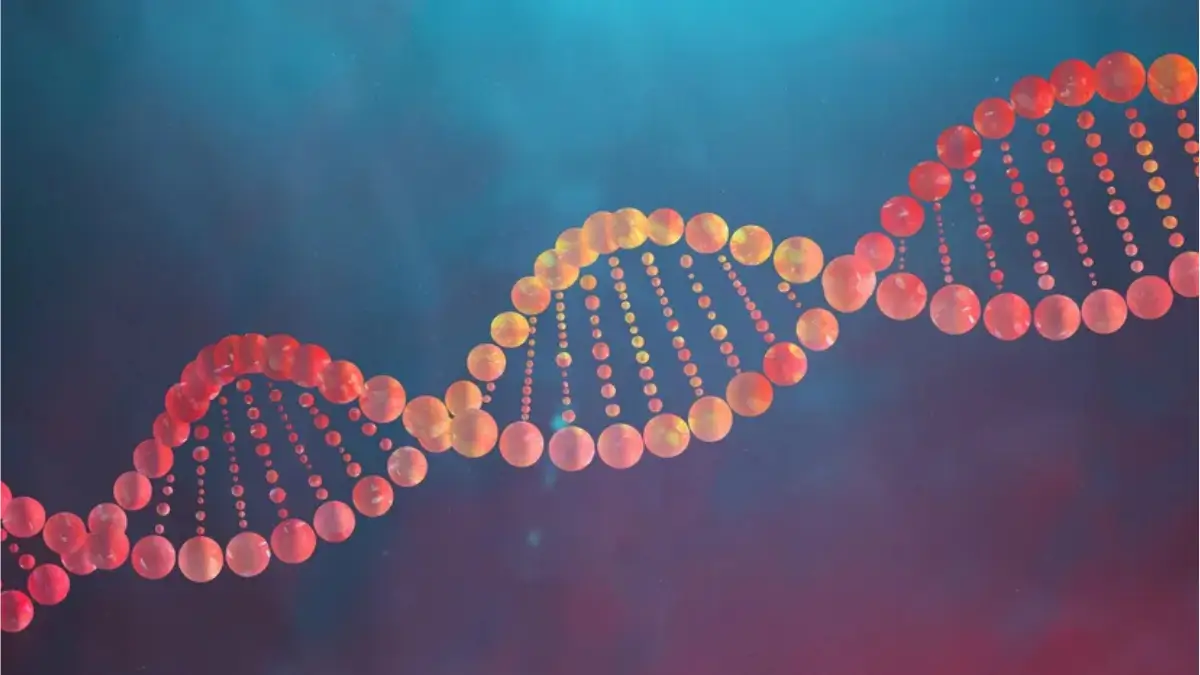
DNA, or Deoxyribonucleic Acid, is a special molecule found in all living things. It carries the instructions that make every plant, animal, and human unique. The story of DNA’s discovery began more than 150 years ago with a Swiss scientist named Friedrich Miescher, and continued with later scientists who explained its structure.
The First Discovery by Friedrich Miescher
In 1869, Swiss biologist Johannes Friedrich Miescher was the first to discover DNA. While working in a laboratory in Tübingen, Germany, he studied white blood cells from used hospital bandages. Miescher found a strange substance inside the cell nuclei that was rich in phosphorus. He called it “nuclein,” which we now know as DNA.
At that time, scientists didn’t realize how important his discovery was. They didn’t yet know that nuclein carried genetic information.
Miescher’s Life and Work
Friedrich Miescher was born on 13 August 1844 in Switzerland. He came from a family of scientists — both his father and uncle were professors of anatomy. Though he studied medicine, Miescher’s hearing problems made him choose research over being a doctor.
He worked carefully to isolate the nuclei of white blood cells and discovered that nuclein contained phosphorus and nitrogen, but no sulfur. This was something completely new in science at that time.
Later Research and the DNA Structure
Many years after Miescher’s discovery, scientists continued studying DNA. In 1953, James Watson and Francis Crick discovered the double helix structure of DNA — a shape like a twisted ladder. Their model showed how DNA stores and copies genetic information.
Rosalind Franklin’s Important Role
A brilliant scientist named Rosalind Franklin played a key part in this discovery. She used X-ray diffraction to take clear images of DNA. Her famous Photo 51 gave Watson and Crick the clues they needed to understand DNA’s real shape. Another scientist, Maurice Wilkins, also helped in this research.
Recognition and Nobel Prize
In 1962, Watson, Crick, and Wilkins received the Nobel Prize in Medicine for discovering the structure of DNA. Unfortunately, Rosalind Franklin had already passed away and did not share the prize, even though her work was vital.
Legacy of Friedrich Miescher
Although Miescher’s discovery was not fully understood during his lifetime, it became the foundation of modern genetics. Today, two research centers — the Friedrich Miescher Laboratory in Tübingen and the Friedrich Miescher Institute for Biomedical Research in Basel — are named in his honor. His work opened the door to understanding life at its smallest level.


 Which State is known as the Green State ...
 How many Nuclear Power Plants in India? ...
 List of Important Days in April 2026, Na...