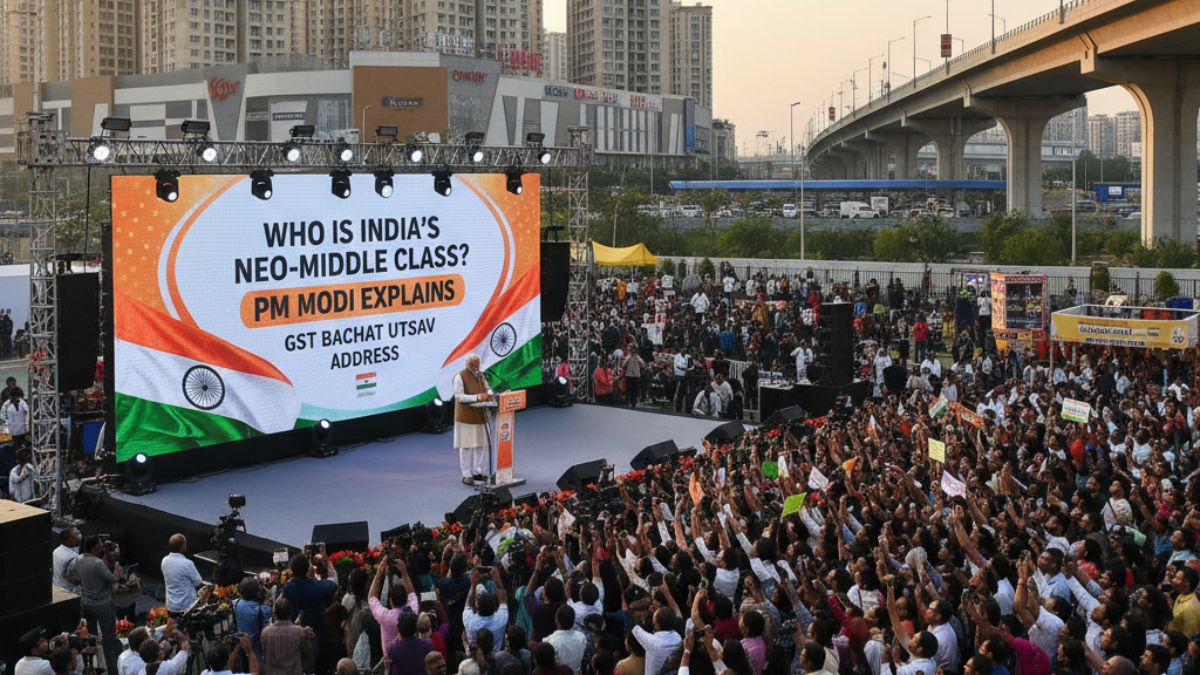
Prime Minister Narendra Modi, in his national address on 21 September 2025, introduced the Next-Generation GST reforms and the launch of the GST Bachat Utsav. Among the highlights of his speech was a special mention of the Neo-Middle Class, a group that has emerged from poverty and is now shaping India’s economy. The PM emphasized that this class is both a symbol of India’s progress and a pillar of future growth.
Who Are the Neo-Middle Class?
- The term Neo-Middle Class refers to those who have recently moved out of poverty but are yet to reach the traditional middle-class status.
- According to PM Modi, nearly 25 crore Indians have overcome poverty in the last eleven years, forming this new economic group.
- They are aspirational citizens with dreams of better education, healthcare, and lifestyle, symbolizing the upward mobility of India’s society.
- Positioned between the lower-income groups and the traditional middle class, this segment reflects both cautious consumption and ambitious desires.
Characteristics of the Neo-Middle Class
- The Neo-Middle Class represents a transitional group in India’s social fabric.
- Their income levels place them above the poor but below the established middle class. This gives them a unique spending behavior—they are willing to spend extra on products and services that improve their quality of life, but they remain careful about unnecessary expenses.
- Socially, they play an important role in bridging rural and urban economies, often being first-generation urban residents or professionals.
- Economically, their rising demand for housing, electronics, education, healthcare, and transport has already begun shaping India’s consumption-driven growth.
Double Benefits Through Government Reforms
- In his address, PM Modi emphasized that this class is now enjoying a double bonanza due to government reforms.
- On one hand, the Union Budget granted relief by making income up to ₹12 lakh tax-free, providing major financial comfort.
- On the other hand, the new GST reforms have reduced the burden on daily essentials, with most items now falling under the 5% tax slab.
- This dual approach not only makes essential goods affordable but also creates opportunities for the Neo-Middle Class to invest in homes, vehicles, education, and healthcare—fulfilling their aspirations with greater ease.
Why the Neo-Middle Class Matters for India
- The Neo-Middle Class is emerging as a powerful force in India’s economy. They represent a population that is eager to consume, innovate, and support domestic industries.
- Their role is central in shaping consumer trends, expanding India’s educated workforce, and fueling entrepreneurship.
- They also strengthen the Made in India movement, as their growing purchasing power directly supports local businesses and MSMEs.
- For policymakers, this group is a crucial indicator of progress—proof that reforms and economic growth are delivering real change in people’s lives.


 India Withdraws Its Plan to Host COP33 S...
 IIM Rohtak Wins BIMTECH's 'Hermes' Dialo...
 Gurgaon Tops the List of India's Most Po...