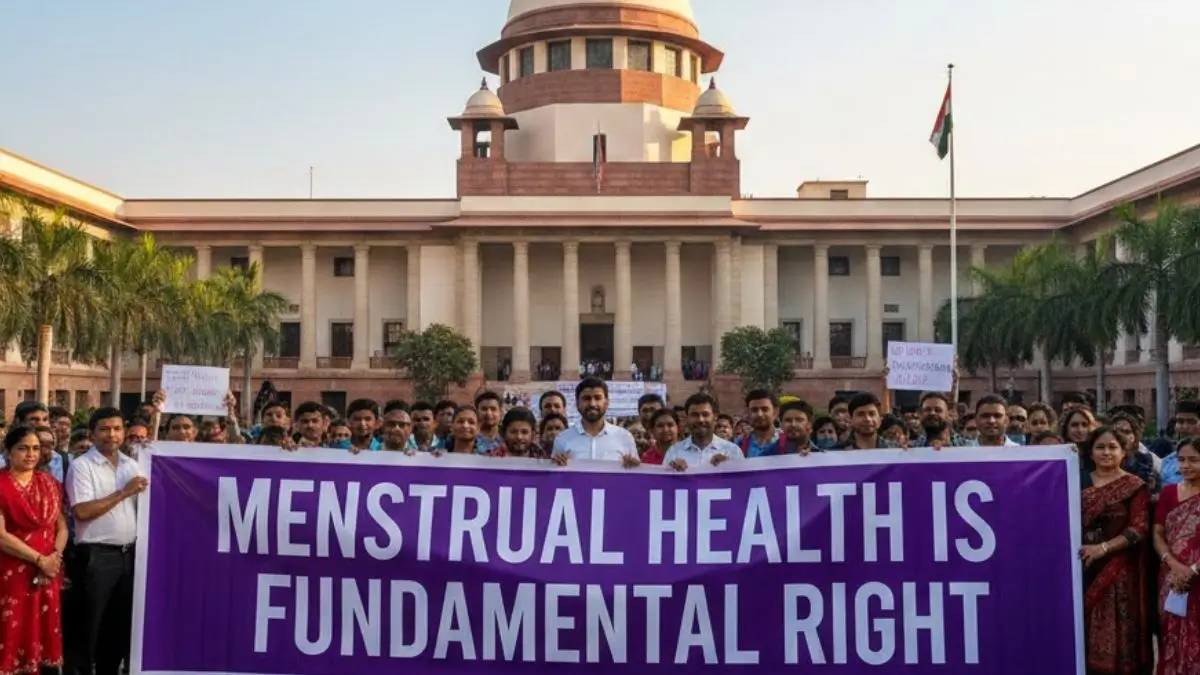
The Supreme Court of India has declared menstrual health as an integral part of the right to life under Article 21, directing all States and Union Territories to provide free sanitary pads, separate toilets, water, and disposal facilities in every government and private school within three months. The ruling recognizes that lack of basic menstrual hygiene facilities pushes girls out of classrooms and into stigma, making it a constitutional issue rather than just a welfare concern.
What the Supreme Court Held
- A Bench of Justices J B Pardiwala and R Mahadevan ruled that Menstrual Hygiene Management (MHM) is inseparable from the right to live with dignity.
- The Court observed that dignity is not abstract and must reflect in everyday conditions.
- For menstruating girls, lack of toilets, sanitary napkins, or disposal mechanisms results in humiliation, exclusion, and avoidable suffering, directly violating Article 21.
Key Directions to States, UTs, and Schools
- The Court ordered that every school, whether government-run or privately managed, in urban and rural areas, must have functional, gender-segregated toilets with water connectivity.
- All toilets must ensure privacy, hand-washing facilities with soap and water, and accessibility for children with disabilities.
- Non-compliance by private schools can lead to de-recognition, while State-run schools will make governments directly accountable.
Free Sanitary Pads and Safe Disposal
- Schools must provide free oxo-biodegradable sanitary napkins compliant with ASTM D-6954 standards.
- These should preferably be available through sanitary napkin vending machines inside toilets.
- Where this is not feasible, pads must be accessible through designated school authorities.
- The Court also mandated safe, hygienic, and environmentally compliant disposal mechanisms as per solid waste management rules.
MHM Corners and Emergency Support
- The judgment requires schools to establish MHM corners, equipped with spare uniforms, innerwear, disposable bags, and essential materials to handle menstruation-related emergencies.
- These measures aim to prevent absenteeism and dropouts caused by fear, discomfort, or lack of resources during menstruation.
Education, Awareness, and Breaking Taboos
- Recognizing stigma as a major barrier, the Court directed NCERT and SCERT to integrate gender-responsive curricula on menstruation, puberty, and reproductive health issues like PCOS and PCOD.
- Public awareness must also be spread through social media, print, radio, television, and outdoor campaigns.
Legal Backing: Right to Education Act
- The Court relied heavily on the Right to Education Act, 2009, especially Section 19 and its Schedule, which mandates separate toilets for boys and girls and barrier-free access.
- The Bench clarified that “barrier-free access” includes removal of menstrual hygiene barriers, as lack of sanitary facilities leads to absenteeism, learning gaps, and eventual dropouts among adolescent girls.
Article 21 Right to Life and Personal Liberty
| Heading | Key Points |
| Text of Article 21 |
|
| Nature of Right |
|
Key Summary at a Glance
| Aspect | Details |
| Why in News? | SC declared menstrual health part of Article 21 |
| Key Order | Free sanitary pads, separate toilets in all schools |
| Legal Basis | Article 21 and Right to Education Act |
| Time Limit | 3 months for compliance |
| Penalty | De-recognition of private schools |
| Curriculum Role | NCERT & SCERT to include menstrual health |
Question
Q1. The Supreme Court linked menstrual health with which Fundamental Right?
A. Article 14
B. Article 19
C. Article 21
D. Article 25

 WHO Foundation and Novo Nordisk Launch I...
 NITI Aayog Releases Fiscal Health Index ...
 UIDAI Launches Bug Bounty Program to Str...