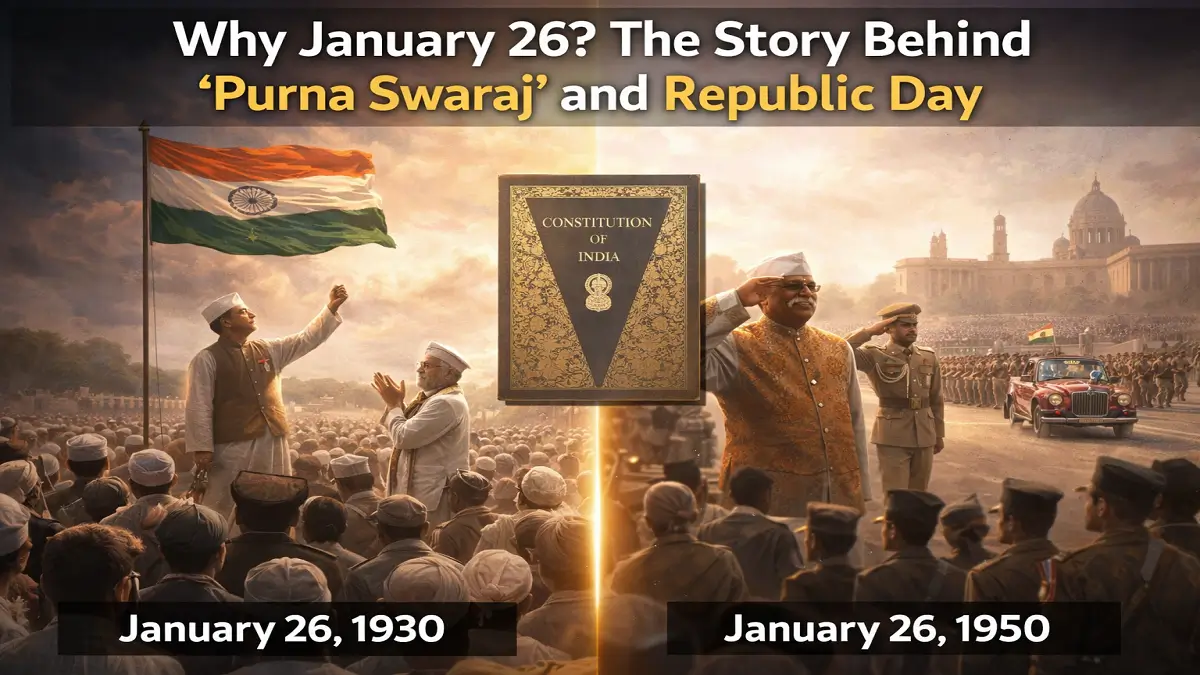
India celebrates Republic Day on January 26 every year to mark the day the Constitution of India came into effect in 1950. But this date was not chosen randomly. Its roots lie in a powerful moment from India’s freedom struggle — the declaration of Purna Swaraj, meaning complete independence, in 1930. The connection between that historic resolution and the birth of the Republic gives January 26 deep national importance.
What Was Purna Swaraj?
During the late 1920s, India’s freedom movement reached a turning point. The British government had offered dominion status, which meant limited self-governance under the British Crown. However, Indian leaders felt this fell short of their aspirations. They demanded full independence.
At the Lahore Session of the Indian National Congress in December 1929, leaders officially adopted the goal of Purna Swaraj as India’s national objective. This was the first time the Congress formally declared that complete freedom from British rule was its ultimate aim.
January 26, 1930: India’s First “Independence Day”
After passing the resolution, the Congress decided that January 26, 1930, would be observed across India as Independence Day. On that day:
- People across the country took a pledge of complete independence
- The national flag was hoisted
- Public meetings were held to spread the message of self-rule
Although India did not gain freedom at that time, January 26 became a symbolic day of resistance and aspiration. For years, Indians continued to observe this date as a reminder of their demand for full sovereignty.
India Becomes Independent — But Not Yet a Republic
India finally achieved political independence on August 15, 1947. However, the country was still governed under colonial-era laws, especially the Government of India Act, 1935, until a new Constitution could be created.
To build a democratic framework, a Constituent Assembly was formed to draft a Constitution for free India. After nearly three years of debate and careful drafting, the Constitution was adopted on November 26, 1949.
But the leaders decided that it should not come into force immediately.
Why the Constitution Came into Force on January 26
When choosing a date to enforce the Constitution, India’s leaders deliberately selected January 26, 1950. This decision was made to honour the Purna Swaraj declaration of January 26, 1930.
By doing so, the country symbolically linked:
- The dream of complete independence in 1930
- With the legal and constitutional reality of a sovereign republic in 1950
On this day, India officially became a Republic, meaning the country would be governed by its own Constitution and an elected head of state, rather than a monarch.
What Republic Day Represents Today
Republic Day is more than a celebration of the Constitution. It represents:
- The fulfillment of the freedom struggle’s goal of complete self-rule
- The birth of India as a sovereign, democratic republic
- A tribute to the sacrifices of leaders and citizens who fought for independence
The grand parade held each year in New Delhi showcases India’s military strength, cultural diversity, and democratic values, reminding citizens of both the journey and the responsibilities of nationhood.


 India Approves New NDC Targets for 2031-...
 IRCTC Food Quality Row: Fine Imposed Aft...
 What is UDAN 2.0? Full Details of India’...