
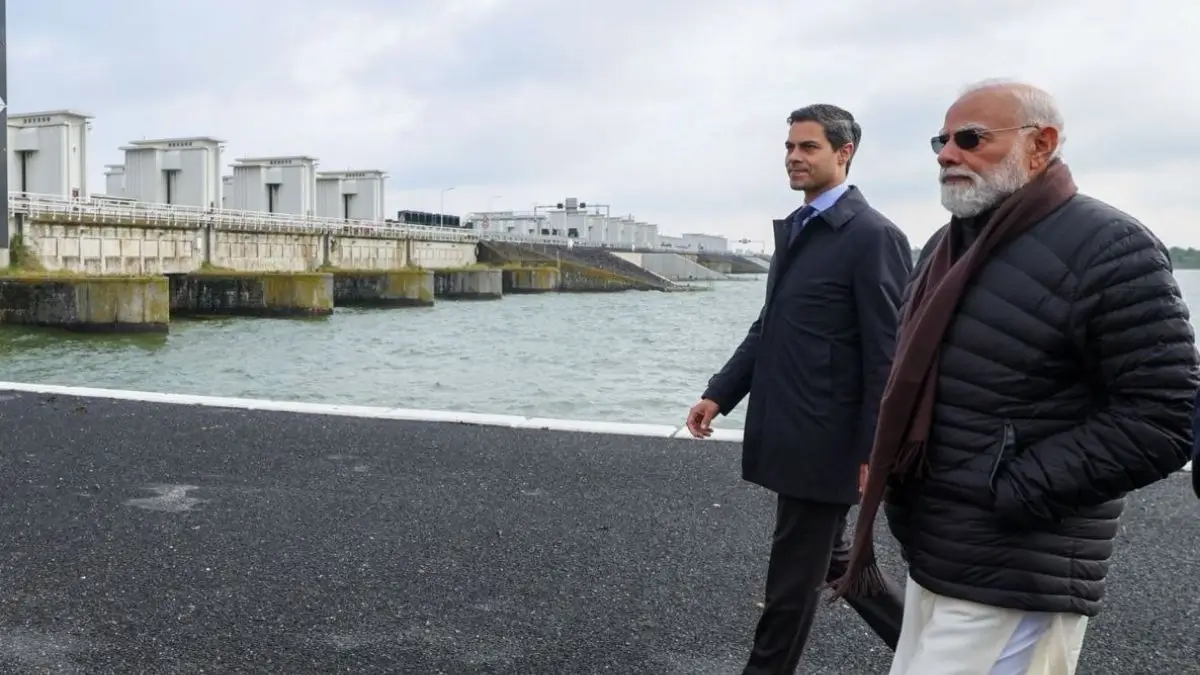
Honorable Prime Minister visited to the iconic Afsluitdijk dam in the Netherlands which is one best engineering system around the world during his official trip to Netherlands. Alongside with him Dutch Prime Minister Rob Jetten also accompanied him to world’s most successful flood control engineering systems. This visit is significant because the Dutch model offers the valuable insights for the Gujarat’s ambitious Kalpasar Project.
Why PM Modi Visited the Afsluitdijk Dam
PM Modi’s visit to the Afsluitdijk dam was not just symblic diplomacy but it was strategic infrastructure learning exercise. The Netherlands is recognized for advanced water engineering, flood defense and climate adaptation systems around the world.
As India and specially coastal states like Gujarat faces the growing challenges from the,
- Rising sea levels
- Flooding
- Water shortages
- Salinity intrusion
- Extreme climate events
By visiting the Afsluitdijk, India is studying how the world class water infrastructure can help to tackle future environmental risks.
PM Modi said the global community has so much to learn from Dutch expertise in water management.
What Is the Afsluitdijk Dam?
The Afsluitdijk is Netherlands one of the most most famous engineering achievements.
It is a 32 kilometre long barrier dam which separates the North Sea from the IJsselmeer freshwater lake.
This project was completed nearly 80 years ago and it was designed mainly to protect low lying Dutch land from devastating sea floods.
In today’s time it do more than expectations.
Its major functions includes the,
- Flood protection
- Freshwater storage
- Inland water transport
- Navigation management
- Climate resilience
- Renewable energy integration
- Ecological conservation
This makes it the multi purpose climate infrastructure model.
Why the Afsluitdijk Is Famous Worldwide
The Netherlands has always battled with water threats due to its geographical location. There are many large parts of the country lie below sea level.
Afsluitdijk became one of the country’s most important engineering solutions.
Now, the Dutch are moderniszng it through the Afsluitdijk 2.0 project, which includes the,
- Stronger flood barriers
- Advanced water discharge technology
- Storm defense systems
- Fish migration channels
- Solar and tidal renewable energy systems
The upgradation reportedly involves an investment of the nearly €800 million.
What Is Gujarat’s Kalpasar Project?
The Kalpasar Project of the Gujarat is India’s one of the most ambitious water infrastructure proposals.
The plan aims to build a giant dam across the Gulf of Khambhat in Gujarat.
Also the goal is to create a massive freshwater reservoir by capturing the river water before it reaches the sea.
According to project proposals, length of dam is nearly 30 kilometres and it will store around 10 billion cubic metres freshwater.
Also the rivers like Narmada, Sabarmati, Mahi and Dhadar rivers are potential source for this project.
The project aims to support the drinking water supply, irrigation, industrial water demand, flood management and transport connectivity.
This project will also reduce travel distance between regions of Gujarat.
Why India Is Interested in Dutch Water Engineering
The Dutch model is attractive because it combines the multiple solutions in one system. Currently, India needs modern infrastructure that solves several problems simultaneously.
Dutch expertise offers the lessons in the,
Multi-purpose Water Infrastructure
In which instead of separate systems for the floods, water storage, and transport one integrated structure can perform multiple roles.
Climate Adaptation
Modern infrastructure must prepare for the future climate extremes not just current risks.
Coastal Protection
Also the states like Gujarat need better protection against the rising sea water level and saltwater intrusion.
Sustainable Engineering
Alongside with upgradation environmental balance is becoming equally important.
Why the Kalpasar Project Is Still Challenging
Since the 1970s, this project discussed multiple times, Kalpasar remains under cultivation.
Major concerns associated with it are,
- Environmental impact
- Marine ecosystem disruption
- Fisheries impact
- Sedimentation risks
- Navigation challenges
- Long-term sustainability
The project cost is also estimated to exceed the ₹85,000 crore.
Construction period for this model could take more than a decade. And no final environmental clearance has been granted yet.
Why Climate Resilient Infrastructure Matters Now
Around the world many governments are rethinking infrastructure practices. As the climate change is increasing the pressure via,
- Extreme rainfall
- Water scarcity
- Coastal flooding
- Droughts
- Rising sea levels
Upcoming mega projects will need to combines the multiple roles by focusing the,
- Water security
- Flood defence
- Ecological management
- Renewable energy
- Transport efficiency








 India’s Internet Subscribers Cross 1.1...
 JOSH Campaign Launched to Support Indiaâ...
 PM GatiShakti Completes Five Years: Obje...










