
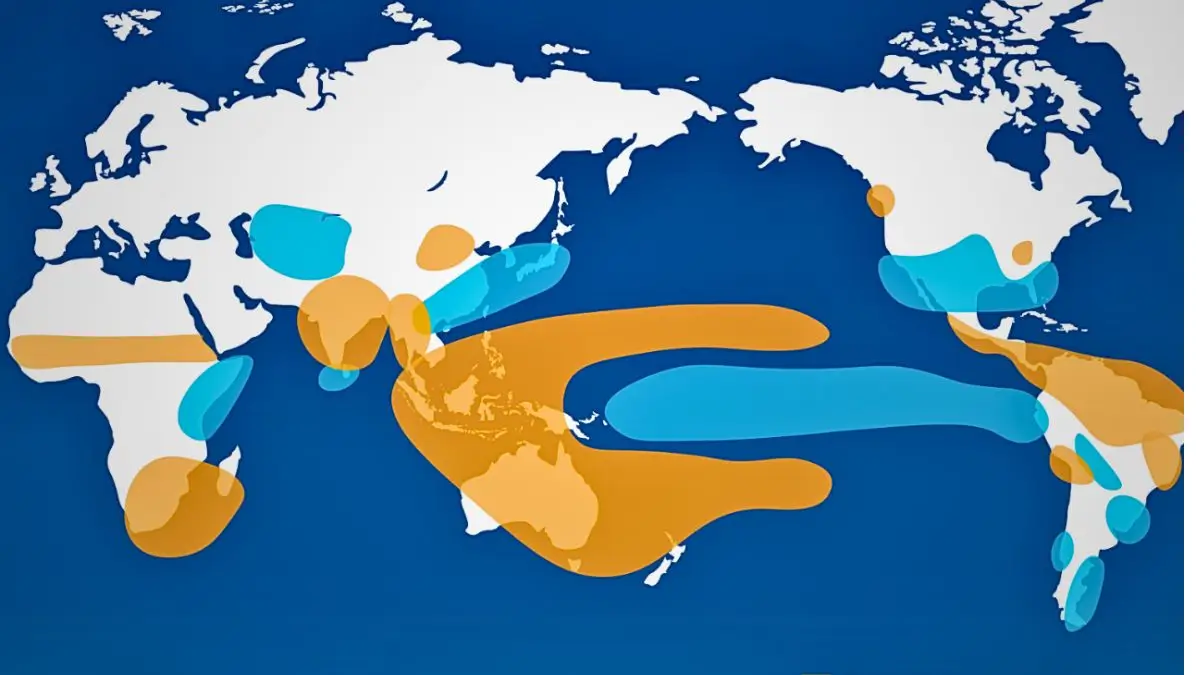
The world’s monitoring agencies have reported that the emergence of the new El Niño event in the equatorial Pacific Ocean and it raising the concerns about the widespread weather disruptions across the world. According to the Japan Meteorological Agency (JMA), this phenomenon is expected to strengthen significantly in the upcoming months and could evolve into the very strong or even “Super El Niño” by the end of the year 2026.
El Niño Officially Returns After The Three Years
The Japan Meteorological Agency has officially declared the onset of the El Niño event will marking the first occurrence since the year 2023.
Scientists expect the phenomenon to intensify during the second half of the 2026 and it will continue through at least December.
If ocean the temperatures continue rising this event could become one of the strongest El Niño episodes ever recorded.
The return of the El Niño is being closely monitored by the meteorologists because of the its far-reaching effects on weather systems across continents.
What is El Niño?
El Niño is the naturally occurring the climate phenomenon which is characterized by the unusual warming of the sea surface temperatures in the central and eastern tropical Pacific Ocean.
This warming changes the atmospheric circulation patterns and it influences the weather conditions all around the world.
Key Features of El Niño
- Pacific Ocean waters are warmer than normal temperature
- Changes the global rainfall patterns
- Increased the risk of droughts and floods
- Disruption of the traditional monsoon systems
- Changes in the hurricane activity
- Higher global temperatures
EL Nino generally occurs every two to seven years and it can last for the several months or more than a year.
Why Scientists Are Concerned About a “Super El Niño”?
The strength of El Niño measured by the how much warmer is the Pacific Ocean temperature as compared to the normal levels.
An anomaly of more than 2°C is generally classified as the very strong event and it is often referred to as a “Super El Niño.”
Meteorologists fears that the current event may approach that threshold later this year.
A stronger El Niño generally results in to the,
- More severe weather disruptions
- Greater agricultural losses
- Increased economic damage
- Higher risks of floods and droughts
- Stronger impacts on global food prices
Impact on India’s Monsoon
One of the most closely watched effects of the El Niño is the its influence on the Indian monsoon.
Several reports indicate that the current event has already contributed to the delayed start of monsoon activity in parts of India.
Historically, the strong El Niño years have often been associated with the,
- Below-normal rainfall
- Regional drought conditions
- Lower agricultural productivity
- Increased the pressure on water resources
Threat to Global Agriculture
Agriculture is among the important sectors which is mostly vulnerable to El Niño-related disruptions.
Changes in the rainfall and temperature patterns can negatively affect the crop production across multiple continents.
Crops Most at Risk
- Rice
- Wheat
- Coffee
- Cocoa
- Cotton
- Palm Oil
Reduced yields can lead to the,
- Higher food prices
- Supply shortages
- Export disruptions
- Farmer income losses
Extreme Weather Events Expected Worldwide
As the El Niño strengthens, weather impacts are expected to become the more pronounced and will lead to,
- Drought Conditions
- Heavy Rainfall and Flooding
- Temperature Extremes
- Water Resource Challenges








 India Hosts First BIMSTEC Home Ministers...
 World Bank Mobilises $112 Billion in Pri...
 Who Is Katie Zacharia? Trump Names New W...










