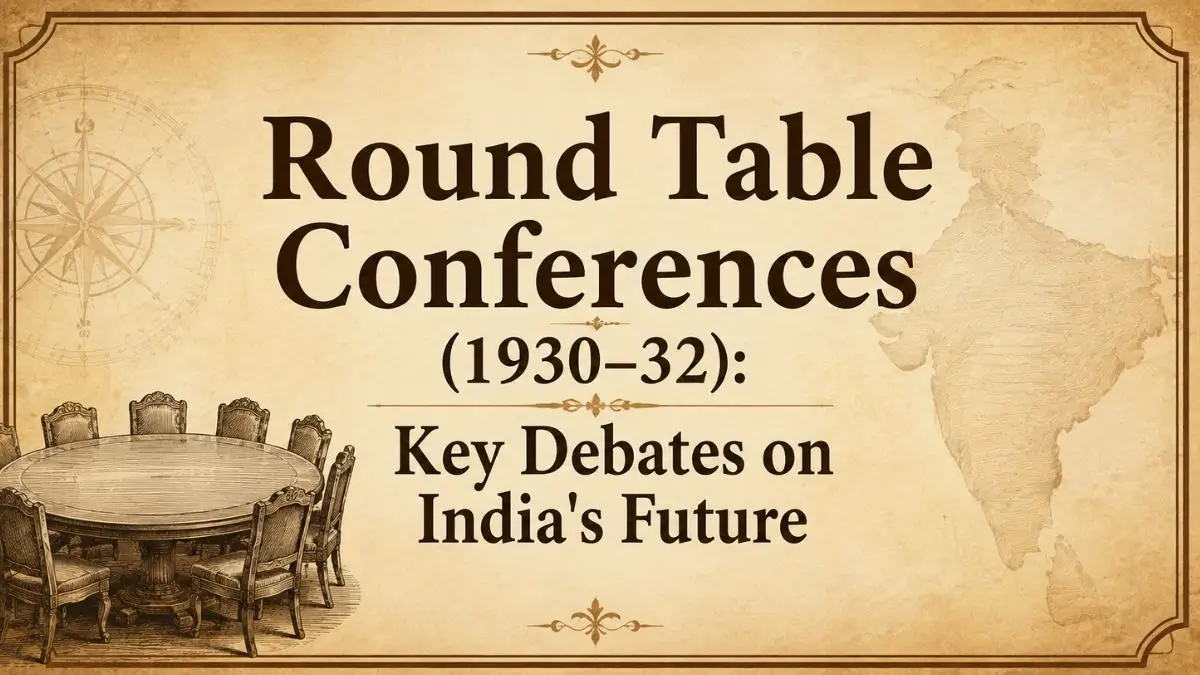
Round Table Conferences were a series of three conferences held in London from 1930 to 1932 discussing the future of Indian Constitution including the issue of Dominion status, federal system, minorities’ representation and responsible government. The Round Table Conferences were convened by the British government due to the rise of Civil Disobedience Movement and Indian aspirations for self-governance.
First Round Table Conference, 1930
First Round Table Conference started on 12th November 1930 in London with British Prime Minister Ramsay MacDonald. This conference was remarkable in that representatives of British India and princely states took part in constitutional deliberations.
Participants
Participants of this conference included representatives of,
- Princely States
- Muslim League
- Justice Party
- Hindu Mahasabha
- Others Indian political and community organizations
But the Indian National Congress refused to attend the conference. Moreover, many members of Congress leadership were in jail because of the Civil Disobedience Movement.
Issues of Debate
- Federal form of the Indian constitution
- Relation between executive and legislative bodies
- Constitutional safeguards for the defense and finances
- Problems of minority representation and separate electorates
- All-India Federation proposed by Tej Bahadur Sapru
Outcome
- There was a consensus that special safeguards in defense and finance should be provided for a future federation of India. But the boycott of Congress weakened the conference politically.
Second Round Table Conference, 1931
The British government realized that constitutional talks could not be conducted effectively without the participation of Congress. The Gandhi-Irwin Pact of 5th March, 1931 set the stage for the attendance of the Congress at the second conference.
The conference started on 7th September 1931 in London, once again headed by Ramsay MacDonald.
The Role of Gandhi in the Second Round Table Conference
Mahatma Gandhi was the only representative of the Indian National Congress. Other members included delegates from the Muslim League, Hindu Mahasabha, Dr. B.R. Ambedkar and various other minorities and provinces.
Gandhi maintained that,
- Congress was the party which stood for the political interests of India.
- India deserved responsible government at both the provincial and central stages.
- Separate electorates for the Depressed Classes could not be conceded to.
- India deserved proper safeguards for her minorities, but separate electorates was not what they desired.
Disagreements
- The second round table conference turned into an arena of disputes on the issue of minorities and separate electorates.
- There was opposition to the stance of Gandhi from many of the minority delegates, especially those representing Muslims and Depressed Classes.
- As a result, no agreement could be reached by the parties to the conference on the constitutional setup of India.
Result
The British government came up with suggestions for,
- Separate provinces in the form of Sindh and the North-West Frontier Province
- An Indian Consultative Committee
- Commitees for franchise, finance and princely states
Third Round Table Conference, 1932
- The Third Round Table Conference commenced on 17 November 1932 in London.
- At this point, the situation had become quite tense. The Gandhiji had returned to India following the failure of the Second Round Table Conference and Civil Disobedience Movement started once again. Congress leaders were arrested, and Congress was declared illegal.
Participants
There were 46 delegates to this conference, although,
- Indian National Congress did not participate
- British Labour Party too did not take part
- Princely States representatives participated in the Conference
- Depressed Classes were represented by Dr. B. R. Ambedkar
- Muhammad Ali, Aga Khan, Fazlul Haq and Muhammad Ali Jinnah represented Muslims
Major Issues
The reports of the Committees which had been formed during the previous conference and the issue of constitutional arrangements were discussed in the conference.
The major issues that came up in the discussion were,
- Federal Constitutional Arrangements
- Representation and Franchise
- Constitutional Safeguards
- Citizens rights
- Relation of British India and princely states
Many progressive recommendations including the Bill of Rights did not get sufficient attention.
Outcome
- The Third Round Table Conference provided the final basic framework upon which the British Government made a constitutional proposal later.
- In March 1933, the British Government issued White Paper making proposals about India’s future constitution. These proposals helped in framing the Government of India Act, 1935.
Why Were the Round Table Conferences Significant?
These conferences were significant because they were attempts by the British government to negotiate the future constitutional form of India with political representatives of India.
However, the absence of Congress at the First and Third Conferences, and the serious differences over the question of minorities at the Second Conference meant that no political agreement could be reached.
The most significant outcome of these conferences was the creation of proposals for constitutions which would eventually become part of the Government of India Act, 1935.








 Dussehra 2026: Top 30 Most Important GK ...
 Dussehra and UNESCO: Ramlila, Durga Puja...
 Mysuru Dasara 2026: History, Jamboo Sava...