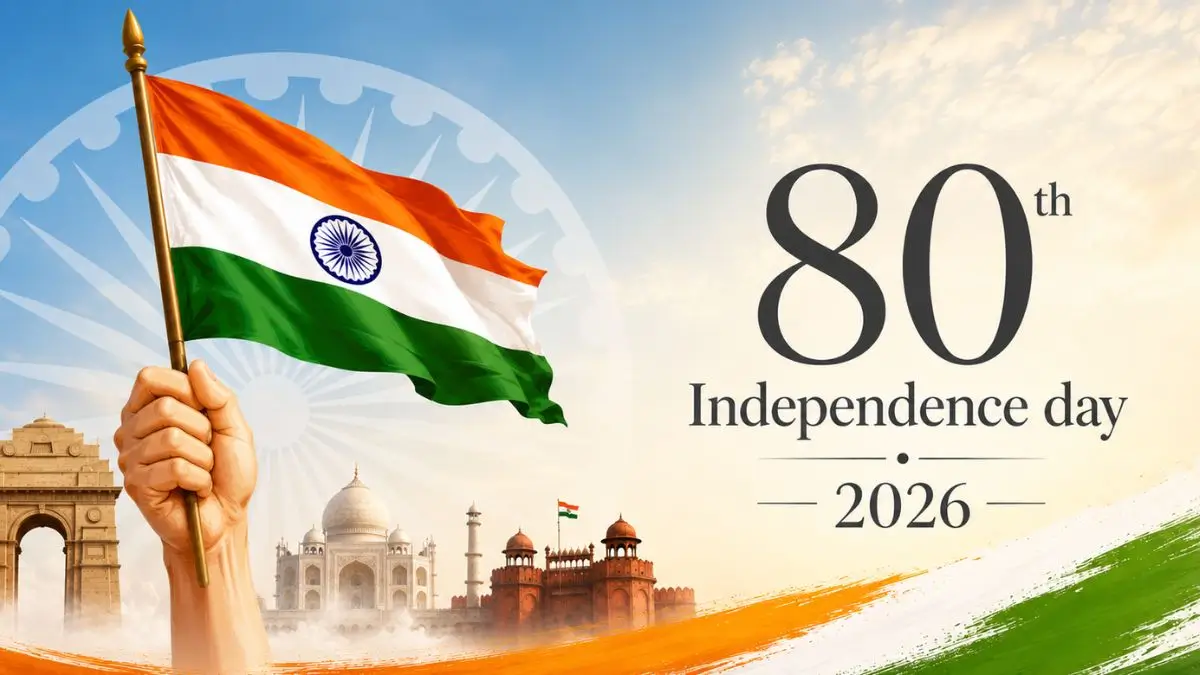
As India geraing up for its 80th independence day in 2026, Tricolour would become the focal point of national festivities. The Indian National Flag symbolizes more than just independence; it has special meanings embodied in its colors and 24-spoke Ashoka Chakra.
The flag that is used today in its modern form was adopted by the Constituent Assembly of India on July 22, 1947 – 24 days before the country gained its independence. It features three equal horizontal strips: deep saffron on top, followed by white in the middle and dark green at the bottom, as well as navy blue Ashoka Chakra.
Meanings of the Three Colors of the Indian Flag
Each of the colors represents one ideal of the Indian nation; altogether they create an image of bravery, truth, peace, progress and prosperity.
Saffron: Courage and Sacrifice
- The saffron strip occupies the top position of the Tricolour. It is the color of power and courage and is associated with sacrifice and valor too.
- In the context of the country’s freedom struggle, the color acquires even greater meaning because it reminds about the courage and sacrifices of people in their fight for freedom.
- Thus, saffron represents the spirit of a nation willing to face the challenges with courage and protect its ideals.
White: Peace and Truth
- The white band constitutes the middle part of the flag. It stands for peace and truth.
- The white colour also serves as the background of the Ashoka Chakra, and thus forms the focal point of the Tricolour.
- This symbol can be interpreted to mean that all power and progress of a country should be based on peace, truth, and ethics.
Green: Growth and Prosperity
- The green band is located at the bottom of the flag. It stands for the fertile, growing and prosperous nature of the country.
- The green colour indicates India’s link with agriculture and natural resources, and its continuous growth.
- In totality, the message conveyed through the three colours is that of bravery and sacrifice on the one hand and of growth and prosperity on the other hand.
Why is the Ashoka Chakra Found on the Indian Flag?
The most unique aspect of the Tricolour is the navy-blue Ashoka Chakra located in the center of the white strip.
The Chakra has been derived from the Dharma Chakra or Wheel of Law of the Lion Capital of Ashoka at Sarnath. The original structure was constructed during the 3rd century BCE.
The Chakra has taken the place of the charkha, which was depicted in the earlier versions of the nationalist flag. The current design has been officially adopted since 1947.
Why does the Ashoka Chakra have 24 spokes?
The Ashoka Chakra is composed of 24 spokes. The meaning of the Chakra includes movement, progression, and dharma (righteousness).
The wheel symbolizes the fact that a country needs to move forward and not stand still. In addition, the wheel shape implies the continuity of life and the necessity of sustaining the process through righteous acts.
One of the interpretations of the Chakra is that movement is synonymous with life whereas stagnation stands for decay.
Hence, the Ashoka Chakra imparts the Tricolour with a dynamical meaning: India should go forward with the sense of righteousness and national values.
Why is the Ashoka Chakra Found on the Indian Flag?
The most unique aspect of the Tricolour is the navy-blue Ashoka Chakra located in the center of the white strip.
The Chakra has been derived from the Dharma Chakra or Wheel of Law of the Lion Capital of Ashoka at Sarnath. The original structure was constructed during the 3rd century BCE.
The Chakra has taken the place of the charkha, which was depicted in the earlier versions of the nationalist flag. The current design has been officially adopted since 1947.
Why does the Ashoka Chakra have 24 spokes?
The Ashoka Chakra is composed of 24 spokes. The meaning of the Chakra includes movement, progression, and dharma (righteousness).
The wheel symbolizes the fact that a country needs to move forward and not stand still. In addition, the wheel shape implies the continuity of life and the necessity of sustaining the process through righteous acts.
One of the interpretations of the Chakra is that movement is synonymous with life whereas stagnation stands for decay.
Hence, the Ashoka Chakra imparts the Tricolour with a dynamical meaning: India should go forward with the sense of righteousness and national values.
What Are the Dimensions and Design of the Indian National Flag?
The ratio between the width and length of the Indian National Flag is 2:3.
There are three horizontal bands in it, which are of equal dimension,
- Top: deep saffron
- Middle: white
- Bottom: dark green
- Center: navy blue Ashoka Chakra with 24 spokes
The flag that has been designed presently by the Constituent Assembly was adopted on July 22, 1947.
Who Was Responsible for the Design of the Indian National Flag?
Pingali Venkayya is very closely associated with the development of India’s present Tricolour because he designed several flags during the freedom movement.
His designs kept on changing, and many contributions and suggestions were made by nationalist leaders in designing the flag, finally leading to the approval of the final design in 1947.
What Do the Tricolour and Ashoka Chakra Symbolise Together?
| Element | Symbolic Meaning |
| Saffron | Strength, courage and sacrifice |
| White | Peace and truth |
| Green | Fertility, growth and prosperity |
| Ashoka Chakra | Dharma, movement and progress |
| 24 spokes | Continuous movement and righteous progress |
| 2:3 ratio | Official proportion of the National Flag |








 Dussehra 2026: Top 30 Most Important GK ...
 Dussehra and UNESCO: Ramlila, Durga Puja...
 Mysuru Dasara 2026: History, Jamboo Sava...