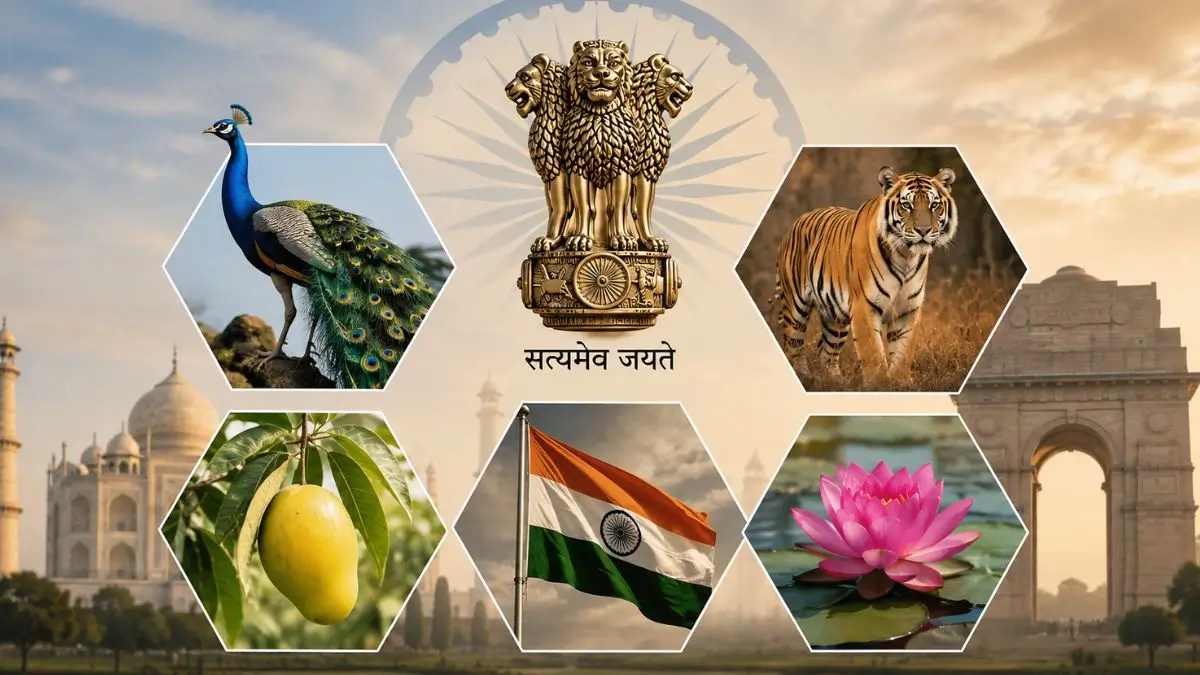
National symbols are not merely about the official symbols of the country but rather about the history of India, cultural tradition, biological diversity and values of the constitution as well as civilisation. Among the national symbols are the Bengal Tiger and Indian Peacock, Lotus, Ashoka Chakra, Lion Capital.
All together they express the notion of India being a nation that combines its ancient civilisation and contemporary democratic identity.
Why Does India Need the National Symbols?
The national symbols give the common identity and it help to represent the history and culture of the country. The national symbols of India were chosen from different sides of the national life – from the wildlife and nature, history, literature, spirituality and constitutional traditions.
Some of the national symbols of India, like the tiger and peacock, represent the natural heritage of the country. Others, like Ashoka Chakra and State Emblem, relate to the historical and philosophical traditions of the country.
Why is the Tiger the National Animal of India?
- The Bengal Tiger is the national animal of India. It is the symbol of strength, courage, power and elegance and plays an important role in Indian culture and wildlife traditions.
- The tiger became the national animal of India in 1973, at the time when Project Tiger, the important conservation program for the protection of the national tiger population in India, was started.
Why Was Peacock Designated as National Bird of India?
- Indian Peafowl became the national bird of India in 1963.
- This bird is native to India and has a distinct appearance and has had an important cultural significance throughout the history of the country.
- This is because the peacock’s colorful feathers made it a great representation of Indian nature and culture.
Why Was Lotus Designated as National Flower of India?
- The National Flower of India is the Lotus flower.
- The lotus flower is native to India and has a rich cultural and spiritual symbolism.
- One of the most distinct aspects of the lotus is its ability to grow in muddy stagnant waters and produce a beautiful flower.
- This characteristic led to the wide belief that the lotus represents purity and spiritual growth.
Why is the Ashoka Chakra Featured on the National Flag of India?
- The Ashoka Chakra is a navy blue wheel, having 24 spokes, placed right in the middle of the national flag of India, which is known as the Tricolour. The Ashoka Chakra originates from the Dharma Chakra, which can be found on the Lion Capital of Ashoka in Sarnath.
- The meaning of Ashoka Chakra is that of the dharma, movement and progress. Thus, the usage of the Ashoka Chakra makes the national flag historically connected with ancient India.
- Initially, during the development of the national flag, the charkha occupied the centre of the Swaraj Flag. The Ashoka Chakra was put in the place of the charkha by the Constituent Assembly on 22 July 1947.
Why Was the Lion Capital Chosen to Be the National Emblem of India?
- The National Emblem of India is based on the Lion Capital of Ashoka in Sarnath.
- In the Lion Capital of Ashoka there are four Asiatic lions standing back-to-back. Only three lions can be seen, while the fourth one cannot be seen on the official emblem.
- Also, the emblem is made up of Dharma Chakra, horse and bull. Besides, the national motto “Satyameva Jayate” is located beneath the lion capital.
Why Was Jana Gana Mana Selected as the National Anthem of India?
- India’s national anthem is Jana Gana Mana, which was authored by Rabindranath Tagore.
- It was sung for the first time in the Indian National Congress Session in 1911 and officially adopted as India’s national anthem on 24 January 1950 before India attained its republic status.
- The anthem stands for India’s national unity as well as for the diverse nature of India and its citizens.
Why Is the Ganga the National River of India?
- The Ganga was declared the national river of India in 2008.
- It is among the most significant rivers of India, contributing to agriculture, ecosystems, settlements and the lives of millions of people living within its basin.
- Apart from the economic and ecological value of the river, the Ganga has immense cultural and religious importance within the Indian civilization.
Why is the Banyan Tree the National Tree of India?
- Banyan tree is the national tree of India.
- Due to its amazing aerial roots, which enable it to cover large spaces, the tree survives for a very long time. These features have made banyan tree a symbol of strength and endurance.
- The tree is also an important part of Indian culture and traditions.
What Does the ₹ Sign Mean?
- ₹ is the symbol of the Indian Rupee. This symbol was created by D. Udaya Kumar.
- The sign consists of elements from the Devanagari alphabet “र” and Latin capital letter “R.” At the same time, the parallel horizontal bars represent the Indian Tricolor flag.
- The sign became official in 2010.
Important National Symbols of India
- National Animal: Bengal Tiger
- National Bird: Indian Peacock
- National Flower: Lotus
- National Tree: Banyan
- National River: Ganga
- National Anthem: Jana Gana Mana
- National Song: Vande Mataram
- National Emblem: Lion Capital of Ashoka
- National Flag: Tiranga
- National Calendar: Saka Calendar
- Currency Symbol: ₹
- National Fruit: Mango
Why are These Symbols Significant?
- Collectively, the national symbols of India narrate the identity of the nation.
- Tiger symbolizes power and valor; Peacock is a representation of nature and culture of India; Lotus symbolizes purity and resilience; and Ashoka Chakra is the symbol of dharma and eternal motion.
- Likewise, Lion Capital is the symbol that connects the present Republic of India to its ancient past and Jana Gana Mana is the symbol of unity of the nation.








 Dussehra 2026: Top 30 Most Important GK ...
 Dussehra and UNESCO: Ramlila, Durga Puja...
 Mysuru Dasara 2026: History, Jamboo Sava...