
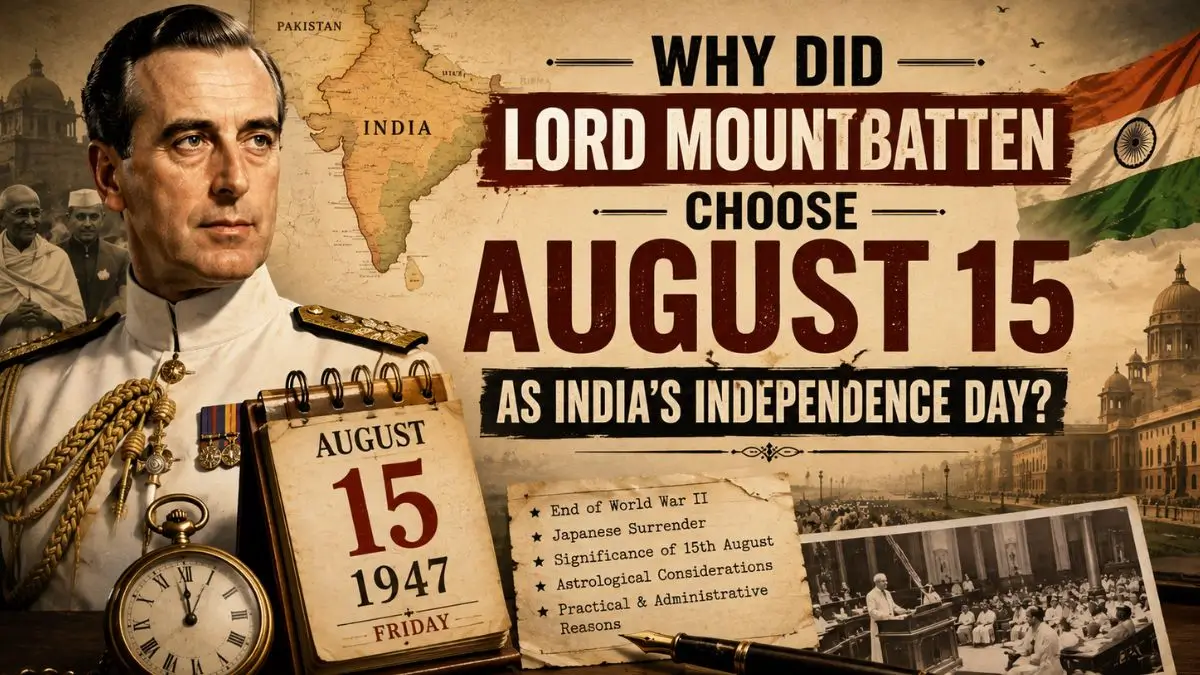
August 15, 1947, is considered one of the most significant days in the history of India. This day marked the formal end of nearly two centuries of colonial British rule in India, after which India became aન Independent nation. But the question arises why August 15 was selected as the Independence Day of India.
It was mainly due to the highly deteriorated political and administrative condition of the country at that time. The last Viceroy of British India, Lord Louis Mountbatten, was supposed to take the transfer of power in the country by June 1948. However, Mountbatten brought the deadline forward considerably.
There was also a very personal significance of the date for Lord Mountbatten.
Transfer of Power by Mountbatten
When Lord Louis Mountbatten came to India in March 1947, Britain had decided to transfer power. The Prime Minister Clement Attlee announced that Britain will withdraw from India in June 1948.
However, Mountbatten soon found out that such delay could be dangerous. There were communal riots taking place in many regions of the country, while politics between Indian National Congress and the Muslim League became increasingly complicated, rendering functioning of the interim government impossible.
Mountbatten thus hastened the schedule of British withdrawal from the region. The plan eventually led to the formulation of the Mountbatten Plan of June 3, 1947 – the plan of Partition and the transfer of power.
Why August 15?
The specific date of August 15 was selected by Mountbatten for an interesting reason, associated with the events of the Second World War.
As is claimed in the book ‘Freedom at Midnight’ by Dominique Lapierre and Larry Collins, Mountbatten was asked at a press conference to provide the date of the day when Britain would transfer its power. According to the authors, he announced August 15 even though he had taken this decision almost instantly.
This date was important for Mountbatten since August 15, 1945 was the day of surrender of Japan in the final stage of the Second World War.
In this regard, it should be noted that at that time, Mountbatten was the Supreme Allied Commander, South East Asia Command. Japan’s surrender was an important landmark in his military career.
Thus, August 15, 1947 was an extremely symbolic date for Mountbatten: exactly two years after Japan’s surrender he would witness the withdrawal of Britain from India.
Why Did Independence Day Celebrate Midnight?
A further peculiarity of the power transfer process.
According to some Hindu traditional astrologers, August 15 was not considered a favorable day for any kind of celebration. Rather than changing the legally fixed date, a pragmatic decision was taken by Indian politicians.
On August 14, 1947, the Constituent Assembly convened late into the evening and Jawaharlal Nehru delivered his famous speech “Tryst with Destiny” close to midnight.
India officially gained its independence at midnight on August 15 according to the calendar.
Such an approach allowed transferring power on the day chosen by Mountbatten but keeping the concern about the celebrations time in mind.
The Mountbatten Plan and August 15, 1947
The choice of the specific date was a part of the more comprehensive political process. The Mountbatten Plan called for a division of British India into two dominions—India and Pakistan.
It included such provisions as the establishment of constituent assemblies, the partition of Punjab and Bengal, the holding of referendums in some areas and the creation of boundary commissions.
Later, the Indian Independence Act, 1947 was passed by the British Parliament.
Thus, India became independent on August 15, 1947 while Pakistan celebrated its independence on August 14.
What Transpired on India’s First Independence Day?
India’s first Independence Day was completely different from the huge national celebrations that have come to be a norm over the years.
At that time, India was also going through one of the biggest tragedies that humanity has ever witnessed – that is, Partition.
Independence Day, however, marked the start of a new political era. India had ceased to be a British colony and had embarked on its path as an independent nation.
Behind August 15 Lays An Interesting History
The importance of choosing the day August 15 can thus be understood in many ways.
On one hand, Mountbatten hastened Britain’s exit due to deteriorating conditions in India, on the other hand, he was also very connected to that date due to his wartime experience.








 Dussehra 2026: Top 30 Most Important GK ...
 Dussehra and UNESCO: Ramlila, Durga Puja...
 Mysuru Dasara 2026: History, Jamboo Sava...










