
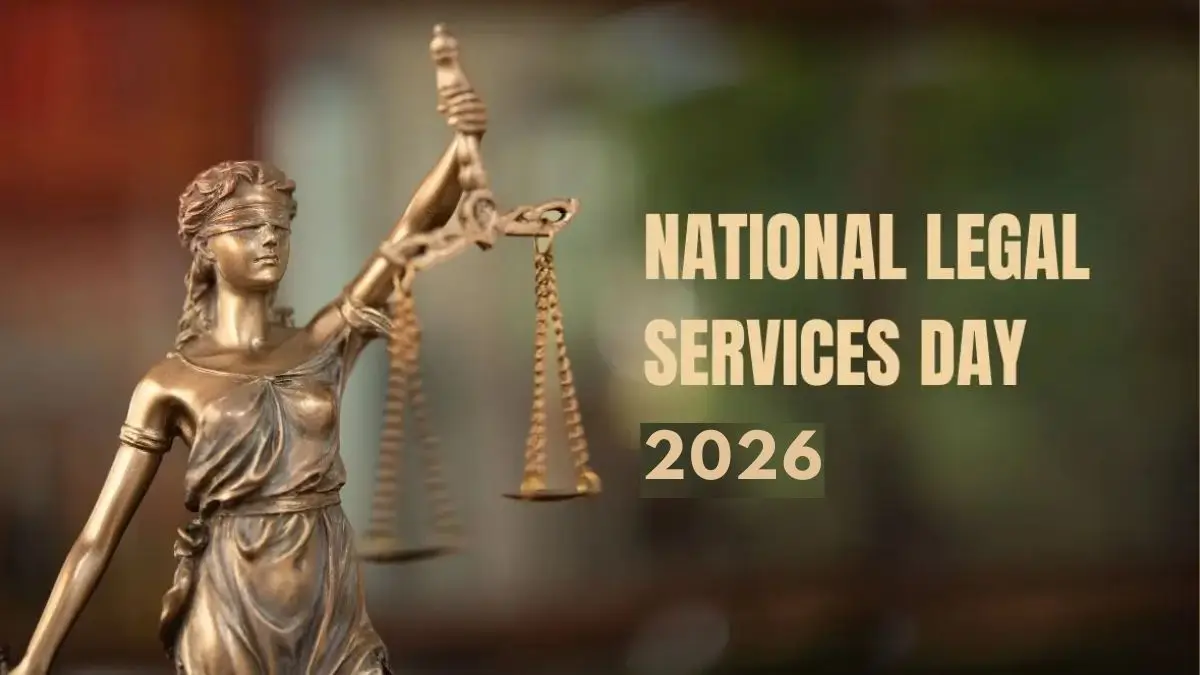
National Legal Services Day is celebrated on 9 November every year in India to raise awareness about Free Legal Aid. This day marks the commencement of the Legal Services Authorities Act 1987, on 9 November 1995. This day aims to emphasize that the Constitution ensures that people will not be deprived of legal aid due to any economic or social disadvantages. It also recognizes the work of the National Legal Services Authority (NALSA) in providing legal aid to those eligible.
National Legal Services Day 2026: Date & Background
Every year on 9 November, National Legal Services Day is celebrated. This is to promote awareness about free legal services available.
This is linked to the implementation of the Legal Services Authorities Act 1987. This put in place a national system to provide free and good-quality legal aid.
The act commenced on 9th November 1995. This established legal services authorities at a national, state and district level.
Background to National Legal Services Day
This is a celebration in India to ensure that people have access to the justice system regardless of their financial or social status.
Key developments,
- Addition of the Article 39A into the Constitution (42nd Constitutional Amendment Act) (1976)
- Parliament passed the Legal Services Authorities Act to provide a statutory framework for Free Legal Aid (1987)
- Act commenced on 9th November 1995
- Since then every year 9th November is celebrated as National Legal Services Day to raise legal awareness.
- The act also provided for the setting up of NALSA and other legal services authorities within the states and districts.
Objectives of National Legal Services Day
This day aims to help ensure everyone has access to justice. Including those who cannot afford legal representation.
Key objectives include,
- Free Legal Aid – Providing legal advice, guidance and legal representation to those eligible.
- Legal literacy – Informing citizens about their rights in the constitution, legal protections and remedies.
- Help Vulnerable Groups – Helping women, children, SCs, STs, industrial workers and other eligible disadvantaged groups.
- Promote alternative dispute resolution – Promoting Lok Adalats.
- Overcome barriers – Overcoming barriers to justice caused by financial hardship, illiteracy and lack of legal awareness.
- Improve legal aid – Improve outreach and provision of legal aid through legal aid solicitors and para legal volunteers.
Constitutional & Legal Framework for Free Legal Aid
The Constitution of India provides for the equal access to justice. As per the Article 39A requires the State to ensure that people are not deprived of justice due to economical or other disadvantages.
Key Articles/Laws
Article and It’s Provision
- Article 14: Equality before the law.
- Article 21: Protection of life and personal liberty. Includes a right to a fair trial and legal aid in certain circumstances.
- Article 39A: Equal Justice & Free Legal Aid.
- 42nd Constitutional Amendment Act (1976): Addition of Article 39A.
- Legal Services Authorities Act (1987): Statutory framework for Free Legal Aid & Lok Adalats.
- Section 12: Outlines who is eligible for Free Legal Aid.
- Section 19: Provides for Lok Adalats.
Article 39A: Equal Justice & Free Legal Aid
Article 39A is a Directive Principle of State Policy which was inserted into the constitution by the 42nd Constitutional Amendment Act (1976).
This requires the state to,
- Provide Free Legal Aid through suitable legislation, schemes or mechanisms.
- Ensure people are not deprived of opportunities to gain justice due to economical or other disadvantages.
- Encourage equal justice for all.
- This article provides the constitutional basis for the legal aid system in India.
Who is eligible for Free Legal Aid in India?
Under Section 12 of the Legal Services Authorities Act 1987 the following groups are eligible for Free Legal Aid:
- Scheduled Castes (SC) and Scheduled Tribes (ST).
- Victims of human trafficking or begar.
- Women and children.
- Disabled.
- Victims of mass disaster, ethnic conflict, caste atrocities, floods, drought, earthquake and industrial disaster.
- Industrial workers.
- Those in custody (including those in protective homes, juvenile homes and psychiatric institutions).
- Those with an annual income below the set threshold.
Different thresholds apply for cases in the Supreme Court and other Courts and can be reviewed by the relevant government.
National Legal Services Authority (NALSA)
The National Legal Services Authority (NALSA) is the top statutory body responsible for overseeing legal aid in India. It was established under the Legal Services Authorities Act 1987 and was officially formed on 9 November 1995.
Its main aim is to ensure those eligible and disadvantaged are provided with free and good quality legal aid.
Legal Services Authorities
The Act has created legal services authorities at various levels.
| Authority | Level | Leadership |
| NALSA | National | Chief Justice of India (Patron-in-Chief). Judge of the Supreme Court (Executive Chairman). |
| State Legal Services Authority (SLSA) | State | Chief Justice of the relevant High Court (Patron-in-Chief). |
| District Legal Services Authority (DLSA) | District | District Judge (Chairman). |
| Taluk Legal Services Committee (TLSC) | Taluk/Subdivision | Senior Judicial Officer (Chairman). |
NALSA oversees these authorities and provides support for legal aid, legal literacy, Lok Adalats and other initiatives.
Significance of National Legal Services Day
National Legal Services Day aims to highlight the importance of having an affordable, inclusive and accessible justice system.
1. Ensure Equal Access to Justice
Free Legal Aid helps to overcome the financial barriers to justice. It aligns with the constitutional principle of equality before the law (Article 14) and equality of justice (Article 39A).
2. Strengthen the Criminal Justice System
LADCS provides legal aid to eligible accused who wouldn’t be able to afford a private solicitor. This helps support their right to a fair trial and protection of personal liberty (Article 21).
3. Promote Alternative Dispute Resolution
Lok Adalats provide an affordable way to resolve disputes through agreement. This reduces the cost of litigation and relieves pressure on standard courts.
4. Improve Access for Rural Areas
Legal aid clinics, para legal volunteers and Tele-Law help those in rural and underserved areas to get legal advice without having to travel far.
5. Help Women and Vulnerable Groups
Legal Services Authorities run awareness-raising initiatives to help women, children, SCs, STs, disabled and other eligible groups.
6. Promote Online Legal Aid
Initiatives like Tele-Law and Nyaya Bandhu make it easier for citizens to access legal professionals through technology.
How to apply for Free Legal Aid in India?
Those eligible can contact their local Legal Services Authority.
To apply you can,
- Online – On the NALSA website and legal aid application page.
- Written – By submitting an application to the relevant Legal Services Authority.
- Verbal – By requesting help from the Legal Services Authority or Para Legal Volunteer.
- Contact a Legal Services Institution – Contact your State, District or Taluk Legal Services Authority.
- Depending on your eligibility and the nature of your case you may be given legal advice, guidance, an advocate appointed, legal documents prepared and representation in court.





 World Freedom Day 2026: History, Importa...
 Bandi Chhor Divas 2026: Why Sikhs Celebr...
 National Cancer Awareness Day 2026: Date...