
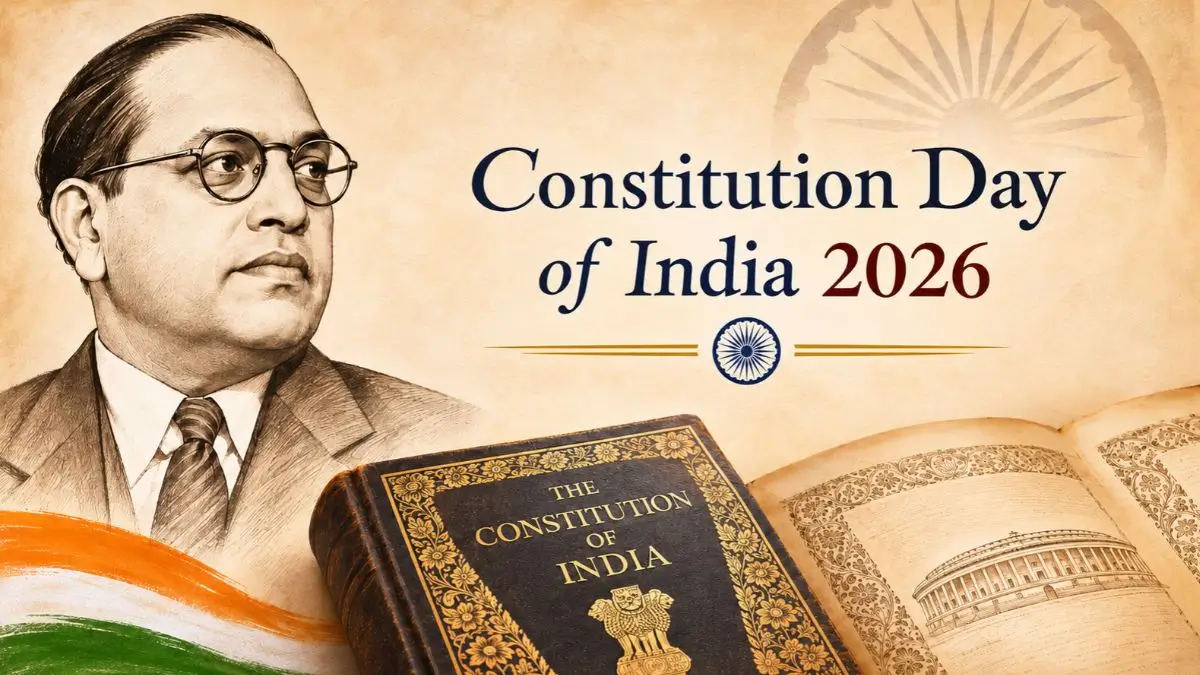
India celebrates the ‘Constitution Day’ (Samvidhan Diwas) on 26th November 2026 to honour the date on which the Indian Constitution was adopted by the Constituent Assembly on 26th November 1949. It is therefore the 77 th year since this landmark happened. The day also recognises the work of Dr B.R. Ambedkar and others who were part of the Constituent Assembly.
The Ministry of Parliamentary Affairs is conducts the nationwide online reading of the Preamble through the MyGov portal in 23 different languages. The observance promotes constitutional awareness, responsible citizenship and democratic values.
Constitution Day 2026 Date
| Aspect | Details |
| Day | Constitution Day (Samvidhan Diwas) |
| Date | 26 November 2026 |
| Country | India |
| Occasion | Adoption of the Constitution of India |
| Adopted on | 26 November 1949 |
| Came into force | 26 January 1950 |
| First officially observed as Constitution Day | 2015 |
| Also known earlier as | National Law Day |
Dr Ambedkar Foundation’s 2026 celebration in New Delhi has the theme called,
“The Constitution @76: Dr. B.R. Ambedkar’s Constitutional Vision and the Future of Indian Democracy”.
The theme focuses on constitutional values, including justice, liberty, equality and fraternity, as well as constitutional morality and accountable, inclusive governance.
Note: This theme is specifically associated with the Dr Ambedkar Foundation’s 2026 programme, as reported in the supplied coverage.
Why Is Constitution Day Celebrated on 26 November?
The Constituent Assembly adopted the Constitution of India on 26 November 1949, after nearly three years of discussions, debates and drafting.
The Constitution came into effect on 26 January 1950, marking India’s transition into a republic.
The Government of India officially declared 26 November as Constitution Day in 2015 to honour Dr B.R. Ambedkar and promote awareness of the Constitution.
Before 2015, the date was observed as National Law Day by legal institutions.
The year 2026 marks 77 years since the Constitution was adopted in 1949.
History of the Indian Constitution: Important Timeline
The making of the Indian Constitution involved extensive deliberations by the Constituent Assembly. Dr B.R. Ambedkar chaired the Drafting Committee, which prepared the draft Constitution.
| Event | Date |
| First meeting of the Constituent Assembly | 9 December 1946 |
| Dr Rajendra Prasad elected President of the Constituent Assembly | 11 December 1946 |
| Drafting Committee formed under Dr B.R. Ambedkar | 29 August 1947 |
| Draft Constitution introduced in the Constituent Assembly | 4 November 1948 |
| Constitution adopted | 26 November 1949 |
| Constitution came into force | 26 January 1950 |
Role of Dr B.R. Ambedkar
Dr Bhimrao Ramji Ambedkar chaired the Drafting Committee of the Constituent Assembly, established on 29 August 1947.
He played a central role in shaping the constitutional framework, with particular emphasis on social justice, equality, individual rights and safeguards for disadvantaged communities.
He is widely recognised as the chief architect of the Indian Constitution.
Constitution Day 2026: Celebrations and Government Initiatives
The Ministry of the Parliamentary Affairs is facilitating the several activities to encourage citizens, particularly young people and students, to understand the Constitution.
1. Online Reading of the Preamble
Citizens can participate in an online reading of the Preamble through the MyGov portal.
- Available in 23 languages.
- Includes 22 Scheduled Languages and English.
- Citizens can read the Preamble, obtain a participation certificate and share it on social media.
2. Constitution Day Quiz 2026
- The Constitution Quiz is being organised through the MyGov and MyBharat portals from 18 to 26 November 2026.
- The initiative aims to improve awareness of constitutional provisions, institutions and democratic values.
3. Viksit Bharat Yuva Samvad
Viksit Bharat Yuva Samvad is being organised from 24 to 26 November 2026 across,
- 786 districts.
- All 36 States and Union Territories.
The programme encourages youth participation and engagement with constitutional values and national development.
4. Activities Across Educational Institutions
Schools, colleges, universities and government institutions are organising activities such as,
- Collective reading of the Preamble.
- Seminars and webinars.
- Constitution quizzes.
- Essay and debate competitions.
- Poster-making and cultural programmes.
- Awareness campaigns, walks and runs.
- Special morning assemblies and discussions.
These activities aim to familiarise citizens with the making of the Constitution, its salient features and the responsibilities of citizenship.
Significance of Constitution Day
Constitution Day is an opportunity to reflect on the principles that guide India’s democratic system.
The Preamble expresses the fundamental ideals of the Constitution:
| Constitutional Value | Meaning |
| Justice | Social, economic and political fairness |
| Liberty | Freedom of thought, expression, belief, faith and worship |
| Equality | Equal status and opportunity |
| Fraternity | Brotherhood and dignity of the individual, along with national unity and integrity |
The observance also encourages awareness of,
- Fundamental Rights: Basic rights guaranteed by the Constitution.
- Fundamental Duties: Responsibilities of citizens towards the nation and society.
- Directive Principles of State Policy: Guidelines for the State to establish social and economic justice.
- Rule of Law: The principle that everyone, including government authorities, is subject to the law.
Constitution Day vs Republic Day
Constitution Day and Republic Day commemorate two different milestones in India’s constitutional history.
| Feature | Constitution Day | Republic Day |
| Date | 26 November | 26 January |
| Historical event | Adoption of the Constitution | Enforcement of the Constitution |
| Year | 1949 | 1950 |
| Significance | Commemorates the adoption of the Constitution | Marks India’s transition into a republic |
| Official observance | Declared in 2015 | Celebrated since 1950 |
| Main activities | Preamble reading, quizzes, seminars and awareness programmes | National celebrations, parade and cultural events |
| Public holiday | Not a national public holiday | National public holiday |
Why 26 January? The date was chosen to honour the Purna Swaraj declaration of 26 January 1930, when the Indian National Congress proclaimed complete independence as its goal.
FAQs on Constitution Day 2026
Q1. When is Constitution Day (Samvidhan Diwas) observed in India, and what does it commemorate?
Ans. Constitution Day is observed on 26 November every year to commemorate the adoption of the Indian Constitution by the Constituent Assembly on 26 November 1949.
Q2. When did the Indian Constitution come into force, and why is 26 January celebrated as Republic Day?
Ans. The Indian Constitution came into force on 26 January 1950, and the date was chosen to honour the Purna Swaraj declaration of 26 January 1930.
Q3. When was Constitution Day officially declared in India, and what was the day previously known as?
Ans. The Government of India officially declared 26 November as Constitution Day in 2015, and the day was previously observed as National Law Day.
Q4. Who chaired the Drafting Committee of the Constituent Assembly, and when was it established?
Ans. Dr B.R. Ambedkar chaired the Drafting Committee, which was established on 29 August 1947.
Q5. What is the theme of the Dr Ambedkar Foundation’s Constitution Day 2026 programme?
Ans. The theme is “The Constitution @76: Dr. B.R. Ambedkar’s Constitutional Vision and the Future of Indian Democracy”.







 National Milk Day 2026: Date, History an...
 International Day for Elimination of Vio...
 Lachit Divas 2026 (Nov 24): History &...