
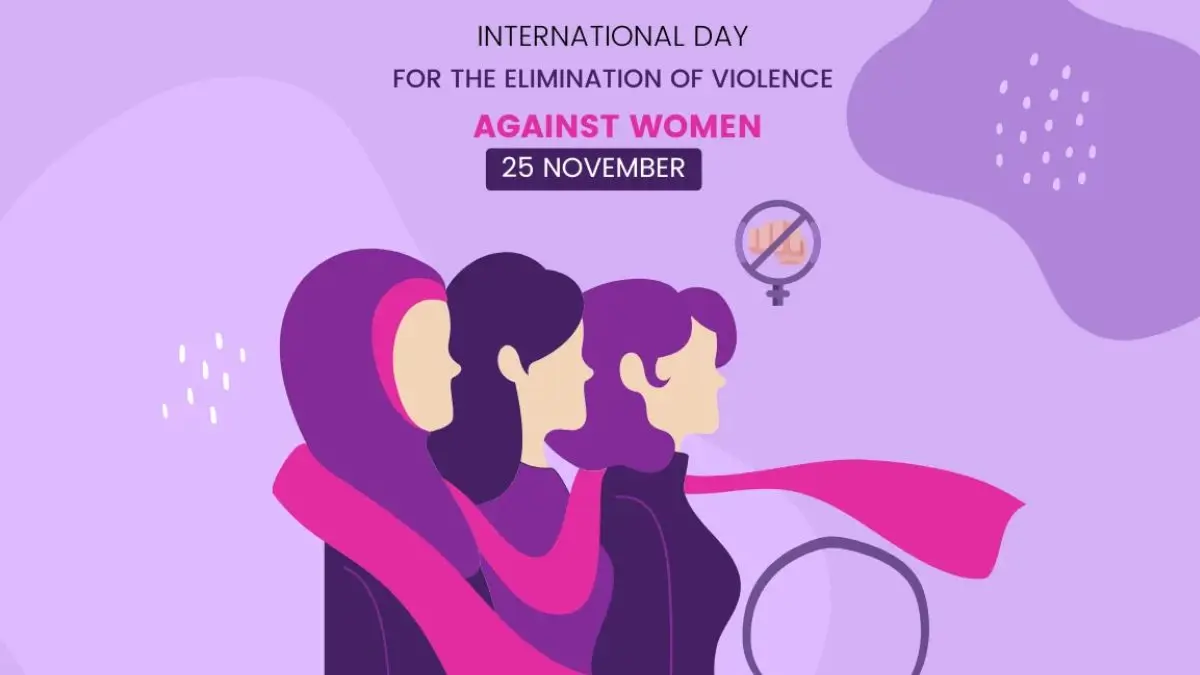
International Day for the Elimination of Violence against Women is an annual event observed on 25th November every year and it aims to raise awareness of violence against women and girls and further efforts to uphold and protect their rights, and ensure their safety and dignity. It was created by the United Nations General Assembly via Resolution 54/134 on 17th December 1999. The 2026 year’s theme is ‘Ensure Justice, Protect Survivors, End Impunity’ and emphasises the importance of providing good quality justice, supporting survivors and holding perpetrators to account.
International Day for the Elimination of Violence against Women 2026
- Name: International Day for the Elimination of Violence against Women
- Date: 25 November
- Created By: United Nations General Assembly
- UN Resolution Number: 54/134
- Date of Resolution: 17th December 1999
- First Official Observation: 2000
- Historical Background: Assassination of the Mirabal Sisters
- Country: Dominican Republic
- 2026 Theme: Ensure Justice, Protect Survivors, End Impunity
- Global Campaign: UNiTE to End Violence against Women and Girls
- Associated Campaign: 16 Days of Activism
- Dates of Campaign: 25th November – 10th December
- Associated SDG: SDG 5 – Gender Equality
What Is the International Day for the Elimination of Violence against Women?
The United Nations International Day for the Elimination of Violence against Women is used to emphasise that violence against women and girls is an attack on human rights and hinders gender equality.
Governments, international bodies and civil society are urged to take action so that violence does not occur and to both better protect women and girls and hold people to account.
As well as identifying violence which occurs in the home, the campaign also addresses violence in the workplace, in education and in the community, together with online. It advocates for women’s ability to safely engage in education, work and society.
Around one in three women suffer some form of physical or sexual violence in their lifetime, according to the United Nations.
2026 Theme – Ensure Justice, Protect Survivors, End Impunity
This year’s theme encourages action to Ensure Justice for survivors, to protect women and girls and to hold perpetrators to account.
Whilst many countries have legislation in place to protect women, this is not always reflected in practice. Women and girls may not come forward to disclose experiences of violence due to a range of factors including fear, stigma and discrimination. Poor institutional responses and lack of funding can also hinder women and girls from disclosing and receiving support.
Thus, the United Nations campaign urges,
- Accessible and secure means of disclosure.
- Support structures for survivors which are informed by, and respond to, the needs of survivors. These should include legal, medical and support services.
- Good quality implementation of legislation and holding perpetrators to account.
- Improved institutional action to better protect women and girls.
- Enhanced support for organisations working to reduce gender based violence.
As previously mentioned, violence can occur in a number of settings including the home, workplace, community and online. Often, several types of violence can occur simultaneously.
Why is 25th November Observed? Background
25th November honours the Mirabal Sisters – Patria, Minerva and Maria Teresa. They were Dominican Republic political activists who resisted the dictatorship of Rafael Leónidas Trujillo.
Commonly referred to as Las Mariposas (The Butterflies), the Mirabal Sisters were murdered by members of the Trujillo regime on 25 th November 1960. Their killing has since been used as a powerful symbol of resistance to political repression and violence.
In 1981, women’s rights activists in Latin America began to observe 25th November as a day which aimed to combat violence against women. The United Nations then officially acknowledged this observance.
Key Historical Milestones
| Year | Development |
| 1960 | Mirabal Sisters assassinated |
| 1979 | UN General Assembly adopts CEDAW |
| 1981 | Women’s rights activists begin to observe 25 th November |
| 1993 | UN adopts Declaration on the Elimination of Violence against Women |
| 1999 | UNGA adopts Resolution 54/134 |
| 2000 | First official UN observation |
| 2008 | UN launches UNiTE campaign |
| 2017 | EU-UN Spotlight Initiative is launched |
| 2026 | Emphasis is placed on justice, protection and holding perpetrators to account |
Important United Nations Campaigns to Reduce Violence against Women
1. Convention on the Elimination of All Forms of Discrimination against Women (CEDAW)
This was adopted by the United Nations General Assembly in 1979. It is an international agreement which works to end discrimination against women. It enables countries to develop initiatives which further gender equality and uphold women’s rights.
2. Declaration on the Elimination of Violence against Women
This was adopted by the United Nations General Assembly via Resolution 48/104 on 20 th December 1993. It created an international approach to identifying and tackling violence against women.
3. UNiTE to End Violence against Women and Girls
Initiated by the UN Secretary-General in 2008, this campaign works to increase awareness and encourage improved policy development and additional resources to effectively eradicate violence against women and girls.
4. 16 Days of Activism Against Gender Based Violence
This international campaign runs from 25 th November (the International Day for the Elimination of Violence against Women) until 10 th December (Human Rights Day).
What Constitutes Violence against Women?
Violence against women is any action based on gender which results in, or is likely to result in, physical, sexual and/or psychological harm or distress. This can involve threatening behaviour, pressure and unlawful detention.
Main Types of Violence against Women
| Type | Description |
| Physical | Includes hitting and other physical assault. |
| Sexual | Encompasses rape, sexual assault and sexual coercion. |
| Psychological | Involves threatening behaviour, bullying, shaming and psychological abuse. |
| Economic | May include limiting access to financial resources and to work. |
| Domestic | Can be physical, sexual, verbal, psychological and/or economic abuse which occurs within a domestic setting. |
| Workplace Sexual Harassment | Sexual propositions and/or sexually charged comments which are unwelcome. |
| Human Trafficking | Labour and/or sexual exploitation through coercion. |
| Technology Assisted Violence | This can include cyberstalking, online harassment, deepfake abuse and sharing of private images without consent. |
International Day for the Elimination of Violence against Women and SDG 5
This observance is strongly associated with Sustainable Development Goal 5 (Gender Equality). It was included in the United Nations 2030 Agenda for Sustainable Development.
Important SDG 5 related targets are,
- Target 5.2 – To eradicate all forms of violence against women and girls, both in the public and private sectors, including human trafficking and sexual exploitation.
- Target 5.3 – To end damaging practices such as child, early and forced marriage and female genital mutilation.
The International Day for the Elimination of Violence against Women underlines the importance of upholding women and girls’ equality in terms of their rights, safety and opportunities.






 Lachit Divas 2026 (Nov 24): History &...
 Guru Nanak Jayanti 2026: Date, History, ...
 World Fisheries Day 2026: Theme, History...