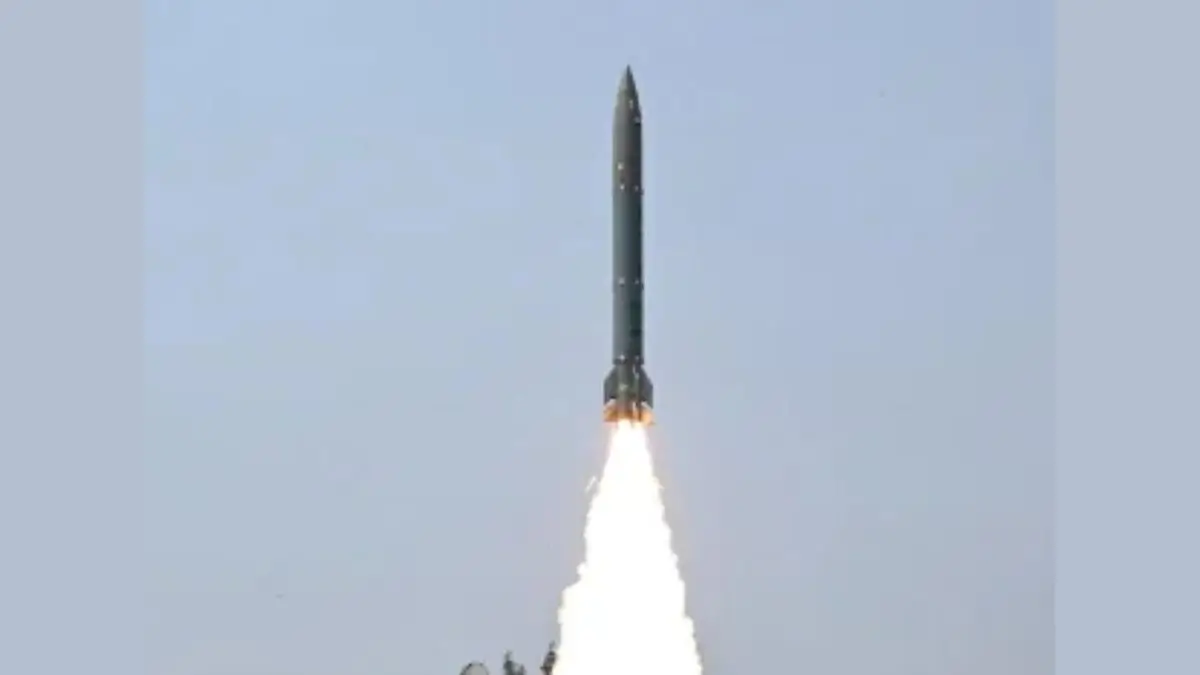
On 5th November, 2026, the Defence Research and Development Organisation (DRDO) had successfully conducted flight trials for its indigenously developed Pralay quasi-Ballistic Missile. It was launched from the Dr APJ Abdul Kalam Island near Odisha, around 11:10am, the missile met all mission objectives. It marks a step closer for the missile to be inducted into the Indian Armed Forces.
What is the Pralay Missile?
The Pralay Missile is an indigenously developed canister-based, short-range surface-to-surface quasi-ballistic missile for tactical and battlefield use.
It has features of both ballistic missiles and manoeuvring capabilities. Therefore, the trajectory of the missile cannot be easily predicted compared to a standard Ballistic Missile.
This missile will provide the Indian Armed Forces a quick-response precision strike capability to hit key military targets.
Development and Production
- Developed by: Defence Research and Development Organisation (DRDO)
- Main Development centre: Research Centre Imarat (RCI), Hyderabad
- Contributor: Other DRDO laboratories.
- Produced by: Bharat Dynamics Limited (BDL). One of the Development-cum-Production Partners.
- Missile type: Short-range quasi-ballistic.
- First flight trial: 22nd December, 2021.
- Most recent trial: 5th November, 2026.
As the missile has been developed using technologies from DRDO’s Prithvi Defence Vehicle (PDV) and Prahaar missiles, Bharat Dynamics Limited, one of the Development-cum-Production Partners have manufactured the missile.
Key Features of the Pralay Missile
1. Range and Payload.
- Range – Around 150km-500km.
- Payload – Missile has been designed to carry conventional warheads.
- The missile can be used to target tactical and battlefield targets which can include key military sites.
- There are various figures about the payload on the Pralay Missile in published sources. However, it has a known range of 150 km- 500 km.
2. Solid Fuel Propulsion.
- Uses a solid propellant rocket motor. This allows quicker preparation for launch, storage, and deployment.
3. Mobile Launch System.
- Can be deployed using a mobile road-based canister launch system.
4. Quasi-ballistic.
- Unlike a standard Ballistic Missile, this missile has manoeuvring capabilities.
- The lower flight profile of the missile means it is harder to lock onto and intercept by enemy air defence systems.
5. Navigation System.
- The missile has an advanced navigation and guidance system. Technical details from DRDO say it has inertial navigation and terminal guidance systems.
6. Conventional Warheads.
- The missile can be equipped with various conventional warhead configurations to attack various battlefield targets.








 INS Amini Delivered to Indian Navy: Indi...
 Exercise Malabar 2026: India, Australia,...
 DRDO Successfully Flight-Tests Indigenou...