
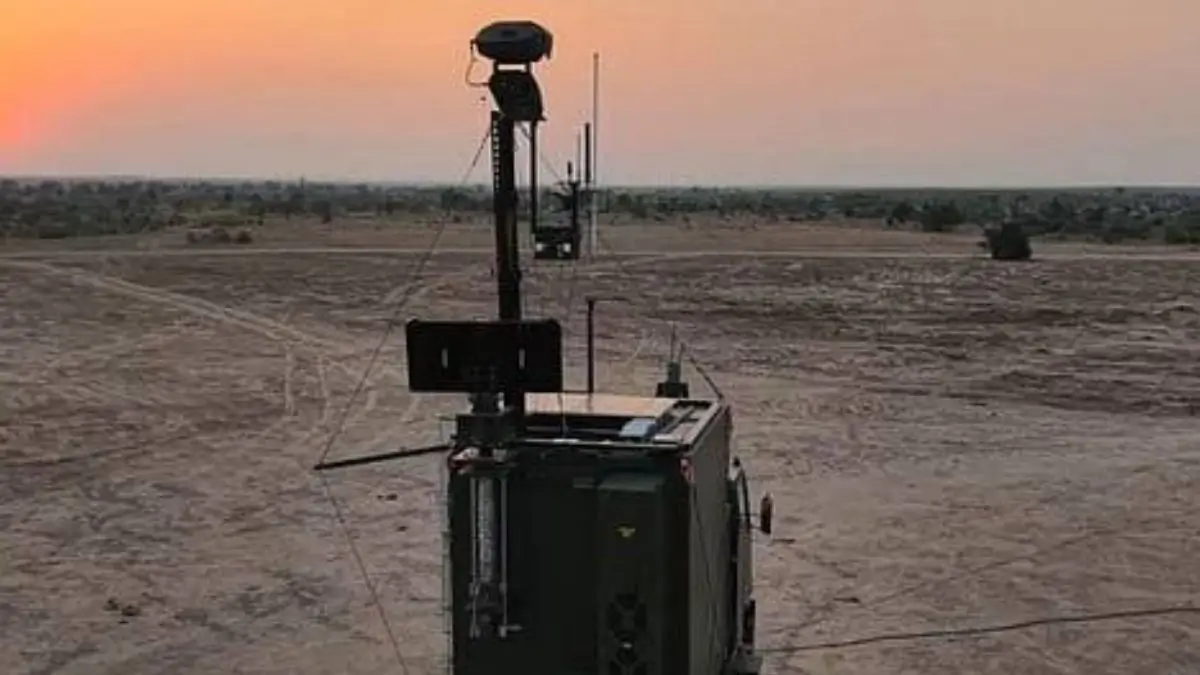
India’s indigenous Bhargavastra counter-swarm drone system, developed by Solar Defence and Aerospace Limited (SDAL), has undergone trials at the Pokhran field range in Rajasthan. Designed to counter the growing threat of drone swarms, the system combines unguided air-defence rockets with guided micro-missiles for different engagement requirements. Its architecture integrates surveillance radars, passive radio-frequency detectors, electro-optical and infrared sensors, and an AI-enabled command system to detect, track and engage aerial threats.
Bhargavastra System: Key Details
Bhargavastra is a vehicle-mounted, two-layer counter-swarm drone system developed by Solar Defence and Aerospace Limited (SDAL) and it is a subsidiary of Solar Industries India Limited. The company describes it as India’s first indigenously designed and developed system of this type.
| Particulars | Details |
| System Name | Bhargavastra |
| Developer | Solar Defence and Aerospace Limited (SDAL) |
| Parent Company | Solar Industries India Limited |
| Category | Vehicle-Mounted Counter-Swarm Drone System |
| System Design | Two-layer defence |
| Trial Location | Pokhran Field Firing Ranges, Rajasthan |
| Trial Period | 20–24 November 2026 |
| Main Weapons | Air-defence rockets and guided micro-missiles |
| Project Category | Indian Army Make-II programme |
| Project Sanction Order | 9 July 2024 |
| Project Completion Date | 31 March 2027 |
How Does Bhargavastra Counter Drone Swarms?
Bhargavastra uses a two-layer hard-kill approach. It physically destroys hostile drones using rockets and guided micro-missiles rather than depending only on electronic jamming or disruption of communication signals.
The two versions have different weapon specifications,
| Feature | Version-I | Version-II |
| Weapon | Unguided air-defence rockets | Guided micro-missiles |
| Launcher Capacity | 64-tube launcher | 64-micro-missile launcher |
| Guidance | Unguided | Autonomous guidance |
| Seeker | Not specified | Infrared (IR) seeker |
| Main Role | Engagement of multiple drones | Precision engagement of aerial targets |
Version-I addresses the Indian Army’s original rocket-based requirement. SDAL independently developed the Version-II with guided micro-missiles and adding a precision-engagement capability beyond the initial requirement.
Detection, Tracking and Command System
Bhargavastra combines multiple sensors with an integrated command-and-control architecture to identify and track incoming aerial threats.
Its main components include,
- Surveillance Radars: Detects and track the aerial targets.
- Passive Radio-Frequency (RF) Detectors: Help identify drone-related radio-frequency emissions.
- Electro-Optical/Infrared (EO/IR) Sensors: Support visual and infrared-based target tracking during day and night.
- AI-Enabled C4I System: Integrates sensor information, tracks targets and coordinates weapon engagement.
The reported detection and tracking ranges are:
| Component | Reported Range |
| Surveillance Radar | Up to 10 km |
| EO Tracking System | Around 6 km |
The vehicle-mounted design is also intended to support deployment across varied geographical conditions, including high-altitude areas.
Bhargavastra Trials at Pokhran: What Was Tested?
SDAL conducted its in-house development trials at the Pokhran Field Firing Ranges in Rajasthan from 20 to 24 November 2026.
The trials involved multiple firings of air-defence rockets and guided micro-missiles against drone targets. According to the company:
- Air-defence rockets were fired at actual swarm-drone targets detected and tracked by the system.
- The rocket warheads hit their designated points.
- Separate tests demonstrated the guidance and terminal-homing capabilities of the guided micro-missiles.
- The trials assessed the integration of sensors and the command-and-control network.
Following these trials, SDAL stated that Bhargavastra was ready for a prototype demonstration in its deliverable configuration. Further optimisation and trials are planned to improve engagement performance and kill probability. The completion of development trials does not, by itself, mean that the system has completed Army induction.






 India–Nepal Joint Military Exercise SU...
 Exercise Suryakiran 2026: 20th India-Nep...
 GRSE Delivers ASW Shallow Water Craft As...