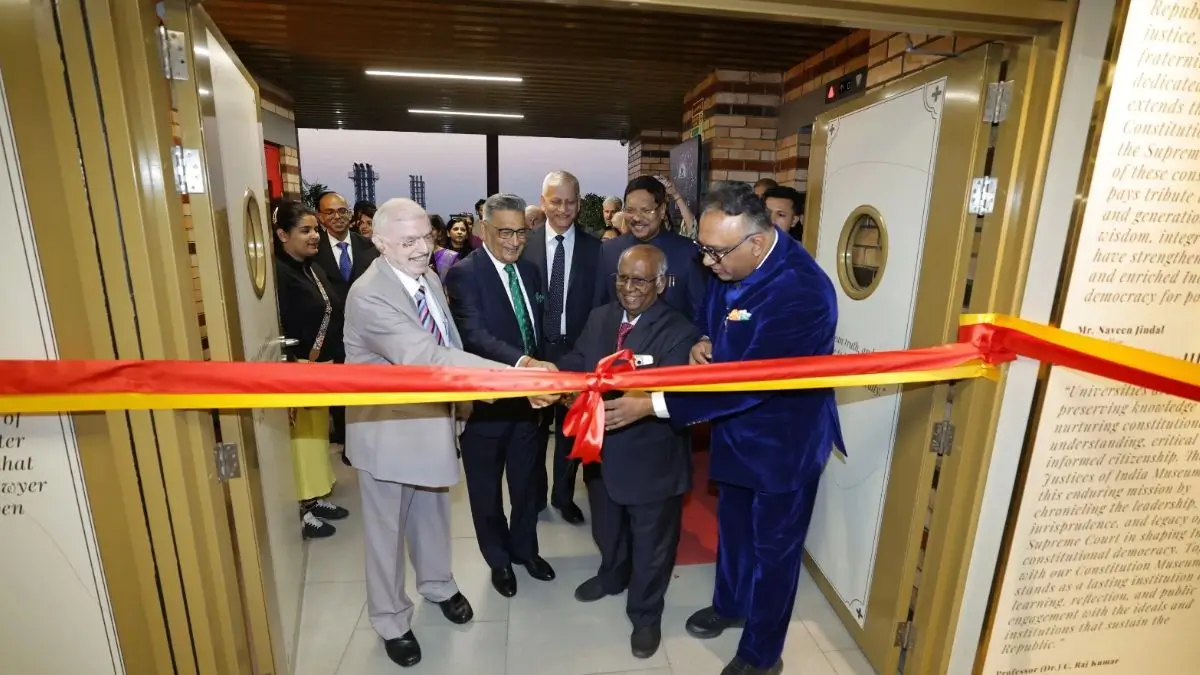
India’s first museum on Chief Justices of India (CJIs), named ‘Guardians of the Republic’, was opened at O.P. Jindal Global University (JGU) in Sonipat, Haryana on 26 th November 2026. The museum showcases the work of past CJIs and outlines the progression of the Supreme Court in conjunction with India’s Constitution. It has five galleries and includes over 280 busts of Supreme Court judges, 25 High Court models together with significant court rulings and interactive installations.
Guardians of the Republic
This museum has been created to archive and exhibit the history of the Supreme Court and work undertaken by previous Chief Justices.
- Museum Name: Guardians of the Republic
- Significance: India’s first Chief Justices of India Museum
- Location: O.P. Jindal Global University, Sonipat
- State: Haryana
- Date Opened: 26th November 2026
- Number of Galleries: 5
- Supreme Court Judge Busts: Over 280
- High Court Models: 25
- Language Tapestries: 22
- Interactive Pillars: 20
- Significant Court Rulings: 20
What Does the Museum Include?
The museum is comprised of five galleries. Information is given on the progression of India’s judiciary through a combination of tangible items, electronic media and archival resources.
Key elements within the museum are,
- Over 280 Busts – Busts of Supreme Court judges which illustrate India’s judiciary.
- High Court Models – Models of twenty-five High Courts.
- Language Tapestries – Tapestries, which showcase the variety of languages spoken throughout India.
- Interactive Pillars – Pillars that provide information regarding the lives and work of previous Chief Justices.
- Significant Court Rulings – Exhibits detailing twenty key rulings.
- Holographic Courtroom – An interactive display of a courtroom.
- Visual Arts and Sculpture – Visual art works which reflect India’s constitutional and judicial legacy.
- Oral History – Audio files documenting the experiences of ex- Chief Justices and judges.
The museum aspires to link the history of the Supreme Court to the progression of India’s constitution.
Ten Ex-Chief Justices Present or Participate Online
Ten ex- Chief Justices of India were present or participated in the opening function.
- M.N. Venkatachaliah
- B.N. Kirpal
- S. Rajendra Babu
- K.G. Balakrishnan
- P. Sathasivam
- R.M. Lodha
- Dipak Misra
- S.A. Bobde
- U.U. Lalit
- B.R. Gavai
Former Chief Justice of India, B.R. Gavai, emphasised during the opening function the actions that had been taken during his time as Chief Justice to further inclusion of Scheduled Castes, Scheduled Tribes, minority groups and women.
Chief Justice of India – Role and Appointment
As leader of the Supreme Court of India, the Chief Justice of India plays a key role within the management of the nation’s top court.
1. Appointment
The President of India appoints the Chief Justice of India. Typically, the most senior Supreme Court judge, who is deemed suitable for the post, is named to this position. The current Chief Justice then advises on, and the appointment is recommended for, the next Chief Justice. Other Supreme Court judges are also involved in the decision making process.
2. Setting up Benches and Case Distribution
As Master of the Roster, the Chief Justice assigns cases to various benches. Constitution Benches are also formed by the Chief Justice so that they can analyse and determine key legal and constitutional issues.
3. The Supreme Court’s Jurisdiction
The Supreme Court has three broad areas of jurisdiction,
Original Jurisdiction
- Responsible for particular issues, such as some Centre-State and State-State matters.
Appellate Jurisdiction
- Reviews the decisions reached by the subordinate courts and tribunals, according to relevant constitutional and statutory guidance.
Advisory Jurisdiction
- Provides advice on issues put to it by the President of India under Article 143 of the Constitution.
FAQs on Guardians of the Republic Museum
Q1. What is the name of India’s first museum dedicated to Chief Justices of India, and where is it located?
Ans. The museum is named Guardians of the Republic and is located at O.P. Jindal Global University in Sonipat, Haryana.
Q2. When was the Guardians of the Republic Museum inaugurated?
Ans. The museum was inaugurated on 26 November 2026.
Q3. How many galleries does the museum have, and how many busts of Supreme Court judges are displayed?
Ans. The museum has five galleries and displays over 280 busts of Supreme Court judges.
Q4. How many High Court models and significant court rulings are featured in the museum?
Ans. The museum features models of 25 High Courts and exhibits highlighting 20 significant court rulings.
Q5. Who appoints the Chief Justice of India, and under which Article can the President seek the Supreme Court’s advisory opinion?
Ans. The President of India appoints the Chief Justice of India, and Article 143 of the Constitution empowers the President to seek the Supreme Court’s advisory opinion.





 Dr Virendra Kumar to Launch SAMAVESH and...
 PANI Project: Centre Proposes Undersea F...
 Nayi Chetna 5.0 to Launch on November 25...