
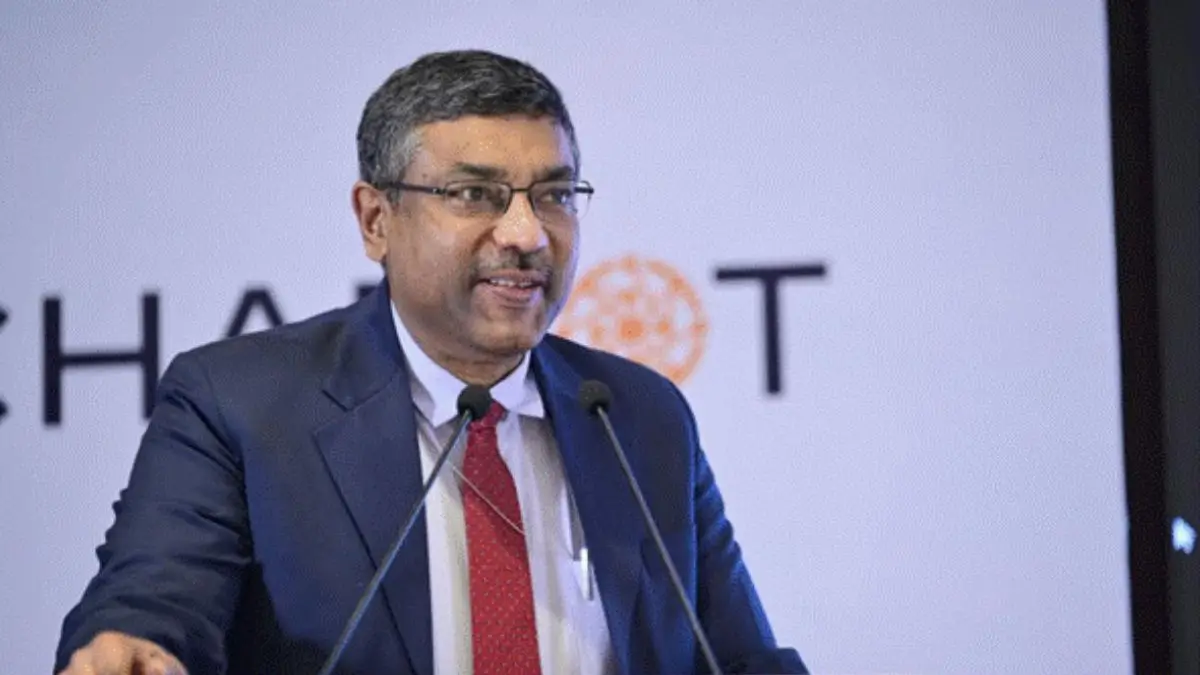
India has launched the Chariot-1 foundation models under the India AI Mission to strengthen domestic artificial intelligence research and development. It is developed by the Chariot Artificial Intelligence Private Limited and this model series includes a Large Language Model (LLM) and a Text-to-Speech (TTS) system. Launched by S. Krishnan, Secretary of the Ministry of Electronics and Information Technology (MeitY) on 26 November 2026 in New Delhi, Chariot-1 focuses on multilingual language processing, computational efficiency and speech generation for India’s diverse linguistic environment.
Chariot-1 AI Models: Key Details
| Particular | Details |
| Model series | Chariot-1 |
| Developed by | Chariot Artificial Intelligence Private Limited |
| Supporting initiative | India AI Mission |
| Launch date | 26 November 2026 |
| Launch venue | Bharat Mandapam, New Delhi |
| Launched by | S. Krishnan |
| Designation | Secretary, MeitY |
| Main models | Chariot-1 LLM and Chariot-1 TTS |
| Main focus | Multilingual AI and speech generation |
| Development approach | Zero-to-no pre-training |
Chariot Artificial Intelligence Private Limited is among the first four teams selected to develop indigenous foundation models under the India AI Mission.
What Are the Chariot-1 Foundation Models?
The Chariot-1 series consists of the two major AI models that includes,
1. Chariot-1 Large Language Model (LLM)
The Chariot-1 LLM is designed for language understanding and processing. It uses a Mixture-of-Experts (MoE) architecture with the following specifications:
- Total parameters: 11 billion.
- Active parameters per token: 4 billion.
- Available model sizes: 10.7 billion, 1.7 billion and 745 million parameters.
Designed for different computing environments and deployment requirements.
The model’s different sizes allow it to operate across computing environments ranging from data centres to laptops, smartphones and edge devices.
2. Chariot-1 Text-to-Speech (TTS)
The Chariot-1 TTS model converts written text into natural-sounding speech.
It supports English and 10 Indian languages,
- Hindi
- Bengali
- Marathi
- Tamil
- Telugu
- Kannada
- Malayalam
- Gujarati
- Punjabi
- Odia
A notable feature is its ability to interpret context when pronouncing numbers, dates, currencies, measurement units, URLs and abbreviations.
This helps generate more natural speech from real-world text rather than simply converting written characters into spoken words.
Three Major Research Innovations Behind Chariot-1
The CHARIOT team presented three research innovations incorporated into the training of its models. These innovations aim to improve multilingual processing and reduce computational requirements.
1. IndicShift
IndicShift is an open-source innovation that introduces a common alphabet for Indian scripts.
Its main features include,
- Incorporates 1,012 characters from 12 Indian scripts.
- Uses a shared representation to capture similarities between Indian languages.
- Requires up to 2.5 times fewer tokens to process Indian-language text compared with OpenAI’s GPT tokenizer, according to the research.
- Reportedly improves Indian-language model performance by 5–8% using the same computing resources.
The approach aims to make multilingual AI training more efficient by reducing the need to process each Indian script as an entirely separate system.
2. Nested Training
Nested training allows three full-size models to be trained simultaneously through a single training run and a shared set of weights.
Its advantages include,
- Supports different model sizes without separate training runs.
- Enables deployment across data centres, laptops, smartphones and edge devices.
- Improves training speed by up to 62% compared with training three model sizes separately.
This approach addresses the challenge of developing separate AI models for different hardware and computing environments.
3. Mixture of Vocabularies
The Mixture of Vocabularies innovation makes the model’s word-selection process more efficient.
Its key features are,
- Divides the vocabulary into 11 groups.
- Scores only the relevant group during word selection.
- Reduces the number of vocabulary entries scored for each word by 5.7 times.
- Improves training speed by up to 38% using the same GPU resources, with negligible changes in model loss.
Chariot-1 TTS: Performance and Accuracy
The Chariot-1 speech model was evaluated on the ASYNC TTS Pronunciation Benchmark.
| Performance Parameter | Result |
| Pronunciation accuracy | More than 97% |
| Real-life sentences in benchmark | 1,029 |
| Non-standard text examples | 2,251 |
| Non-standard text categories | 42 |
| Hindi Character Error Rate (CER) | 7.60% |
| Average CER across nine other Indian languages | 6.47% |
The model demonstrated the ability to handle different forms of written information, including dates, numbers, currencies and abbreviations.
A lower Character Error Rate (CER) indicates fewer character-level errors in the generated speech output.
What Is the India AI Mission?
The India AI Mission is a Government of India initiative aimed at building a strong domestic artificial intelligence ecosystem.
It focuses on developing indigenous AI capabilities, supporting research and innovation, and expanding access to AI infrastructure and technologies.
Supporting teams developing foundation models is an important part of the mission. Chariot AI is among the first four selected teams working towards the development of indigenous foundation models.
The initiative aims to encourage Indian researchers and enterprises to develop AI technologies suited to the country’s linguistic, social and technological requirements.






 India Develops First North-East-Specific...
 India Launches Indigenous Bird Flu Vacci...
 AI Kavach: IIT Kanpur and Bharat1.ai Lau...