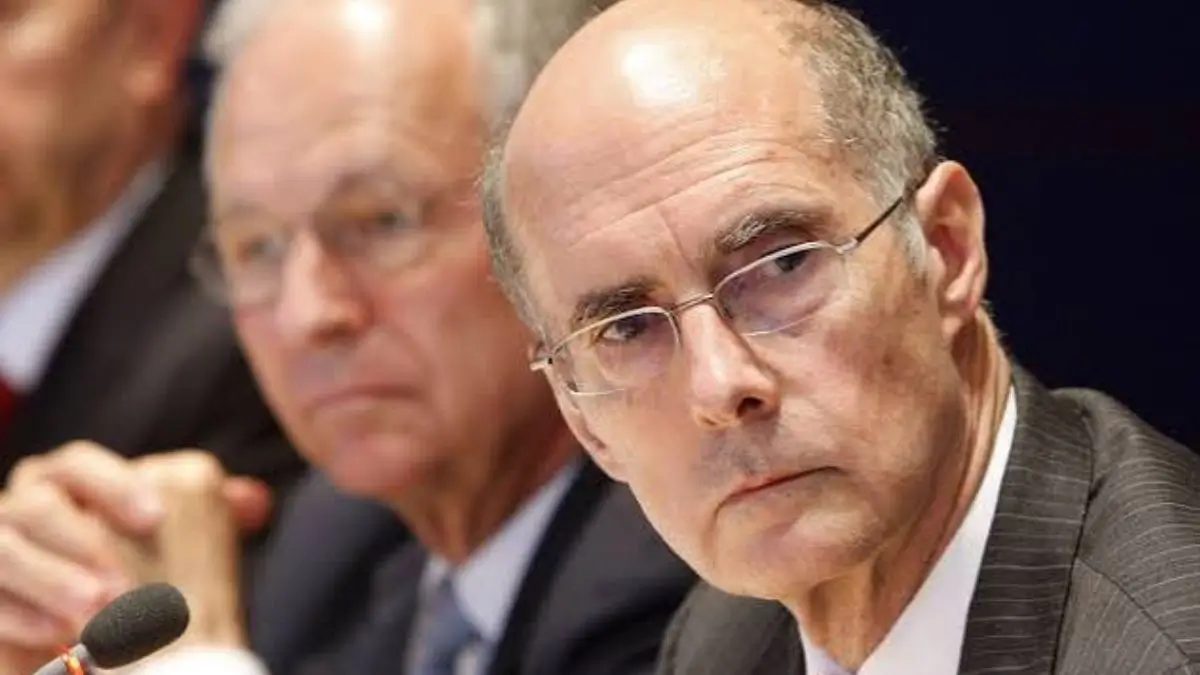
US Deputy Secretary of State Strobe Talbott has died aged 80. Talbott was involved in facilitating dialogues in Washington with then Indian External Affairs Minister Jaswant Singh which aided Indo-US relations post India’s 1998 Pokhran-II nuclear tests. A total of 14 dialogues were held in seven different countries on three different continents between June 1998 and September 2000. These dialogues paved the way for further strategic collaboration between India and the US.
Strobe Talbott and the India-US Dialogue (post-Pokhran-II)
India performed a second round of nuclear testing in May 1998. This resulted in a strain on Indo-US relations as the US introduced sanctions and attempted to persuade India to conform to the international non-proliferation regime.
Talbott was the main US counterpart to India’s Jaswant Singh then External Affairs Minister in these dialogues.
A total of 14 dialogues were held in seven countries on three different continents between June 1998 and September 2000.
Topics discussed included,
- Nuclear security and non-proliferation;
- Arms control and nuclear testing;
- Trade;
- Strategic collaboration;
- And the future of Indo-US relations.
Whilst not conclusively resolving differing views on nuclear issues, the dialogues did facilitate further diplomatic collaboration between the two nations.
Talbott’s contribution to the India-US Strategic Partnership
The dialogues facilitated by Talbott helped to pave the way for US President Bill Clinton’s visit to India in March 2000. This was a key moment in enhancing Indo-US relations which had been adversely affected by long-standing diplomatic issues.
Clinton gave a speech to the Indian Parliament. This was the first presidential visit to India since that of Jimmy Carter in January 1978.
Furthermore, the dialogues also helped to foster greater strategic collaboration between the two countries in later years.
Following the dialogues, the Next Steps in Strategic Partnership (NSSP) was launched in 2004 and in July 2005 Prime Minister Manmohan Singh and President George W. Bush announced the India-US civil nuclear collaboration. Thus collaboration moved beyond just nuclear issues.
Talbott’s View of the India-US Civil Nuclear Collaboration
Despite his contribution to enhancing Indo-US relations, Talbott voiced misgivings regarding the 2005 India-US civil nuclear collaboration.
In March 2006 he expressed concern that allowing India to be exempt from current international nuclear regulations might undermine the global non-proliferation regime. Furthermore, it might even prompt other nations to pursue their own exemptions.
Talbott also condemned the US Senate’s decision in 1999 not to ratify the Comprehensive Nuclear-Test-Ban Treaty (CTBT). He viewed this as adverse for worldwide non-proliferation initiatives.
Therefore, Talbott’s views highlight how his commitment to continuing collaboration with India was tempered by his concern for the global nuclear regime.
Strobe Talbott: Career and Key Roles
| Year/Period | Role/Development |
| 1946 | Born in Dayton, Ohio, USA. |
| 1971-1993 | Journalist for Time magazine. |
| 1993-1994 | US Ambassador-at-Large and Special Adviser on the Newly Independent States. |
| 1994-2001 | Deputy Secretary of State. |
| 2001 | Founder director of the Yale Center for the Study of Globalization. |
| 2002-2017 | President of Brookings Institution. |
| 2011-2017 | Chair of the US State Department’s Foreign Affairs Policy Board. |
| 2026 | Died (aged 80). |
Talbott attended Yale University and the University of Oxford. For 21 years prior to his governmental career Talbott worked for Time and wrote on topics including Eastern Europe, the US State Department and the White House. He then progressed to becoming Time’s Washington bureau chief and also a foreign affairs columnist.
He also translated and edited two books of memoirs by the late Soviet leader Nikita Khrushchev.
Notable Book: Engaging India
- Engaging India: Diplomacy, Democracy and the Bomb
- Author: Strobe Talbott
- Publisher: Brookings Institution Press
- Date of publication: 2004
- Topic: Indo-US dialogues post 1998 nuclear testing.
Within this book Strobe Talbott details his personal experience of the dialogues with Jaswant Singh and subsequent diplomatic events after the 1998 nuclear testing. It is a key source on Indo-US relations under the Clinton administration.





 Pandit Manilal Nag: Sitar Maestro and Ex...
 Arpita Singh, Renowned Indian Modernist ...
 Patrick Stewart Dies at 86: The Legacy o...