
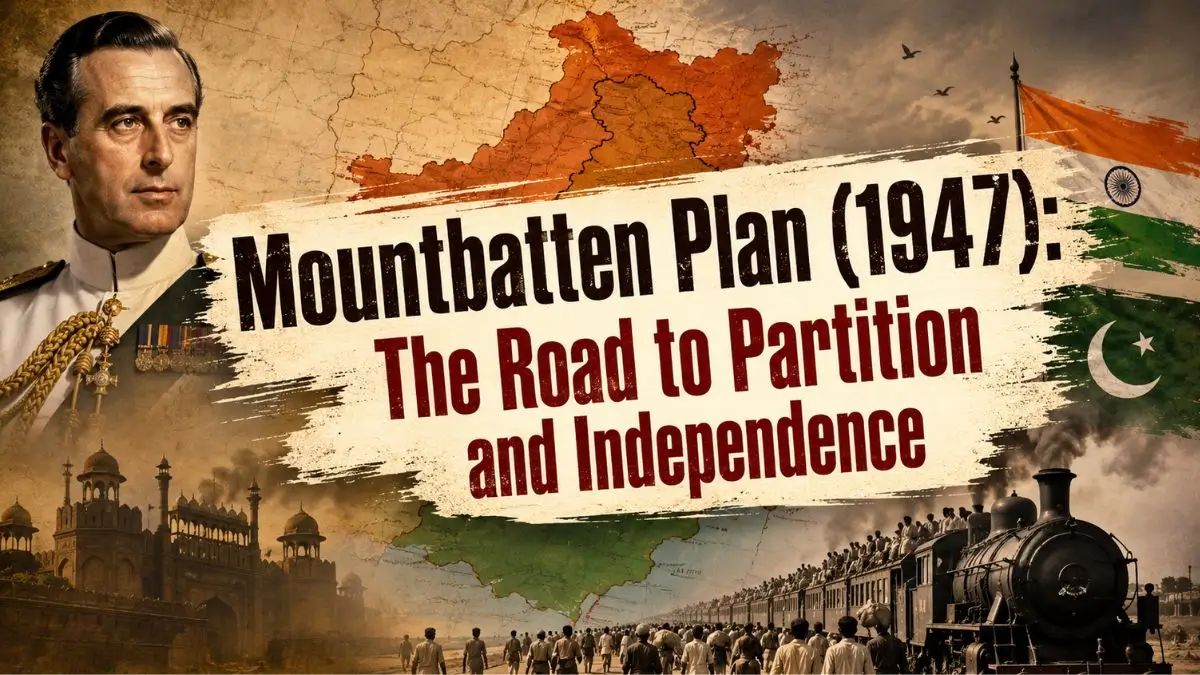
The Mountbatten Plan or the 3rd June Plan was proposed by Viceroy Lord Louis Mountbatten on 3rd of June 1947. This plan became the blueprint for the transfer of power and partition of British India into two separate dominions.
This plan was formulated against the backdrop of growing communal riots, political deadlock, and the British government’s decision to quit India soon. The implementation of this plan finally put an end to the nearly two-hundred-year-long colonial rule in India, but Partition led to a large-scale communal riot and displacement.
Background of the Mountbatten Plan
Britain found itself in a state of serious economic and political crises post the Second World War. The failures of other constitutional initiatives like Cripps Mission and the continued nationalist movement left the country in great trouble.
British Prime Minister Clement Attlee, on 20 February 1947, announced Britain’s intention to transfer its power in India.
Lord Mountbatten replaced Lord Wavell as Viceroy of India in March 1947. His mandate was to negotiate a speedy transfer of power.
On the other hand, political disagreement between Indian National Congress and the Muslim League, especially regarding the demand for Pakistan, was creating a deadlock situation. Communal riots further increased the need for a quick political settlement.
What was the 3 June Plan?
On 3 June 1947, Lord Mountbatten presented his plan to the Indian political leaders. His proposal was to divide British India and then to transfer power to two successor states.
The main political parties finally accepted the plan which helped in formulating the Indian Independence Act, 1947.
Provisions of the Mountbatten Plan
1. Partition of British India
- British India was to be partitioned into two dominions: India and Pakistan.
2. Partition of Punjab and Bengal
- The legislative assemblies of Punjab and Bengal would decide whether their provinces would be partitioned, with separate arrangements being made for the Muslim and non-Muslim portions of the provinces.
3. Referendum in NWFP
- There would be a referendum in the North West Frontier Province (NWFP) regarding whether it would join India or Pakistan.
4. Referendum in Sylhet
- There would be a referendum in Sylhet district of Assam whether it would be with Assam or with East Bengal.
5. Sindh
- The Sindh Legislative Assembly had been empowered to decide whether the province would join Pakistan.
6. Boundary Commissions
- There would be boundary commissions for the delineation of the boundaries between India and Pakistan, particularly in Punjab and Bengal. Sir Cyril Radcliffe headed the boundary commissions.
7. Princely States
- The princely states would not continue to be under the paramountcy of Britain. They were to accede to India or Pakistan as determined by geographical and other considerations.
8. Separate Constituent Assemblies
- India and Pakistan were to have separate constituent assemblies for formulating their constitutional set-up.
9. Transfer of Power
- The date of transfer of power was advanced from that envisioned by the British government to August 15, 1947.
Congress and Muslim League Reactions
The plan met with varying responses from India’s most prominent political parties.
Indian National Congress
- The Congress party leaders had been demanding independence for some time, and historically, they had been against the partition of India. By 1947, however, communal strife and political stalemate had led to an extremely complicated situation.
- Congress finally accepted the plan and regarded partition as an unpleasant but realistic way of achieving independence from Britain and the formation of an independent government of India.
Muslim League
- The leader of the Muslim League, Muhammad Ali Jinnah, accepted the plan since it gave him an opportunity to establish Pakistan.
Mahatma Gandhi
- Gandhi was very much against the idea of Partition, and he had always advocated Hindu-Muslim unity. He was not in favor of the partition emotionally, though it was politically necessary.
Indian Independence Act 1947 after Mountbatten Plan
Following the Mountbatten Plan was the Indian Independence Act, 1947, enacted in July 1947 in the British Parliament.
The act was assented to by the King/Queen on 18 July 1947 and provided for the legal establishment of the two dominions.
On 15 August 1947, the British rule came to an end and India gained independence. The dominion of Pakistan was established in the month of August 1947. August 14 is celebrated as Independence Day of Pakistan.








 Dussehra 2026: Top 30 Most Important GK ...
 Dussehra and UNESCO: Ramlila, Durga Puja...
 Mysuru Dasara 2026: History, Jamboo Sava...










