
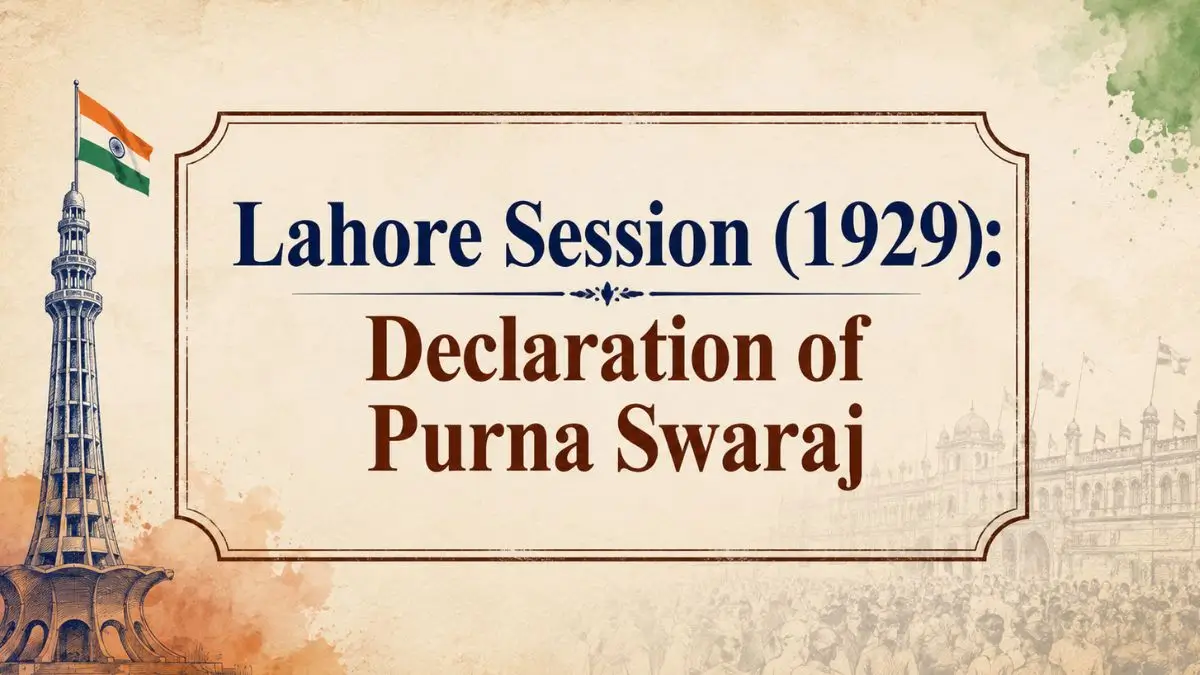
The Lahore Session of the Indian National Congress in 1929 was the turning point of India’s fight for liberation. Under the presidency of Jawaharlal Nehru, the Congress declared the goal of Purna Swaraj or complete independence of the nation from being a part of the British Empire and obtaining dominion status.
It changed the goal of the national liberation movement in India. Instead of being perceived as some sort of far possibility, independence became a definite political goal that should have been attained by means of the national liberation movement.
What Was the Lahore Declaration of 1929?
The historic session of the Indian National Congress took place in December 1929 with Jawaharlal Nehru being the Congress president.
The Congress adopted the Purna Swaraj Resolution which declared complete independence as the supreme objective of the Indian national liberation movement.
This decision marked the departure from the previous position and was a clear step to gaining independence from Britain. It paved the way for the next stage of the national liberation movement.
Moreover, at the session, the role of such tools as civil disobedience and Swadeshi were recognized in the struggle against colonialism.
Who Was the Congress President of the Lahore Congress in 1929?
The president of the Lahore Session of the Indian National Congress was Jawaharlal Nehru.
The appointment of Jawaharlal Nehru as president of the Congress signified the increasing importance of the new breed of nationalists that called for a freedom struggle that went further than dominion status to full independence.
The presidency of Jawaharlal Nehru at Lahore thus became associated with the move towards Purna Swaraj of the Congress Party.
Why Was Purna Swaraj Necessitated?
By the end of the 1920s, confidence in the process of gradual constitutional reforms had been greatly diminished.
A number of factors increased the call for complete independence. The Simon Commission of 1927, which lacked an Indian representative, led to demonstrations against it throughout the country. “Simon Go Back” became a popular slogan during those times.
Meanwhile, economic troubles started affecting the farmers and other sections of the Indian populace. The falling prices of agricultural produce, debts, and colonial taxation were the cause of the public discontent.
Combined together, politics and economics provided strong arguments for the inability of gradual reforms to solve the problem of India.
How Did the British Policy Contribute to the Requirement of Purna Swaraj?
British policy only added to the anger of the nationalists.
Viceroy Lord Irwin issued a statement in October 1929 that mentioned dominion status as the ultimate objective of India’s constitutional evolution. But several Indian nationalists found the statement inadequate since it didn’t offer the any concrete way of the self-governance.
The delays of constitutional reforms and Round Table Conferences were seen as an indication that Britain was not willing to pass on political powers.
This political environment facilitated the requirement of Purna Swaraj.
What Happened after the Purna Swaraj Resolution?
The Lahore Resolution was then followed by a huge political campaign.
The Congress made it clear that January 26, 1930, would mark Independence Day throughout India. The citizens of India were asked to proclaim their support for total independence.
It is important to note that this day marked the celebration of independence 17 years before the country became independent in 1947.
It also laid down the political base for the next stage of the national movement.
What Were the Consequences of the Declaration of Purna Swaraj for the Movement of Civil Disobedience?
After making a declaration of total independence, preparations started for a mass campaign against the British rule.
The Congress started a Civil Disobedience Movement under the guidance of Mahatma Gandhi in 1930. It is considered that Gandhi’s violation of the salt law through his march from Dandi became one of the most memorable events of this movement.
The declaration of Purna Swaraj thus had importance beyond that of a declaration of political intentions. It played an important role in creating an objective for mass disobedience.
Why January 26 was Taken as the Republic Day?
The importance of January 26 is not only in the celebration of Independence Day in 1930.
When India attained its freedom in 1947, the Constitution was adopted on November 26, 1949 but became effective from January 26, 1950.
The choice of this particular day was deliberate as a tribute to the declaration of Purna Swaraj and Independence Day of January 26, 1930.
Therefore, the Republic Day, which we celebrate today, has its historical link with Lahore Congress and demand for total independence.
Why was the Lahore Session a Turning Point?
The Lahore Session transformed the nature and language of the fight for Indian independence.
Prior to 1929, most of the constitutional discussions had revolved around the degree of self-government that could be granted to India by the British rulers. With the declaration of Purna Swaraj, the fundamental question was changed into whether or not India should continue to exist under the sovereignty of the British.
The Congress was unequivocal in its reply; complete independence was the objective of India.








 Who Is Navi Pillay? Nobel Peace Prize 20...
 Vande Bharat vs Amrit Bharat Express: Ke...
 Asian Games to LA28: Which Sports Earned...










