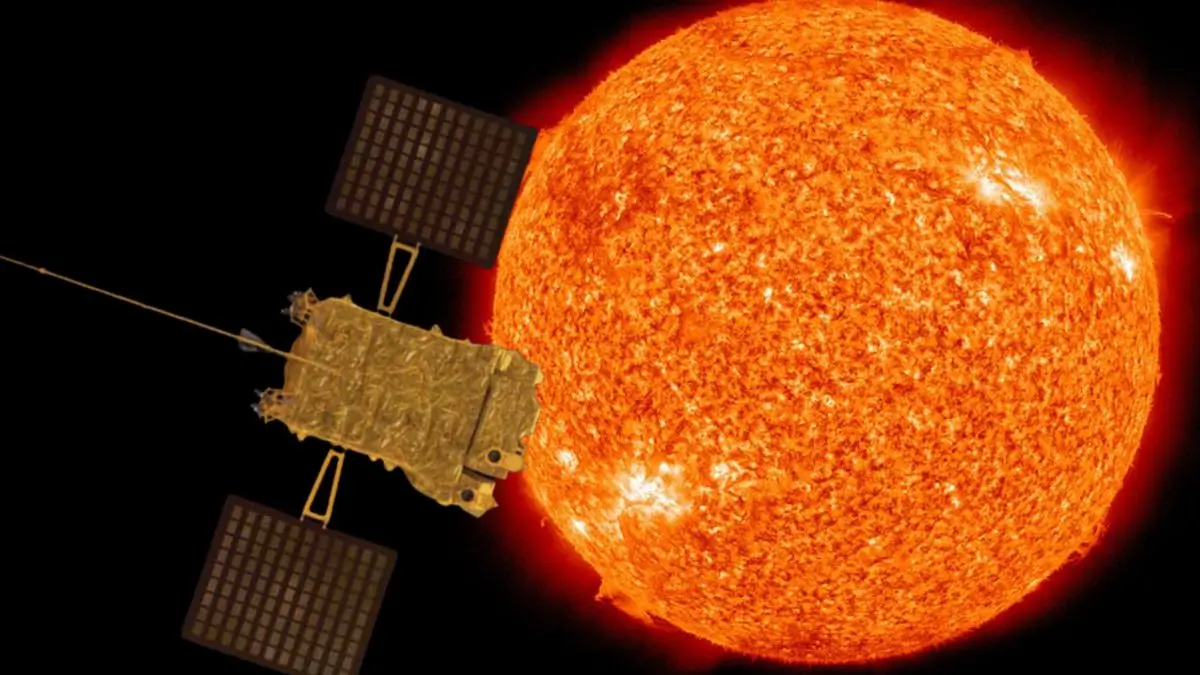
India’s first space-based solar observatory, Aditya-L1, has helped scientists understand more about how solar eruptions expand. Scientists at the Indian Institute of Astrophysics (IIA), Bengaluru, found that a coronal mass ejection (CME) spotted on 5 August 2024 had an asymmetric expansion. The finding will improve our understanding of space weather. Normally, it is assumed that these large eruptions have symmetrical expansions.
Aditya-L1 Study: Key Findings
The study was carried out by scientists from the Indian Institute of Astrophysics (IIA), an autonomous institution under the Department of Science and Technology (DST).
The scientists used,
- Aditya-L1’s Visible Emission Line Coronagraph (VELC) for spectroscopic data on the solar corona.
- NASA’s Solar Dynamics Observatory for imaging of the CME’s motion across the Sun’s surface.
- Three-dimensional modeling to help determine the geometrical and kinematic characteristics of the eruption.
- The study was published in The Astrophysical Journal Letters, under the title Spectroscopic Signatures of Nonuniform Lateral Expansion of a Coronal Mass Ejection in the Low Corona with ADITYA-L1/VELC.
What Did the Scientists Find?
The scientists looked at the coronal mass ejection on 5 August 2024 and found that there were two clear Doppler-shifted emission features on opposite sides of the coronal emission line. This showed that the plasma in the CME was expanding both towards and away from the observer.
The researchers created a 3D model to help explain their findings. They found that the asymmetric expansion could not be explained by a symmetric model, however a model that took into account an inclined CME axis and asymmetric lateral expansion created a much better fit.
This demonstrates that the CME was undergoing asymmetric expansion.
What is a Coronal Mass Ejection (CME)?
A coronal mass ejection is a large eruption of plasma and magnetic fields from the Sun’s outer layer, also known as the corona.
This releases large amounts of charged particles into space. If a coronal mass ejection heads towards Earth, it can interact with Earth’s magnetic field causing a geomagnetic storm.
This can cause problems such as,
- Issues with satellites, navigation systems.
- Issues with radio communications.
- Issues with the power grid.
- Increased risk of radiation exposure to astronauts and spacecraft.
- Issues with high frequency communications and aviation.
- The speed, direction, magnetic properties and expansion of the coronal mass ejection will affect how it may impact Earth.
VELC Used to Study Solar Eruptions
The Visible Emission Line Coronagraph (VELC) is a key scientific instrument onboard Aditya-L1. It was designed and developed by the Indian Institute of Astrophysics, Bengaluru. It received significant support from ISRO.
VELC observes the sun’s corona using spectroscopy. It specifically observes the green emission line at a wavelength of 530.3 nanometres from highly ionised iron (Fe XIV).
It uses a technique called Doppler spectroscopy.






 IndiaAI Mission Releases Indigenous AI F...
 ISRO Successfully Launches GSLV-F18 with...
 Who Is Anil Menon? NASA Astronaut Comple...