
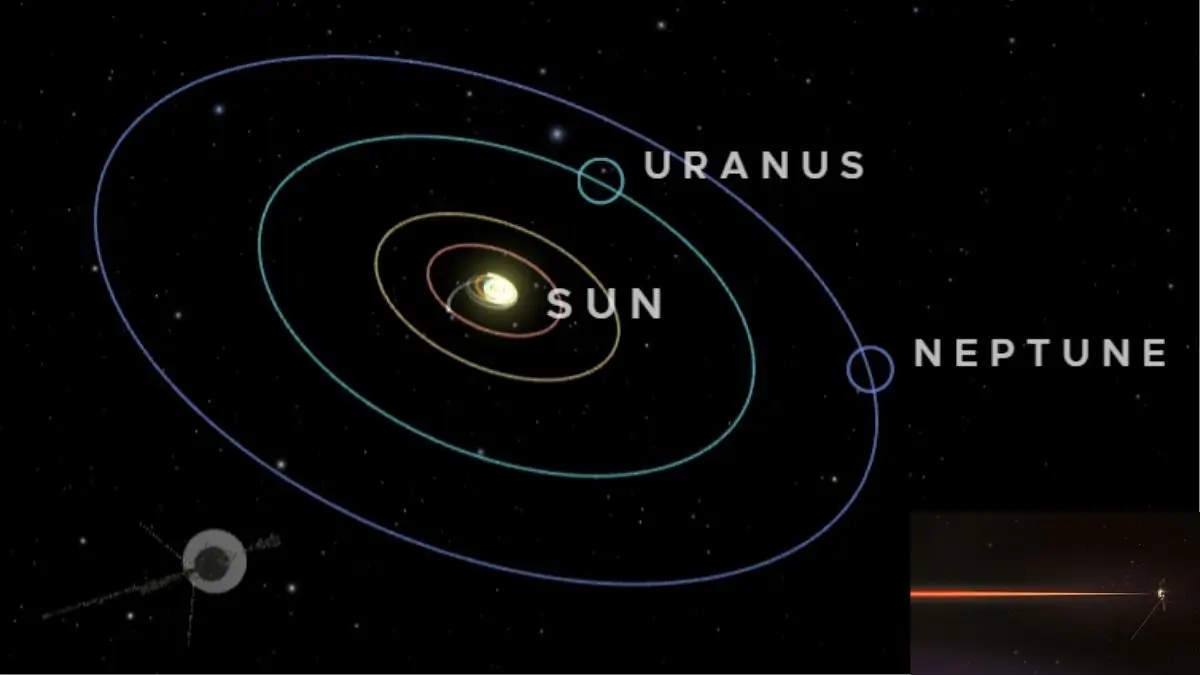
On 18 November 2026, Voyager 1 will travel one light-day from the Earth. Launched in 1977, this makes Voyager 1 the first artificial object to travel this far in space, 49 years after launch. One light day equals the distance light can travel in one day. Therefore, it is equal to approximately 25.9 billion km. If a signal is sent from Earth to Voyager 1 it will take just under a day. It will then take a further 24 hours for a signal to be sent back. This means that there is a delay of almost 2 days between sending a signal and receiving a reply from Voyager 1.
Key facts About the Mission
- Name of probe: Voyager 1
- Agency: National Aeronautics and Space Administration (NASA)
- Launch date: 5th September 1977
- Launch site: Cape Canaveral, Florida, USA
- Launch Vehicle: Titan IIIE-Centaur
- Planned For: Jupiter and Saturn
- Mission managed by: NASA’s Jet Propulsion Laboratory (JPL)
- Current mission: Voyager Interstellar Mission
- Power source: Radioisotope Thermoelectric Generator (RTG)
- Key Fact: First artificial object to reach one light-day from Earth.
What is one light day?
One light day is a measure of distance in space. It indicates how far light can travel in 24 hours.
As light can travel at 299,792km/s, one light day is approximately equal to 25.9 billion km.
Distances in space
| Distance (from Earth) | Time light takes to reach |
| Moon | 1.3 seconds |
| Sun | 8min 20s |
| Mars | 3- 22 min |
| Neptune | 4 h 10 min |
| Voyager 1 (at one light day) | 24 hours |
Note: These are approximations. Distance from Earth to Mars can vary depending on where each planet is in its orbit.
Significance of the Mission
When Voyager 1 has reached one light day from Earth,
- A signal sent from Earth will take approximately 24 hours.
- A reply will take a further 24 hours.
- Therefore, in total a communication with Voyager 1 may take up to 48 hours.
- Scientists must take this communication delay into consideration when controlling the spacecraft.
Note: Reaching one light-day from Earth is a distance, not the time taken for Voyager 1 to reach this point.
Voyager 1 and Voyager 2
Two identical probes were launched by NASA in 1977. They were sent to explore the outer planets.
Interestingly, Voyager 2 was launched before Voyager 1. It was launched on the 20th August 1977, whereas Voyager 1 was launched on 5th September 1977. Despite being launched later, Voyager 1 had the prefix ‘1’, as it was expected to reach Jupiter and Saturn before its twin.
Due to a rare alignment of planets, the gravity of one planet could be used to propel the spacecraft to another.
Comparison Between Voyager 1 and 2
| Feature | Voyager 1 | Voyager 2 |
| Launched | 5th September 1977 | 20th August 1977 |
| Jupiter encounter | 5th March 1979 | 9th July 1979 |
| Saturn encounter | 12th November 1980 | 25th August 1981 |
| Uranus encounter | N/A | 24th January 1986 |
| Neptune encounter | N/A | 25th August 1989 |
| Interstellar Space | August 2012 | November 2018 |
| One light-day | 18th November 2026 | Expected November 2035 |
About Gravitational Slingshot
- A gravitational slingshot, or gravity assist, is when the spacecraft uses the gravitational pull and movement of a planet to increase speed or change direction.
- This allows spacecraft to be sent to very far places in space with less fuel.
- Voyager 1 and 2 used gravitational slingshots during their missions. Voyager 2 was the first (and only) spacecraft to visit Uranus and Neptune.
Voyager 1 in Interstellar Space
- On 25 August 2012, Voyager 1 became the first artificial object to leave the Solar System by passing through the heliopause.
- Its twin passed into interstellar space on November 2018.
What is the Heliosphere?
- The heliosphere is a large protective bubble formed by the solar wind and magnetic field of the sun.
- The outer edge of the heliosphere is called the heliopause. This is where pressure from the solar wind outward is balanced with pressure from the interstellar medium.
- Once past the heliopause, spacecraft are said to be in interstellar space. However, this does not mean they are entirely out of the solar system.
What is the Oort Cloud?
- Beyond the known solar system lies the Oort Cloud. It is thought to consist of billions of icy objects and is considered to be the source of many long-period comets.
- According to data from NASA, provided in the report, Voyager 1 may reach the edge of the Oort Cloud in approx 300 years.
- However, passing through the Oort Cloud may take approximately 30,000 years.
- So Voyager 1 is currently in interstellar space, but has not yet passed the Oort Cloud.
Why is Voyager 1 still working after nearly 50 years?
Originally, Voyager 1 was intended to work for 5 years however, it has now been operating for nearly 50 years. This is due to careful engineering, reprogramming and power saving by engineers at NASA.
1. Radioisotope Thermoelectric Generators (RTG)
- Voyager 1 has 3 RTGs. Plutonium-238 decays and emits heat. This heat is converted into electricity.
- However, the amount of electricity generated by Voyager 1 reduces yearly by 4W, as the radioactive material decays.
2. Power Saving
- Many non-essential parts, heating elements and scientific equipment have been turned off to allow Voyager 1 to last as long as possible.
- In October 2026, it was announced that adjustments were made to help Voyager 1 save energy, meaning that its scientific equipment will last longer.
3. Remote Reprogramming
- Commands can be sent from Earth to Voyager 1. This enables engineers to make changes to Voyager 1, in order to carefully manage its limited resources.
Deep Space Network (DSN)
The Deep Space Network allows communication with spacecraft in deep space. It is a network of large radio telescopes operated by NASA across the globe. There are 3 sites,
Goldstone (USA)
- Based in California.
Canberra (Australia)
- Based in the Australian Capital Territory.
Madrid (Spain)
- Near to Madrid.
The sites are located around 120 degrees apart in terms of longitude. This allows NASA to communicate with far-off spacecraft as Earth turns.
Data and telemetry is received from spacecraft, and commands from mission control are sent using the DSN.
Golden Record
Both Voyager spacecraft have a ‘Golden Record’. This is a 12-inch gold-plated copper disc containing information about Earth and civilization to send to alien life if found.
Within the record, there is,
- Greetings in fifty-five languages
- Sounds from Earth (natural and man-made)
- 90 minutes of music
- 115 pictures showing life and civilization on Earth
- Messages from world leaders
This Golden Record was meant to be a message from humanity to the universe.
Key points of Voyager 1
Year Wise Timeline
- 1977: Launched
- 1979: Jupiter fly-by
- 1980: Saturn fly-by
- 1998: Farthest artificial object in space, surpassing Pioneer 10
- 2012: Enter interstellar space
- 2018: Voyager 2 enters interstellar space.
- 2026: Will be one light-day away from Earth.
- 2035: Voyager 2 is expected to be one light-day away from Earth.






 AIIMS Delhi Performs India’s First Ope...
 India to Develop Indigenous AI-Powered E...
 New COVID-19 Variant PJ.2.1: Symptoms, S...