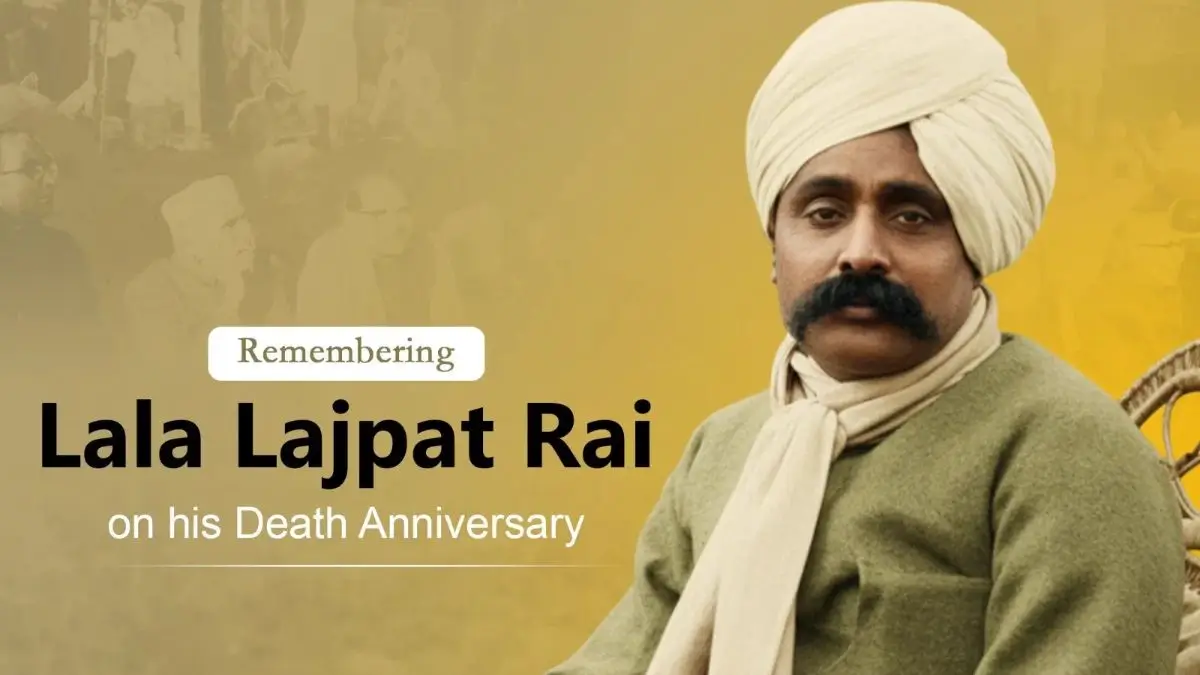
Lala Lajpat Rai (Punjab Kesari) was a prominent freedom fighter, nationalist, writer and social reformer. He was born on 28 January 1865 in Dhudike in Punjab and passed away on 17 November 1928. He is well-known for his contribution to leading the protest against the Simon Commission on 30 October 1928 in Lahore. He was one of the prominent members of the famous triad, Lal-Bal-Pal. He made significant contributions to the Swadeshi Movement, national education, journalism and establishing institutions. His death is commemorated every year on 17 November.
Who Was Lala Lajpat Rai?
He was an important figure in the Indian national movement in the late 19 th and early 20th century. He was associated with Arya Samaj and believed in strengthening national self-reliance, education and opposing British colonialism through active methods.
He was popularly known as Punjab Kesari, meaning the Lion of Punjab. He was a prominent member of the national triad along with Bal Gangadhar Tilak and Bipin Chandra Pal, popularly known as Lal-Bal-Pal.
- Full name: Lala Lajpat Rai
- Popular name: Punjab Kesari
- Date of birth: 28 January 1865
- Place of birth: Dhudike, Punjab
- Father’s name: Munshi Radha Krishan
- Mother’s name: Gulab Devi
- Political affiliation: Indian National Congress
- Ideological influence: Arya Samaj
- Famous associations: Lal-Bal-Pal
- Date of death: 17 November 1928
- Place of death: Lahore
Contribution of Lala Lajpat Rai in the Indian Freedom Struggle
Lala Lajpat Rai made an important contribution to the development of aggressive nationalism. He supported the Swadeshi Movement, national education and mobilisation against the British.
1. Lal-Bal-Pal – The National Triad
Lala Lajpat Rai, Bal Gangadhar Tilak and Bipin Chandra Pal were collectively known as Lal-Bal-Pal. They became prominent during the Swadeshi Movement after the partition of Bengal.
They advocated aggressive nationalism and supported,
- Swadeshi – Promote the use of indigenous products.
- Boycott – Reject British products and institutions.
- National Education – Encourage national education.
- Swaraj – Self-government.
This helped spread nationalist ideas outside of Bengal, particularly within Punjab and Maharashtra.
2. Opposed Partition of Bengal (1905)
- Lala Lajpat Rai opposed the announcement of the Partition of Bengal by Lord Curzon in 1905. He supported the Swadeshi Movement and Boycott Movement. He encouraged Indians to become economically self-reliant.
- His contribution helped spread the influence of the anti-partition movement to Punjab.
3. Deported to Mandalay (1907)
- Lala Lajpat Rai protested against the agrarian policies of the British in Punjab in 1907. These policies included the Punjab Colonisation Bill, heavy land revenue and irrigation.
- On 9 May 1907 Lala Lajpat Rai was deported by the British government to Mandalay, Burma (Myanmar). He was deported without a trial. After around six months, he was released.
- This became an important example of how the colonial government would use executive powers to suppress nationalist leaders.
4. Role in Non-Cooperation Movement
- Lala Lajpat Rai returned to India in 1920 and joined the national movement led by Mahatma Gandhi.
- He presided over the Special Session of the Indian National Congress in Calcutta in September 1920. This session discussed the Non-Cooperation programme. He supported the movement and the aim of Swaraj.
- During 1921-1923, Lala Lajpat Rai was imprisoned. However, he later became associated with the Swaraj Party and became involved in legislative politics.
5. Protest Against Simon Commission (1928)
- The Simon Commission was appointed by the British government in 1927. It was an inquiry into the functioning of the constitutional reforms established by the Government of India Act, 1919.
- The commission was chaired by Sir John Simon and consisted of seven British members. Since there were no Indian members, many people protested against the commission.
- When the Simon Commission arrived in Lahore on 30 October 1928, Lala Lajpat Rai led a peaceful protest march. Protesters held black flags and chanted the slogan ‘Simon Go Back’.
- During the protest, the police used lathi charge and Lala Lajpat Rai suffered injuries. He passed away on 17 November 1928, 18 days after the protest.
- This became a key symbol of resistance to colonial oppression. His death increased the anger of younger nationalists and revolutionaries.
Impact of the Death of Lala Lajpat Rai
Lala Lajpat Rai’s death had a significant impact on the Indian nationalist movement. Particularly on members of the Hindustan Socialist Republican Association (HSRA).
The revolutionaries decided to take revenge against the police actions by targeting James A. Scott, the police officer involved in the lathi charge. However, in December 1928 Bhagat Singh, Shivaram Rajguru and their associates mistakenly killed Assistant Superintendent of Police, J.P. Saunders.
This became known as the Saunders assassination. It is a key event in the revolutionary period of the Indian freedom struggle.
Historical note: In Indian nationalist and official sources it is said that Lala Lajpat Rai died due to the injuries he received during the protest. However, in the British House of Commons on 26 November 1928 it was stated that the government had found no evidence to suggest that Lala Lajpat Rai’s death was due to the injuries he received.
Other Contributions of Lala Lajpat Rai
Lala Lajpat Rai was an educator, journalist, social reformer and founder of institutions.
1. Arya Samaj
- Lala Lajpat Rai was influenced by Swami Dayanand Saraswati and became associated with the Arya Samaj in 1882.
- He supported the movement and its focus on education, social reform and self-reliance. He also worked to eliminate untouchability and social inequality.
2. Education
- Lala Lajpat Rai believed that education was key for national awakening and social development. He supported the Dayanand Anglo-Vedic (DAV) movement and helped to establish the National College in Lahore. Bhagat Singh attended this college.
3. Servants of the People Society (1921)
- In 1921 Lala Lajpat Rai founded the Servants of the People Society in Lahore. The organisation aimed to train committed individuals to serve the public. It also aimed to improve education, social and economic development.
- The organisation still operates today.
4. Banking
- He supported the development of indigenous banks to help India become economically self-reliant.
- Lala Lajpat Rai was associated with the founding of the Punjab National Bank. The bank opened in Lahore on 12 April 1895. This was a joint effort by many Indian nationalists and businessmen.
- He was also associated with the Lakshmi Insurance Company.
5. Journalism
Lala Lajpat Rai used journalism to spread nationalist ideas and comment on social, political and economic issues.
Some of his key books are,
| Book | Year | Content |
| The Story of My Deportation | 1908 | His deportation to Mandalay |
| Arya Samaj | 1915 | History and philosophy of Arya Samaj |
| Young India: An Interpretation and a History of the Nationalist Movement from Within | 1916 | Indian nationalism |
| England’s Debt to India | 1917 | British economic policies in India |
| Unhappy India | 1928 | Colonial criticism |
He also contributed to newspapers and magazines such as The Tribune and The People.
Lala Lajpat Rai and the Indian National Congress
Lala Lajpat Rai made an important contribution to the political activities of the Indian National Congress.
He contributed to,
- Supporting aggressive nationalism during the Swadeshi Movement.
- Opposing the Partition of Bengal in 1905.
- Presiding over the Special Session of the Congress in Calcutta in September 1920.
- Supporting the Non-Cooperation Movement.
- Involvement in legislative politics and debates.
- Leading the protest against the Simon Commission in Lahore in 1928.








 International Students Day 2026: Date, H...
 International Day for Tolerance 2026: Da...
 International Day of the Mediterranean D...