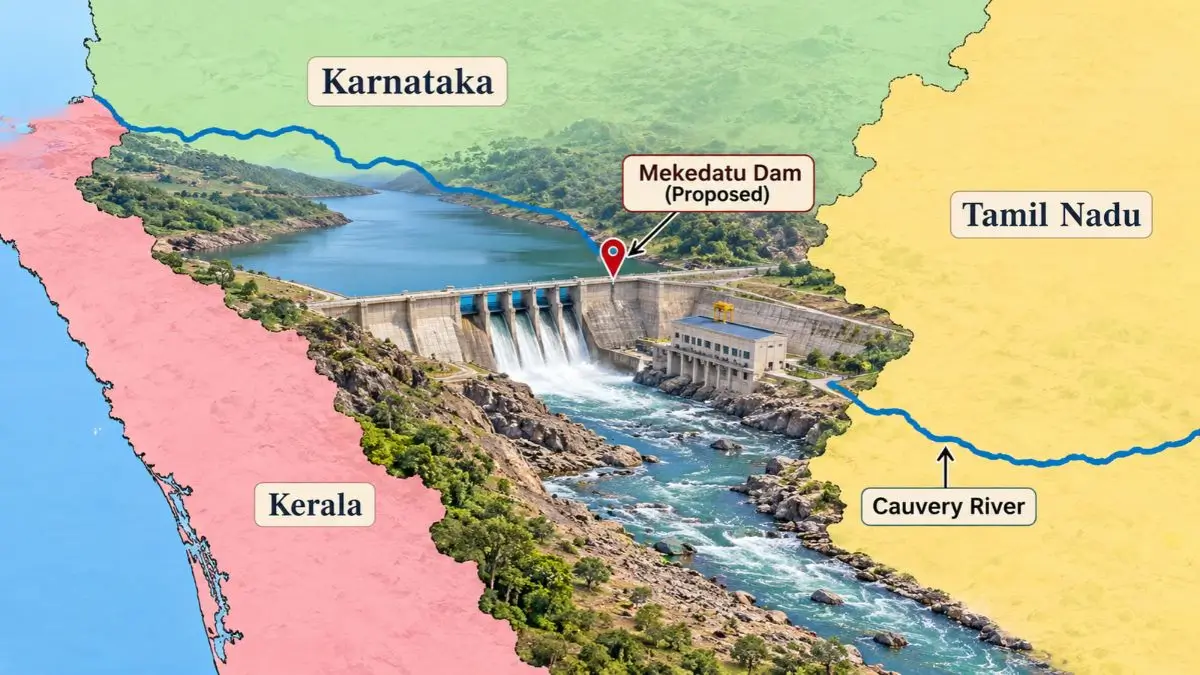
The Mekedatu Dam Project is a proposal for building a balancing reservoir and drinking water facility over the Cauvery River in Karnataka, located close to the boundary between Karnataka and Tamil Nadu. While Karnataka maintains that the construction will cater to Bengaluru’s increasing demand for drinking water, regulate flow in the river and generate hydropower, Tamil Nadu has opposed the proposal due to apprehensions about the impact on the timely availability of the river water to its agricultural zones.
What is the Mekedatu Dam Project?
The Mekedatu Balancing Reservoir and Drinking Water Project is a multi-purpose project set up by the Karnataka government.
This includes building a concrete gravity dam and reservoir at a site close to the Karnataka-Tamil Nadu border. This is being done by the Cauvery Neeravari Nigam Limited.
The term Mekedatu translates to Goat’s Leap in the Kannada language. This is due to the narrow gorges that the Cauvery River runs through.
Project Details
- Project Name: Mekedatu Balancing Reservoir and Drinking Water Project
- River: Cauvery
- Location: Close to Mekedatu, Karnataka
- Dam Type: Concrete Gravity Dam
- Dam Height: 99m
- Storage Capacity (Gross): 67.16 TMC ( Thousand Million Cubic feet)
- Storage Capacity (Live): 59.46 TMC
- Water Supply: 4.75 TMC
- Hydropower: 400MW
- Agency: Cauvery Neeravari Nigam Limited
- Estimated Cost: 9000 Crore
Note: The Gross Storage Capacity is 67.16 TMC however, this has been corrected from 16 TMC. The Live Storage Capacity is 59.46 TMC and not 75 TMC. The Water Supply is also 4.75 TMC and not 75 TMC.
Where is the Mekedatu Project Located?
The dam would be built on the Cauvery River. This would be downstream of the Arkavathi River and Cauvery River meeting point (Sangama) and upstream of the Karnataka-Tamil Nadu interstate border.
This is an important location as the reservoir would be within Karnataka but very close to the point where the river enters Tamil Nadu.
Why does Karnataka want to build the Mekedatu Dam?
There are three main reasons Karnataka wants to build the dam,
1. Provide Water Supply to Bengaluru
- With the increased urbanisation and population of Bengaluru there is increasing demand on water resources.
- Water supply would be provided to the Bengaluru Metropolitan Region and surrounding areas using 4.75 TMC of water.
2. Regulate Releases of Cauvery Water
- Karnataka claim that it would help to regulate the seasonal flow of the Cauvery. This would allow them to control the releases at Biligundlu.
- They argue that it would not impact their requirement to release the correct amount of water to Tamil Nadu.
3. Hydro Power Generation
- The project includes a proposed 400MW hydro power project. The dam would create a head difference between the river bed at Mekedatu and the river bed at Biligundlu.
- This makes the project a water supply, regulation and renewable energy project.
Why is Tamil Nadu opposed to the Mekedatu Dam?
Tamil Nadu is a low riparian state within the Cauvery basin and relies heavily on the river for irrigation purposes. They are opposed to the project due to,
- Greater control over water management. Tamil Nadu do not want a large dam in Karnataka as they feel it would give them more control over the river flow within the state.
- Impact on farmers in Cauvery delta. They are worried that changing the flow could affect farmers in the Cauvery Delta area especially if there is a poor rainfall year.
- Karnataka must ensure that the water rights given to them and the monthly release schedule are protected.
- Permission should not be granted for the project without addressing the concerns of other Cauvery basin states.
The core issue is whether the dam would be able to be operated without impacting the required releases downstream.
History of the Cauvery Water Dispute
The Cauvery Water Dispute has been a long standing dispute between Karnataka, Tamil Nadu, Kerala and Puducherry (Union Territory).
A Cauvery Water Disputes Tribunal was set up in 1990 to resolve the dispute. The tribunal issued a final award in 2007 detailing how much water each state should receive.
However, the Supreme Court ruled in 2018 that they wanted the tribunal decision changed.
Allocation of Cauvery Water (after Supreme Court ruling 2018)
| State/Purpose | Amount (Per Year) |
| Karnataka | 284.75 TMC |
| Tamil Nadu | 404.25 TMC |
| Kerala | 30 TMC |
| Puducherry | 7 TMC |
| Environmental Protection | 10 TMC |
| Inevitable Escapage to Sea | 4 TMC |
| Total | 740 TMC |
The Supreme Court also ruled that Karnataka must ensure that 177.25 TMC of water is released at Biligundlu (interstate border with Tamil Nadu) during normal water years.
Supreme Court Ruling on Mekedatu Dam Project
On 13th November 2025, the Supreme Court had also denied Tamil Nadu’s applications to challenge the Central Water Commission granting Karnataka permission to prepare the Detailed Project Report (DPR) for the Mekedatu Dam.
The Court said that Tamil Nadu’s application was premature as granting permission for a DPR would not be granting permission to build.
They noted that the DPR would need to address any objections from Tamil Nadu and go to various expert bodies including the Cauvery Water Management Authority and the Cauvery Water Regulation Committee.
Note: The Supreme Court did not grant Karnataka permission to build the Dam in 2025. The project will require the relevant technical and statutory clearances.
Recent Updates to Mekedatu Dispute (2026)
The Mekedatu issue has caused some recent political tension in November 2026.
- On 19th June 2026, Tamil Nadu passed a resolution unanimously in the Legislative Assembly stating its opposition to granting permissions for the project.
- On 27th May 2026, Tamil Nadu approached the NGT requesting that no environmental clearances be given until the interstate issues are resolved.
- On 3rd August 2026, Tamil Nadu filed a writ petition to the Supreme Court regarding the guidelines issued by the Center in December 2025 for preparing DPRs for irrigation and multipurpose projects in the Cauvery basin.
- On 6th of November 2026 Tamil Nadu’s Chief Minister C. Joseph Vijay sent a letter to the Prime Minister Narendra Modi requesting that the Center not grant the permissions without addressing the concerns of downstream states.
- Finally, on 13th November 2026, Tamil Nadu’s Water Resources Minister N. Anand stated again that they will oppose the building of the dam. However, Karnataka’s Deputy Chief Minister D.K. Shivakumar is pushing hard for the project to go ahead and requested the Center’s help to obtain the remaining clearances.
This shows that the dispute is ongoing and both states have different opinions.
Environmental Concerns
The new dam has raised concerns regarding loss of forest and biodiversity in the Cauvery basin.
The project will involve submerging around 4996 hectares of forest, wildlife and revenue land. Major Environmental concerns include,
- Loss of forest and wildlife.
- Impact on Cauvery Wildlife Sanctuary.
- Disruption to Elephant Corridors.
- Changes to river ecosystem and aquatic habitat.
- Resettlement and rehabilitation of affected settlements.
The project will require detailed environmental analysis and the relevant forest and wildlife clearances.








 Odisha Cabinet Approves Bovine Breeding ...
 Noida Metro Aqua Line Extension Approved...
 Shigella Outbreak in Kerala: Cases Repor...