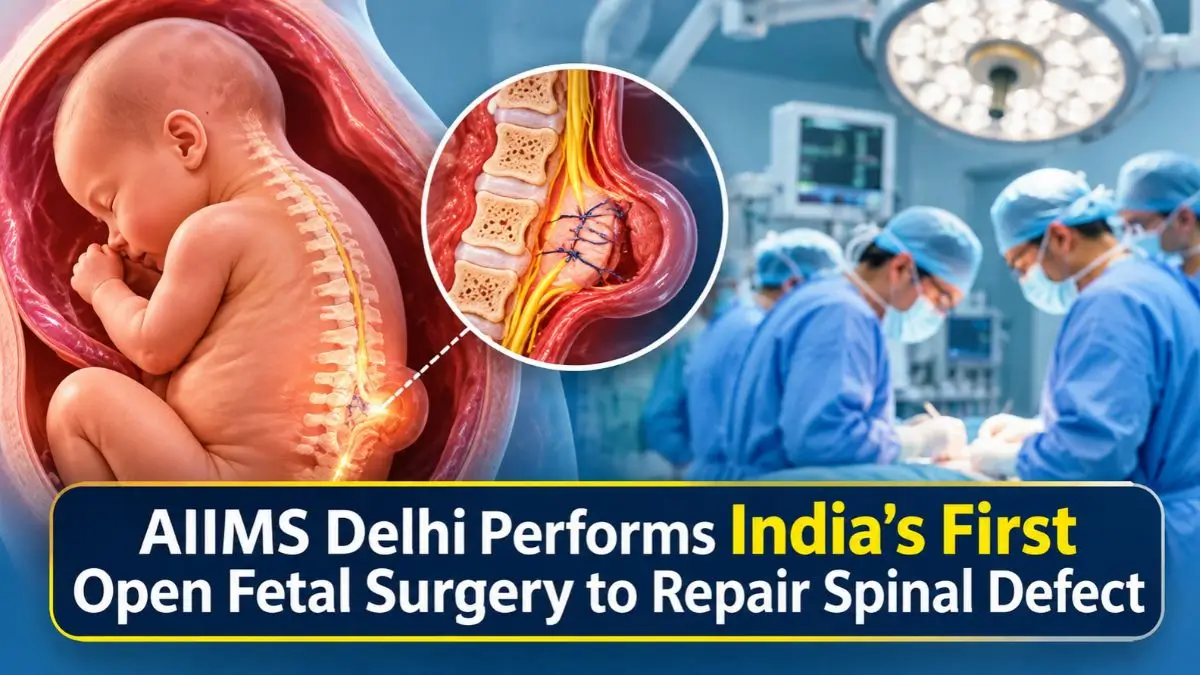
Doctors at the All India Institute of Medical Sciences (AIIMS) in New Delhi have completed India’s first open fetal surgery, to repair a severe spinal abnormality in a foetus. The surgery, completed on the 12th November 2026, lasted six hours and repaired the myelomeningocele – a severe form of spina bifida – whilst the patient was 25 weeks pregnant. This is an important milestone in developing fetal speciality medicine and surgery within India.
Overview of India’s First Open Fetal Surgery
A lumbosacral myelomeningocele – an abnormality affecting the lower area of the spinal column was repaired at the AIIMS Neurosciences Centre.
The surgery includes the details about,
- 12th November 2026.
- 25 week gestation period
- 6 hours long sergery
- With the assistance of over 30 doctors, clinicians and nurses.
Utilising high-end microscopes and continuous ultrasound guidance.
The surgery was completed after several weeks of preparation. A detailed fetal scan was completed, alongside counselling, anaesthetic planning and simulation. Doctors from specialist backgrounds were present including neurosurgery, maternal fetal medicine, obstetricians, anaesthetists, plastic surgeons, radiodiagnosticians and neonatologists.
The mother and child will continue to be monitored closely by a multidisciplinary team throughout the remainder of their pregnancy, labour and postnatal period. The surgery was free of charge as part of the Government’s Janani Shishu Suraksha Karyakram (JSSK).
What is myelomeningocele?
Myelomeningocele is the most severe form of spina bifida – a birth defect caused by incomplete closing of the neural tube during early embryonic development.
The neural tube forms the brain and spinal cord. If the lower part of the neural tube doesn’t properly close a gap can occur in the spinal column. This causes the spinal cord and surrounding meninges to protrude in myelomeningocele.
Serious complications can include,
- Paralysis/weakness – Damaged nerves in the spinal cord can cause issues with movement, often affecting the legs.
- Bladder and Bowel issues – Damaged nerves can cause issues with bladder and bowel control.
- Hydrocephalus – Too much cerebrospinal fluid builds up in the brain and sometimes a shunt needs to be placed.
- Further neurological complications – Some children may need long term treatment, rehabilitation and specialist care.
How severe the issue is depends on where and how severe the spinal abnormality is.
Why did they operate before birth?
Myelomeningocele is traditionally repaired after birth. However, the exposed spinal cord and nerves can be damaged further during pregnancy.
Open fetal surgery allows the doctor to close the spinal abnormality during pregnancy. This protects the exposed neural tissue.
This is backed up by many studies from the US. One being the Management of Myelomeningocele Study (MOMS). This was a clinical trial to compare prenatal surgery versus post-natal surgery.
The trial found that prenatal repair reduced the need for a shunt for hydrocephalus. However, there were increased risks including preterm birth and complications with the mother’s uterus.
This means that fetal surgery isn’t a cure and can only be offered to selected pregnancies. Children may still need further treatment, rehabilitation and long term medical care.
Why is this an important achievement in India?
This shows an improvement in advanced fetal treatments available within India. Previously families may have had limited access to treatments of this nature.
This is important for,
- Advanced fetal medicine – Demonstrates that an Indian public hospital can offer complex pre-birth surgery.
- Multidisciplinary care – Required a team of specialists from many different medical backgrounds.
- Affordable specialist treatment – Treatment was free of charge under JSSK, showing the importance of public hospitals in providing advanced medical care.
This can allow further development of fetal surgery and specialist treatment within India.
Prevention of Neural Tube Defects
Whilst fetal surgery can help manage some birth defects, prevention is still very important. Neural tube defects happen very early in pregnancy and often before a woman knows she is pregnant.
- Folic acid (vitamin B9) is an important part of neural tube development.
- The Comprehensive Emergency Obstetric and Newborn Care (CEmONC) curriculum by the National Health Mission recommends:
- Take 400 micrograms (mcg) of folic acid a day.
- This should be continued until 12 weeks into pregnancy.
- Women with risk factors such as a previous pregnancy with neural tube defects should take higher amounts of folic acid, with medical advice.
This can reduce neural tube defects by nearly 75%. The World Health Organisation also recommend taking 400 mcg of folic acid per day from conception until 12 weeks of pregnancy.








 RBI Cancels Registrations of 49 NBFCs; 1...
 Trust in a Time of Crisis: Sucheta Dalal...
 India's Wholesale Inflation Rises to 12....