
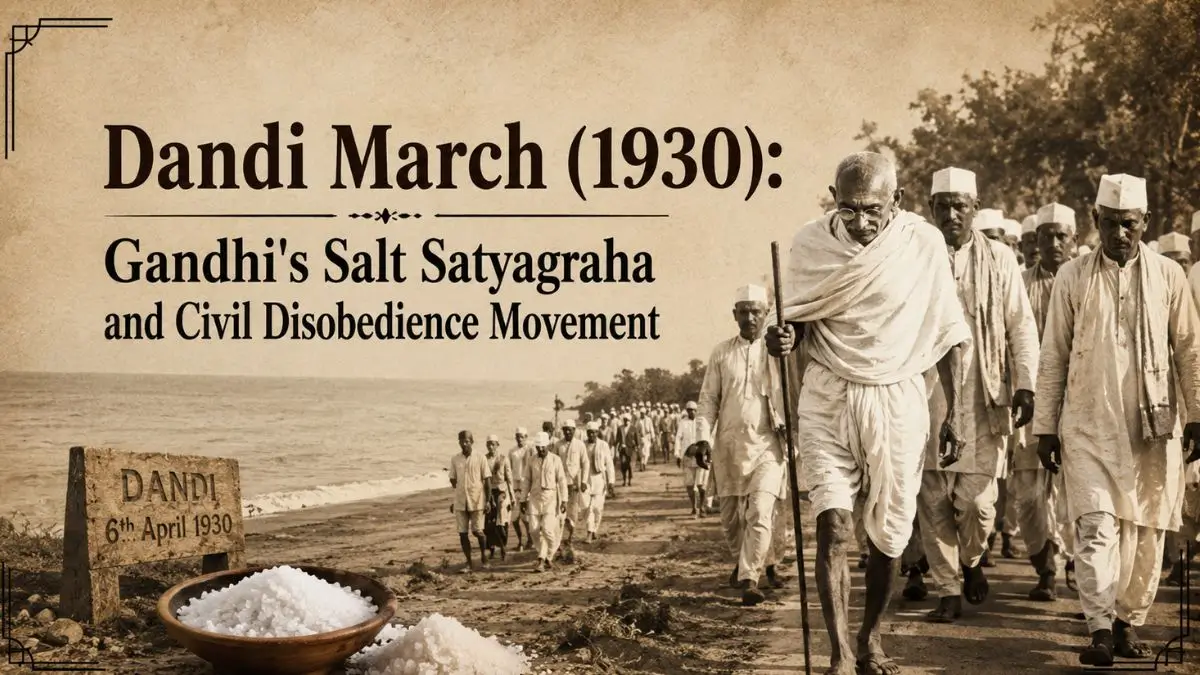
The Civil Disobedience Movement (1930-1934) is one of the biggest mass movements of the Indian freedom struggle. Initiated and led by Mahatma Gandhi, the movement marks a very important transition from constitutional protest to non-violent breaking of laws of colonial regime. The Civil Disobedience Movement came into existence on the demand of Purna Swaraj (Complete Independence) with Dandi March and Salt Satyagraha as its opening acts.
This movement increased the social scope of the national struggle by including farmers, women, students, traders, workers and tribals in it. Though it did not lead to complete independence immediately, it challenged the very moral standing of British rule over India.
Background of the Civil Disobedience Movement
The seeds of the Civil Disobedience Movement lie in the political situation that existed in the late 1920s. Simon Commission, formed in 1927 without even an Indian member in it, created a lot of opposition. The slogan “Simon Go Back” was a symbol of Indian defiance.
The demand of Dominion Status was accepted in principle by Congress at its Calcutta Session of 1928, but Congress gave some time limit to the British to accept it. While in his declaration of October 1929, Viceroy Lord Irwin gave no clear indication regarding Dominion Status.
But all this changed at the time of Lahore Session of 1929 chaired by Jawaharlal Nehru when Congress adopted Purna Swaraj as its goal and decided to start a civil disobedience campaign.
Eleven Points Put Forward By Gandhi
Before organizing this struggle, Gandhi made eleven demands to the viceroy, Lord Irwin. These included,
- Reforming the rupee-sterling exchange rate
- Reducing land revenue
- Abolishing the salt tax and the salt monopoly of the Government
- Reducing the military expenditure
- Release of all political prisoners
- Reforms in riminal Investigation Departmen
- Promote the Indian textiles
- Ban on the Intoxicants
- Reserving coastal shipping for Indians
- Popular control over firearm licenses
- Acceptance of the Postal Reservation Bill
As the British Government refused to accept these demands, Gandhi took the decision to start civil disobedience.
Dandi March: Start of the Salt Satyagraha
Gandhi chose salt as the issue deliberately because salt is an essential commodity used by the rich and poor alike. Therefore, the salt monopoly and the salt tax gave him a strong issue on which people of all classes could rally.
On 12 March 1930, Gandhi started the famous Dandi March from Sabarmati Ashram of Ahmedabad along with 78 selected volunteers.
After walking about 390 km, Gandhi and his party reached Dandi on 5 April 1930. On 6 April 1930, Gandhi defied the law of the salt tax by making salt from seawater. This was the starting point of the Civil Disobedience Movement.
Main Types of Civil Disobedience
The campaign gained ground in various regions of India, taking diverse shapes,
- Production of salt illegally
- Failure to pay specific taxes
- Breaches of forest rules
- Non-purchase of foreign clothing
- Picketing establishments selling alcohol
- Non-attendance of British educational institutions
- Voluntary quitting of official positions
- Campaigns for no rent and revenue payment
This campaign stood on the principles of truth, non-violence, and violation of the unjust colonial laws
Spread of the Movement Across India
| Region | Major Leader(s) | Important Activity |
| Tamil Nadu | C. Rajagopalachari Vedaranyam | Salt Satyagraha |
| Tamil Nadu | Malabar K. Kelappan, P. Krishna Pillai | Salt marches and anti-liquor campaigns |
| Bengal | Subhas Chandra Bose, J.M. Sengupta | Salt Satyagraha and anti-chowkidari tax agitation |
| Peshawar | Khan Abdul Ghaffar Khan | Khudai Khidmatgar mobilisation |
| Dharasana | Sarojini Naidu and others | Dharasana Salt Works Satyagraha |
| Bardoli and Kheda | Vallabhbhai Patel | No-tax and land-revenue campaigns |
| United Provinces | Jawaharlal Nehru | No-revenue and no-rent campaigns |
| Bihar | Ambika Kant Sinha and others | Salt Satyagraha and chowkidari tax resistance |
| Odisha | Gopabandhu Choudhury | Coastal salt Satyagraha |
Other Social Groups
Another key aspect of the movement was the involvement of other social groups in it.
Women were an active part. They took part in processions and picketed liquor shops, opium houses and foreign cloth shops. Leaders like Sarojini Naidu became prominent in the movement.
Peasants took part in no-revenue and no-rent movements while students staged strikes, demonstrations and boycotts.
Industrial and business classes, especially sections of Indian businessmen and industrialists, participated in the movement in its early stage by way of donating funds and promoting the use of swadeshi products.
Yet Muslims and Dalits participated less in it than Congress had expected.
Gandhi-Irwin Pact, 1931
The negotiations between Gandhi and Viceroy Lord Irwin marked the end of the first phase of the movement.
Gandhi-Irwin Pact was signed on 5 March 1931. The key terms of the pact were as follows,
- Release of political prisoners not involved in violent acts
- Withdrawal of ordinances concerning the movement
- Allowing Indians to make salt for personal consumption in coastal areas
- Restoration of property seized wherever possible
- Agreement of Congress to call off the Civil Disobedience Movement
- Gandhi’s participation in the Second Round Table Conference
Second Stage and Final Withdrawal
Gandhi had participated in the Second Round Table Conference held in London in 1931, but it did not come up with any agreement that was acceptable to Congress.
On his return to India, Gandhi continued the Civil Disobedience Movement which was answered with arrests, censorship, seizures of properties, and many other means of oppression on the part of the government.
Gandhi was arrested in January 1932, and the movement began to weaken under extreme government oppression.
The movement was temporarily suspended by Gandhi in May 1933 and was finally withdrawn in April 1934.
Importance of Civil Disobedience Movement
There were several reasons behind the importance of the Civil Disobedience Movement,
- Raised the demand for Purna Swaraj – Complete Independence was the political slogan.
- Increased mass participation – A large number of peasants, women, students, traders and other sections joined the movement.
- Questioned British authority – Violation of the British laws proved that their authority could be challenged.
- Highlighted non-violence – The power of non-violent organization was shown by this movement.
- Increased participation of women – Women participated in political activity in an unprecedented manner.
- Internationalized the Indian struggle – The incidents like the Dandi march drew international attention.
- Undermined colonial legitimacy – The authority of the British government rested on coercion rather than consensus.
- Strengthened the Congress – The Congress became the most important organization of the nationalist movement.








 Who Is Navi Pillay? Nobel Peace Prize 20...
 Vande Bharat vs Amrit Bharat Express: Ke...
 Asian Games to LA28: Which Sports Earned...










