
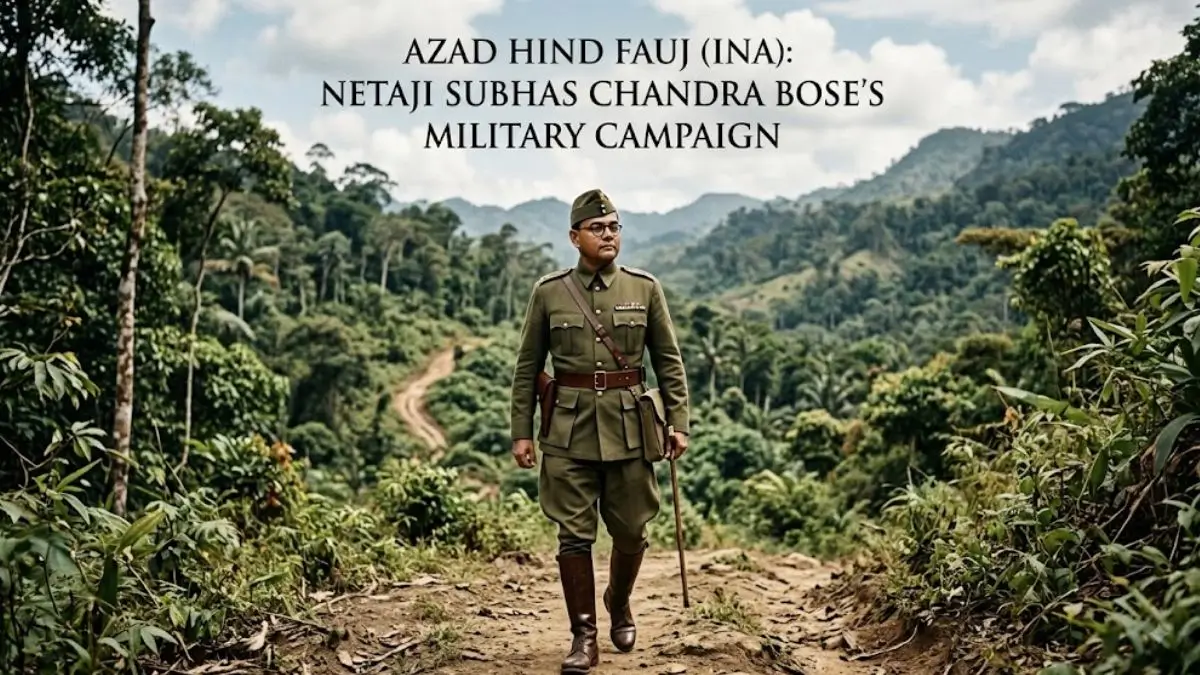
The Indian National Army (INA), or Azad Hind Fauj, emerged as one of the most remarkable stories in the history of India’s freedom struggle during the Second World War. With Netaji Subhas Chandra Bose as its leader, the INA sought to free India by means of armed revolution against British rule. Though the military efforts of the INA were futile, its nationalism ideology, diverse composition and subsequent trials of the INA members generated strong anti-British sentiments and helped weaken the colonial rule.
Origin of the Indian National Army
The first INA was established in September 1942 under Captain Mohan Singh with Indian prisoners of war captured by the Japanese after the fall of Singapore. It consisted of about 12,000 Indian soldiers with the aim of fighting for the independence of India.
However, differences between Mohan Singh, Indian Independence League and the Japanese government regarding the use of Indian soldiers led to the collapse of the first INA at the end of 1942.
Revival of the INA by Subhas Chandra Bose
The INA got a fresh lease of life with the arrival of Subhas Chandra Bose in Singapore in July 1943. He took command of the organisation and rebuilt it into a more patriotic military organisation.
It was Bose’s mission to utilise the Second World War to wage a war against British rule. The INA under him managed to recruit soldiers and civilians from all of South-East Asia.
Some of its notable nationalistic concepts included,
- “Jai Hind” as the national salute
- “Ittefaq, Etemad, Qurbani” as its motto
- The Rani of Jhansi Regiment, comprising women soldiers
- Regiments bearing names of nationalistic figures including Gandhi, Nehru and Azad
Captain Lakshmi Swaminathan (Lakshmi Sahgal) was the commander of the Rani of Jhansi Regiment.
Military Operations of the INA
The military operations of the INA were in association with Japanese forces in the campaigns of Burma and northeast India. The operations of the INA in 1944 involved assisting the Japanese troops in their operation towards Imphal and Kohima.
The operations were meant to invade India and inspire rebellion against the British rule. The military defeats of the Japanese, shortage of supplies and difficulties in terrain and the defeat of Japan marked the end of the campaign.
Therefore, the military goal of the INA to invade Delhi and overthrow British rule was not achieved.
Trial of the INA and Red Fort
The greatest political impact of the INA was made after the end of the Second World War.
During 1945-46, there were trials of some senior officers of the INA in the Red Fort of Delhi. These trials included,
- Shah Nawaz Khan
- Prem Sahgal
- Gurbaksh Singh Dhillon
Among the charges for which they were to be tried were those of waging war against the King and the rest were connected with their activities in the war.
These trials created great public sympathy. Indian National Congress had constituted an INA Defence Committee to defend the accused officers. Among the lawyers who argued on behalf of the accused officers were,
- Bhulabhai Desai
- Asaf Ali
- Tej Bahadur Sapru
- Kailash Nath Katju
Impact of the INA in India’s Freedom Struggle
The significance of the INA reached beyond the battles they fought in.
1. Promoted National Unity
INA united Indians from all religions, regions and communities under the banner of nationalism.
2. Fueled Armed Revolt Against the British
It showed the readiness of Indians to oppose the British with weapons.
3. Led to Mass Support
The trials of the INA soldiers led to mass demonstrations in their favor.
4. Led to Unrest in the Armed Forces
The nationalist environment created during the INA trials became one of the reasons of unrest in the colonial armed forces like the Royal Indian Navy Mutiny in 1946.
5. Forced Britain to Reconsider Its Position in India
Nationalist principles and weakening confidence in the loyalty of the Indian troops made it harder for the British government to maintain their control over India.
Significance of INA Trials Even After the Failure of Their Armed Struggle?
The INA was not able to defeat the British forces militarily, but the significance of their actions reaches beyond this.
Under the guidance of Bose, the struggle for independence of India got a powerful ideological weapon of armed struggle, self-sacrifice and national unity. Diversity of the ranks and women fighters of the INA challenged communal and regional divisions.
Participation of women in the struggle for India’s freedom through the Rani of Jhansi Regiment expanded the perception of the fighters for India’s independence.
The subsequent trials of the soldiers of the INA made it into a national political issue.








 Dussehra 2026: Top 30 Most Important GK ...
 Dussehra and UNESCO: Ramlila, Durga Puja...
 Mysuru Dasara 2026: History, Jamboo Sava...










