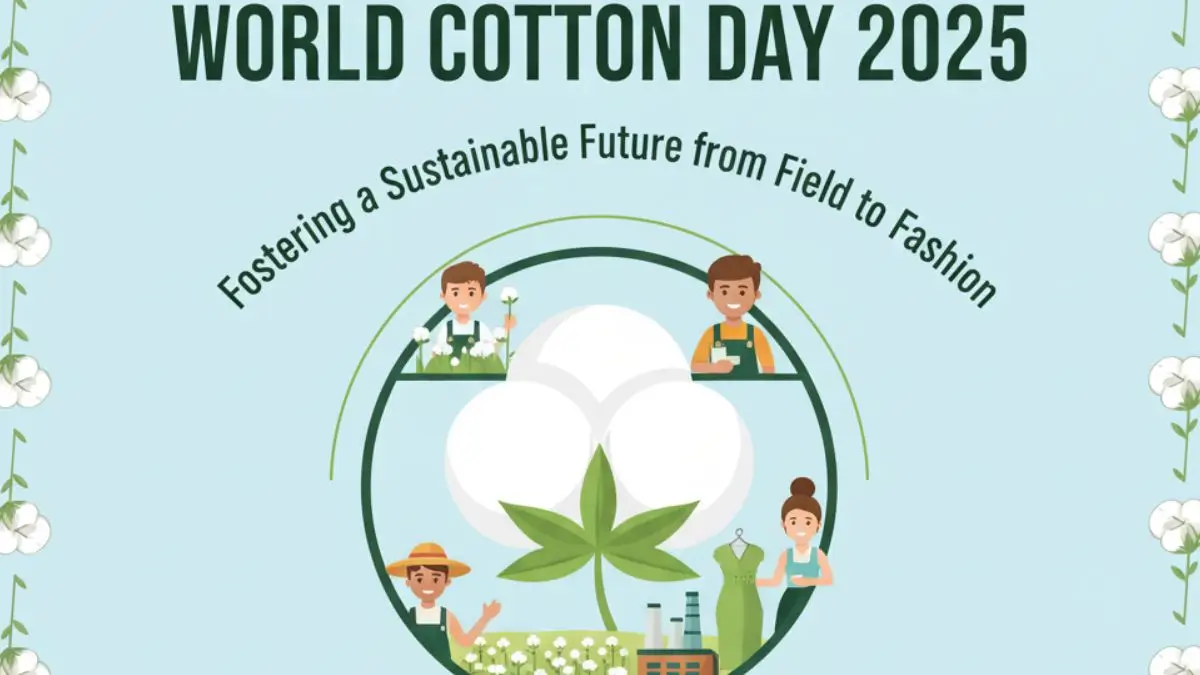
World Cotton Day, celebrated annually on October 7, is a global observance that recognizes the economic and social significance of cotton, particularly for least-developed countries (LDCs). It underscores cotton’s critical role in employment, trade, and sustainable development across five continents. First launched in 2019, the day is now officially recognized by the United Nations and serves as a platform to promote inclusive trade policies, sustainable cotton production, and equitable participation of developing nations in the global cotton value chain.
Global Significance of Cotton
Cotton is cultivated in more than 75 countries across five continents, making it one of the most widely grown agricultural commodities in the world. Beyond its direct use in textiles, cotton,
- Supports the livelihoods of millions, especially in rural areas
- Provides a source of income for smallholder farmers
- Drives export earnings and economic stability for cotton-producing nations
- Enables the development of cotton by-products, like cottonseed oil and feed
Cotton remains a strategic crop in global agricultural and trade policy, impacting both food security and economic diversification in many regions.
Official Recognition by the United Nations
On 30 August 2021, the UN General Assembly formally designated 7 October as World Cotton Day, following a proposal by the Cotton-4 countries: Benin, Burkina Faso, Chad, and Mali, later joined by Côte d’Ivoire. The UN resolution A/RES/75/318 acknowledges cotton’s value in,
- Supporting millions of jobs across the supply chain
- Providing subsistence to vulnerable rural populations
- Promoting sustainable agriculture and development in LDCs
This recognition marked a historic milestone, giving global visibility to cotton-producing countries and enabling enhanced multilateral support for the sector.
World Cotton Day Celebrations
The first World Cotton Day was celebrated on 7 October 2019, spearheaded by the World Trade Organization (WTO) in Geneva. Over 800 global participants attended, including,
- Ministers and policymakers
- UN agencies: FAO, UNCTAD, ITC, ICAC
- Cotton producers, traders, and researchers
- Representatives from international brands, retailers, and development partners
The event served as a knowledge-sharing platform to promote cotton-based innovations, showcase products, and push for policy reforms supporting fairer trade for developing nations.
Since then, annual celebrations have focused on,
- Encouraging sustainable cotton farming
- Promoting value addition and processing in LDCs
- Bridging gaps between producers and global markets
- Highlighting the role of cotton in climate resilience
Cotton and the Sustainable Development Agenda
World Cotton Day aligns with multiple UN Sustainable Development Goals (SDGs), such as,
- SDG 1 (No Poverty) – by boosting rural incomes
- SDG 8 (Decent Work & Economic Growth) – through job creation in agriculture and industry
- SDG 12 (Responsible Consumption & Production) – by advocating for environmentally responsible cotton use
- SDG 13 (Climate Action) – as cotton farming adapts to climate challenges through innovation
Efforts are also underway to reduce trade barriers, build local processing capacity, and support gender-inclusive participation in the cotton sector.


 List of Important Days in April 2026, Na...
 Utkal Divas 2026 Odisha: Formation Day H...
 Mahavir Jayanti 2026: Why Lord Mahavir’s...