
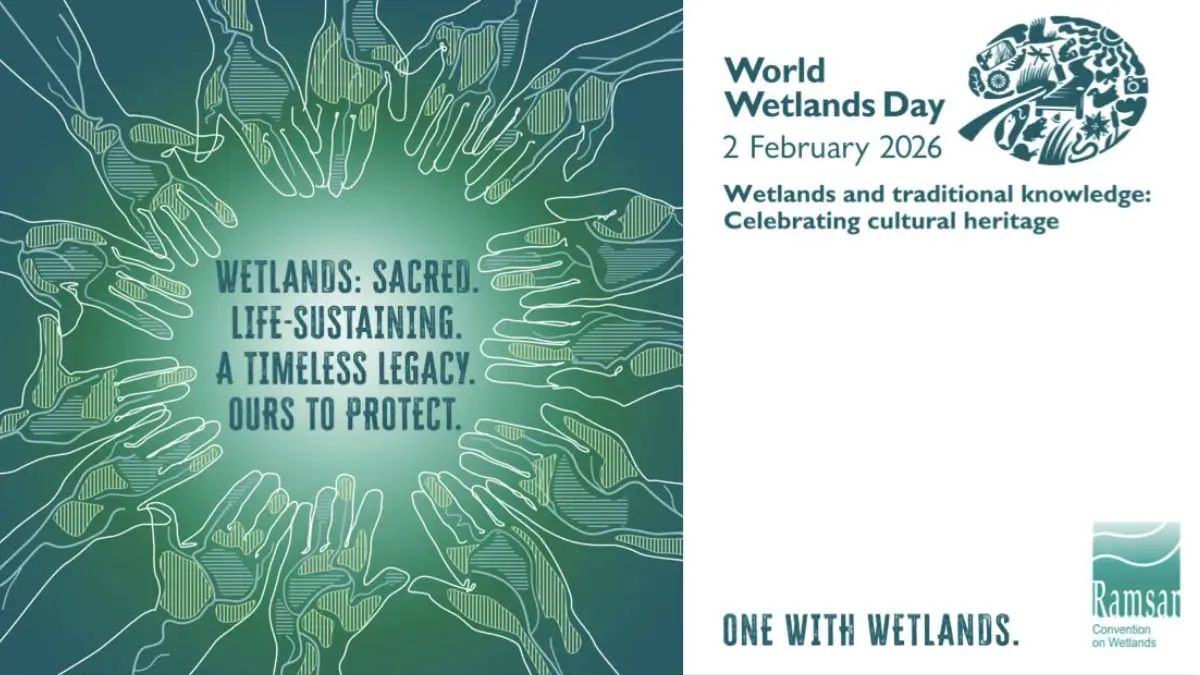
World Wetlands Day 2026 is being observed on 2 February with a renewed focus on culture and community wisdom. This year’s global theme draws attention to how traditional and indigenous knowledge has protected wetlands for centuries. While wetlands are vanishing rapidly due to modern development and climate stress, local communities continue to manage them sustainably using age-old practices. The 2026 observance reminds policymakers that science and tradition together can safeguard wetlands, which are essential for biodiversity, water security, and millions of livelihoods worldwide.
What Is World Wetlands Day
- World Wetlands Day is celebrated annually on 2 February to mark the signing of the Ramsar Convention in 1971 at Ramsar in Iran.
- The day aims to raise awareness about wetlands such as lakes, marshes, mangroves, floodplains, and lagoons.
- These ecosystems provide clean water, reduce floods, store carbon, and support rich biodiversity.
- Despite their importance, wetlands are often ignored in development planning. World Wetlands Day serves as a reminder that protecting wetlands is directly linked to human survival and sustainable development.
Theme of World Wetlands Day 2026 Explained
- The 2026 theme, “Wetlands and Traditional Knowledge: Celebrating Cultural Heritage,” focuses on the role of indigenous peoples and local communities in wetland conservation.
- For generations, fishing communities, pastoral groups, and forest dwellers have managed wetlands through sustainable harvesting, seasonal use, and cultural restrictions.
- These practices ensured ecological balance without modern technology.
- The theme recognises that traditional knowledge is not outdated but highly relevant in today’s climate crisis.
- It also promotes respect for cultural heritage while framing conservation as a people-centred approach rather than a purely administrative one.
Ramsar Convention and Community Participation
- The Ramsar Convention is a global treaty dedicated to the conservation and wise use of wetlands.
- With more than 170 contracting parties, it encourages countries to protect wetlands while allowing sustainable livelihoods.
- One key principle of the convention is “wise use,” which aligns closely with traditional practices.
- As of 2025, there are over 2,500 Ramsar sites worldwide, covering more than 250 million hectares.
- Increasingly, the convention stresses community involvement, recognising that conservation efforts succeed best when local people are active stakeholders rather than passive beneficiaries.
Wetlands in India and Cultural Linkages
- India hosts 98 Ramsar sites, the highest number in South Asia, covering about 1.35 million hectares.
- Indian wetlands are deeply connected to culture, religion, and livelihoods.
- The Chilika Lake supports traditional fishing communities, while the Sundarbans Wetland sustains livelihoods through honey collection and fishing.
- From boat festivals to sacred lakes, Indian wetlands are living cultural landscapes. This makes India especially relevant to the 2026 theme.
Categories of Wetlands in India
- India’s wetlands are broadly classified into eight categories, including Himalayan lakes, Gangetic floodplain marshes, Deccan plateau reservoirs, coastal lagoons, mangroves, saline wetlands, northeast swamps, and island ecosystems. Each category has evolved with local knowledge systems adapted to climate, terrain, and water availability.
- Traditional water harvesting in arid regions and seasonal fishing bans in floodplains show how communities historically protected wetland health while meeting their needs.
Wetland (Conservation and Management) Rules, 2017
- The Wetland (Conservation and Management) Rules, 2017 provide the legal framework for wetland protection in India.
- They require states to identify wetlands, restrict polluting activities, and prepare management plans.
- Importantly, the rules encourage community participation, aligning well with the 2026 theme.
- However, implementation gaps remain due to weak enforcement and competing development interests.
- Integrating traditional knowledge into formal governance can improve compliance and conservation outcomes.
Key Summary at a Glance
| Aspect | Details |
| Why in News? | World Wetlands Day 2026 observed with focus on traditional knowledge |
| Theme 2026 | Wetlands and Traditional Knowledge: Celebrating Cultural Heritage |
| Global Treaty | Ramsar Convention, 1971 |
| India’s Status | 98 Ramsar sites, highest in South Asia |
| Legal Support | Wetland (Conservation and Management) Rules, 2017 |
Question
Q1. The theme of World Wetlands Day 2026 is:
A. Wetlands for sustainable cities
B. Protecting wetlands for our common future
C. Wetlands and Traditional Knowledge
D. Wetlands and climate finance


 International Day for Mine Awareness 202...
 Good Friday 2026: Date, History, Meaning...
 World Autism Awareness Day 2026: Underst...











