
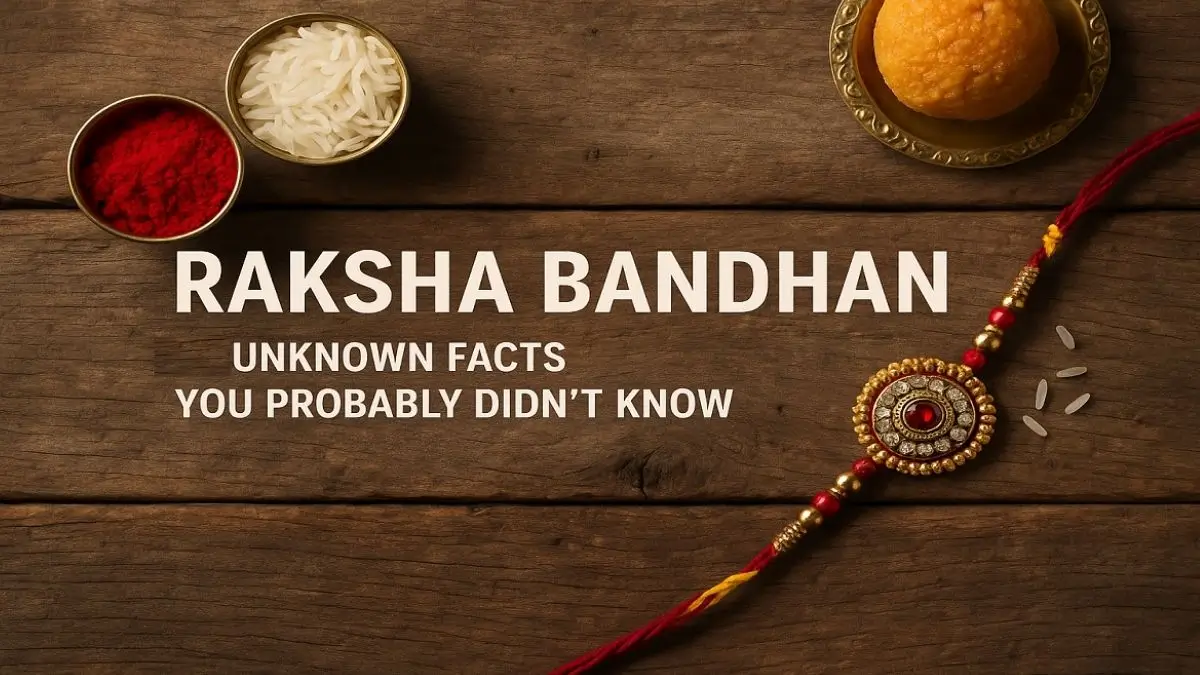
Raksha Bandhan is that festival where sisters tie rakhis around their brothers wrists, exchange sweets and renew their bond. However, there are many more stories and facts behind the festival of Raksha Bandhan. Celebrated on the Shravana Purnima, the festival is related to ancient protective threads, legends in Hinduism and local traditions. It even became a part of modern Indian history through the use of rakhis as a sign of unity by Rabindranath Tagore during the Partition of Bengal of 1905.
15 Interesting Facts About Rakshabandhan
1. Raksha Bandhan Falls on the Full Moon Day of Shravana Month
Raksha Bandhan is celebrated on the full moon day or Purnima of the Shravana month in the Hindu calendar.
In 2026, the festival will be celebrated on Friday, August 28. The Purnima tithi starts on Thursday, August 27, and ends on Friday, August 28.
2. The Festival’s Name Is a Symbol of Protection and Bond
Words ‘raksha’ and ‘bandhan’ mean ‘protection’ and ‘bond’ or ‘tie’.
It shows that the festival focuses on the bond of affection, duty and wellbeing.
Though the festival is now mainly associated with brothers and sisters, the concept of a protective thread was used in various religions and cultures throughout history.
3. The Festival Has No Official Historical Origins
There is no widely known historical event which can be considered as the origin of the modern festival of Raksha Bandhan.
Various legends, religious rituals and local traditions related to the festival have developed for many centuries, so individual stories should not be regarded as its origins.
4. Krishna and Draupadi Are Connected with Raksha Bandhan
The legend about Krishna and Draupadi is one of the best-known legends about Raksha Bandhan.
According to the popular version of the story, Draupadi tore her sari to cover Krishna’s injured finger and he promised her protection in return.
It shows how the simple gesture of compassion leads to a long-lasting bond between two people.
5. Rakhi Has a History of Older Tradition
There is nothing new about the concept of protective thread, rakhi, that a sister ties around her brother during the Raksha Bandhan festival.
There is older tradition of using protective threads/raksha sutras for various religious purposes as well. For instance, one of the traditions connects raksha suture to Indra and Indrani.
6. Tagore Made Use of Rakhi as a Symbol of Unity
The most interesting moment in the modern history of Raksha Bandhan came to life in 1905, when the Partition of Bengal occurred under the British rule.
Tagore did not agree with the partition and urged people to make use of rakhi as a symbol of unity and social solidarity.
7. Rakhi was an Element of Swadeshi Movement
The initiative of Rabindranath Tagore to use rakhi as a symbol of unity was one of the many elements of a wider reaction to the Partition of Bengal and Swadeshi Movement.
Public gatherings, songs, literature, promotion of Indian goods and products were the main forms of resistance used at the time. Rakhi served as a cultural symbol of uniting people in one social group.
8. Rakhi was Used in Environmental Campaigns Too
Sometimes the symbolism of protection is used in a broader way – not only to protect people but also to protect nature.
As part of environmental campaigns, people often tie rakhis around the trees as a symbol of their commitment to protect them from being cut down.
9. Raksha Bandhan is Not Only About Gifts
Gifts have now become a very common element of modern Raksha Bandhan celebrations. However, they are not the central part of the ritual itself.
The traditional ritual can include such practices as tilak, aarti, rakhi tying, prayers and sweets. Gift-giving takes place within the general ritual of celebrating the relationship between the siblings.
10. Each Region Has Its Own Traditions
Although Raksha Bandhan is celebrated all over India, people may not necessarily celebrate it in the same way.
Several other festivals are held by different groups of people during Shravana Purnima. People from other regions may follow their own traditions.
11. It Is About Reciprocal Relationship
In the traditional way, this festival is about sisters seeking protection from their brothers. Today the ritual is more reciprocal.
Modern siblings care for each other in terms of emotions, financial help and other things. Therefore, the rakhi may symbolize both protection and responsibility from each other.
12. The Story about Karnavati and Humayun Is Controversial
One of the well-known historical stories connected with this festival claims that Rani Karnavati of Mewar used to send a rakhi to Mughal emperor Humayun to seek his protection from an invader.
This story is usually retold as an example of the rakhi uniting two different religions and two different sides. However, there are some doubts regarding this story raised by the historians.
13. Raksha Bandhan is Celebrated Everywhere
Though this festival is particularly known in India, there are many Hindu communities in Nepal and other countries that celebrate it as well.
As Indian communities migrated and settled in different places, they took this festival along with themselves and were able to celebrate this holiday together with their relatives.
14. This Ceremony Involves Prayers for Wellbeing
The rakhi ritual is just one part of the celebration.
Depending on family and regional traditions, the celebration may include such ceremonies as puja, tilak, aarti, prayers, sweets and gifts.
15. The Significance of the Festival Has Changed Over Time
What makes Raksha Bandhan particularly interesting is that there is no single meaning of this festival.
It can be seen as a festival of protection, affection between siblings, religious devotion, community, environment and so forth.







 Who Is Navi Pillay? Nobel Peace Prize 20...
 Vande Bharat vs Amrit Bharat Express: Ke...
 Asian Games to LA28: Which Sports Earned...










