Context:
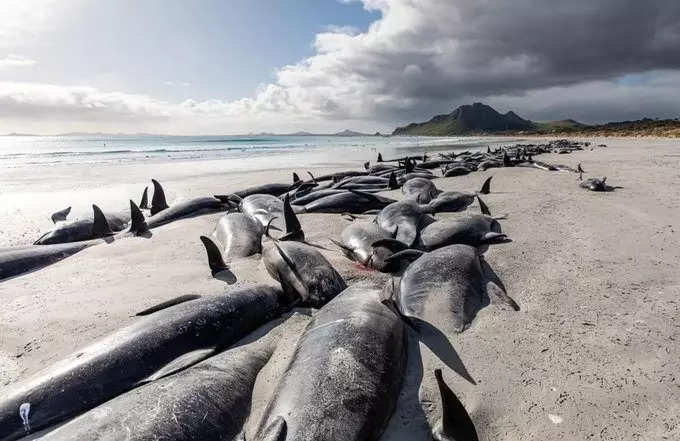
More than 50 pilot whales have died in Scotland and being stranded on a beach on the Isle of Lewis– the largest mass stranding in the country in decades.
What’s in News?
Over 50 pilot whales died in Scotland after they washed up on a beach on the Isle of Lewis on 17th July. According to the inertial reports, about 55 animals both adults and calves were discovered, of which only 15 are alive.
Marine rescuers rushed to Traigh Mhor in North Tolsta when they spotted dozens of whales in difficulty.
Officials from the British Divers Marine Life Rescue (BDMLR) charity attempted to re-float two of the more active whales which were low down in the water on the outgoing tide.
About Pilot Whales:
- Despite their names, pilot whales are one of the largest members of the dolphin family.
- They belong to the dolphin family
- There are two species of pilot whales:
- Short-finned pilot whale (Globicephala macrorhynchus) which are mainly found in tropical and warm-temperate region.
- Long-finned pilot whales (G.melas), which inhabit colder waters.
Features:
- They are characterized by a round bulging forehead, a short beaklike snout, and slender pointed flippers.
- The short-finned pilot whales and long-finned pilot whales are similar in appearance except for the pronounced difference in flipper length between the two species.
- Both long-finned and short-finned are about 4-6 meters long.
- Male of both species of pilot whale are larger than females.
- Both species are black, some individuals have a pale, elongated anchor-shaped mark adorning the throat and chest.
- Pilot whales live in groups numbering from dozens to hundreds.
Find More Miscellaneous News Here










 Tamil Nadu Vettri Payanam Scheme 2026: F...
 Anup Bagchi Appointed HDFC Bank MD and C...
 Lovlina Borgohain Wins Asian Games 2026 ...