Prime Minister Narendra Modi marked a historic moment on Monday as he inaugurated the Swarved Mahamandir in Umaraha, Varanasi. This newly constructed meditation center stands tall at seven floors, accommodating an impressive 20,000 devotees at a time for meditation. The inauguration ceremony showcased the Prime Minister’s commitment to fostering spiritual well-being and cultural heritage in the holy city.
Architectural Marvel of Swarved Mahamandir
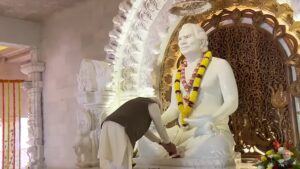
- The Swarved Mahamandir is a mesmerizing architectural marvel, seamlessly blending traditional and modern design elements.
- Intricate marble carvings adorn its structure, and towering lotus-shaped domes reflect the rich cultural heritage of Varanasi.
- The seven-floor superstructure stands as a testament to the city’s spiritual legacy while embracing contemporary aesthetics.
Modi’s Address and the Integration of AI Technology
- During the inauguration, Prime Minister Modi addressed the audience and expressed his optimism about the integration of artificial intelligence (AI) technology.
- In a significant move, he urged attendees from Tamil Nadu to use earphones equipped with AI technology for a translated experience of his speech.
- Modi envisions AI as a tool to facilitate effective communication, allowing him to connect with people across linguistic barriers.
Connecting Tamil Nadu to Kashi
- The Prime Minister emphasized the symbolic significance of individuals from Tamil Nadu visiting Kashi, equating it to moving from one home of Mahadev to his other home.
- Modi highlighted the unique bond between the people of Tamil Nadu and Kashi, emphasizing the warmth and love shared between the two regions.
- He expressed confidence in the people of Kashi leaving no stone unturned in serving their guests.
Top 9 Highlights of Swarved Mahamandir
1. Capacity for 20,000 Devotees
Following the inauguration, Prime Minister Modi, along with Uttar Pradesh Chief Minister Yogi Adityanath, toured the meditation center that boasts a capacity to seat 20,000 people simultaneously for meditation.
2. Verses of Swarveda Adorn the Walls
The seven-floor superstructure features verses from the Swarveda, intricately carved upon its walls. This spiritual text adds an extra layer of sanctity to the already awe-inspiring Mahamandir.
3. Nodal Agency and Ministries Involved
The Union Ministry of Education takes the lead in organizing the event, with participation from various ministries such as culture, tourism, railways, textiles, food processing, MSME, information and broadcasting, skill development, entrepreneurship, and IRCTC.
4. Kashi Tamil Sangamam
The event includes the Kashi Tamil Sangamam, covering lectures on literature, ancient texts, philosophy, spirituality, music, dance, drama, yoga, and Ayurveda. Seminars on innovation, trade, knowledge exchange, edutech, and next-gen technology are also part of the agenda.
5. Named After Swarved
The temple derives its name from the Swarved, a spiritual text authored by Sadguru Shri Sadafal Deoji Maharaj, the eternal yogi, and founder of Vihangam Yoga.
6. Illuminating Humankind with Spiritual Aura
Swarved Mahamandir aims to illuminate humankind with its magnificent spiritual aura, enveloping the world in a state of peaceful alertness.
7. Emphasis on Brahm Vidya
The temple promotes the teachings of Swarveda, placing a special emphasis on Brahm Vidya—a body of knowledge empowering spiritual seekers to maintain a state of consummate Zen, characterized by unwavering constancy in peace and happiness.
8. Principles of Swarveda
Advocating the principles of Swarveda, the temple encourages spiritual seekers to attain a state of complete tranquility, marked by steadfast peace and happiness.
9. Adorned with Pink Sandstone
The walls of Swarved Mahamandir are adorned with pink sandstone, enhancing the grandeur of the structure. Additionally, a beautiful garden featuring medicinal herbs adds to the overall aesthetic appeal.
Swarved Mahamandir: Bridging Spirituality, Culture, and Technology in Varanasi
- The inauguration of Swarved Mahamandir signifies a monumental step towards promoting spirituality, cultural richness, and the integration of modern technology in Varanasi.
- The center stands as a beacon of tranquility, inviting devotees to experience the serenity within its magnificent walls.
Questions Related to Exams
Q1. Who authored the spiritual text Swarveda, after which the temple is named?
A: Sadguru Shri Sadafal Deoji Maharaj, the founder of Vihangam Yoga.
Q2. What special feature distinguishes the Mahamandir’s architecture?
A: The Mahamandir features intricate marble carvings and lotus-shaped domes.
Q3. What principles does the temple advocate, with a focus on Brahm Vidya?
A: Swarved Mahamandir promotes the teachings of Swarveda, emphasizing Brahm Vidya for spiritual seekers.









 IMC 2026: PM Modi Highlights India’s 5...
 Government Unveils 2026-2030 Strategy to...
 Health Ministry to Launch JOSH Teams for...