
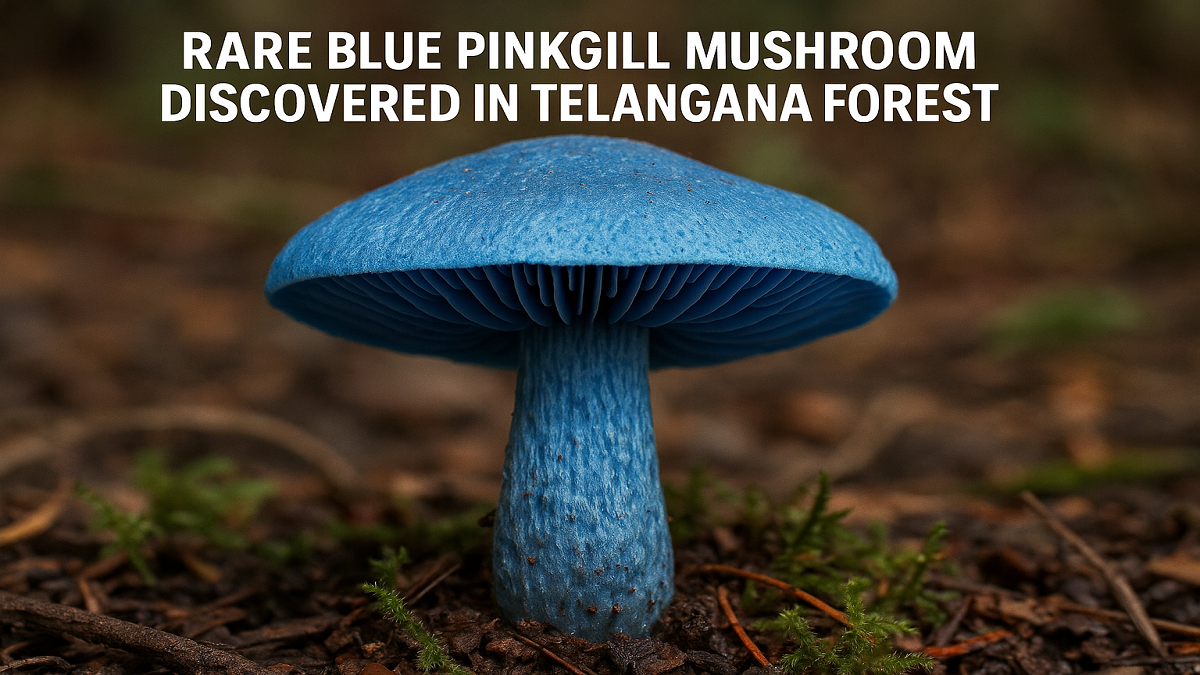
The Kagaznagar forest division in Komaram Bheem Asifabad district, Telangana, has witnessed an exceptional sight — the Blue Pinkgill mushroom (Entoloma hochstetteri), a species otherwise native to New Zealand. Known for its striking sky-blue colour, this mushroom contains rare azulene pigments, making it one of the most visually distinctive fungi in the world.
In addition, the shuttlecock mushroom (Clathrus delicatus) has been recorded for the first time in the Eastern Ghats, within the Kawal Tiger Reserve, further emphasizing the rich fungal diversity of the region.
Blue Pinkgill – Features and Identification
The Blue Pinkgill, also called the sky-blue mushroom, is easily recognisable due to its vivid appearance:
- Cap: Bright blue, ranging from flat to funnel-shaped.
- Stems: Equally blue, matching the cap’s vibrancy.
- Gills: Initially pink to purplish, later turning pale due to spores.
- Spore Print: Pink to salmon in colour.
The mushroom’s blue hue comes from azulene pigments, which are extremely rare in fungi. These visual features help mycologists and nature enthusiasts identify the species in the wild.
Native Habitat and New Distribution
Originally native to New Zealand, the Blue Pinkgill grows in broadleaf forests with soil rich in leaf litter. It typically appears during monsoon when:
- Moisture levels are high
- Soil conditions are optimal for fungal growth
Its discovery in Telangana is unusual and suggests that the forests of Komaram Bheem Asifabad offer favourable ecological conditions comparable to its native habitat.
Shuttlecock Mushroom – A First for the Eastern Ghats
Alongside the Blue Pinkgill, researchers also documented the shuttlecock mushroom in Kawal Tiger Reserve — a fungus previously known from the Western Ghats.
- Significance: This marks the first recorded sighting in the Eastern Ghats.
- Ecological Implication: Extends the known habitat range of the species, challenging earlier assumptions and indicating possible ecological linkages between India’s different mountain ranges.
Ecological and Environmental Significance
These fungal discoveries highlight:
- Biodiversity richness in Telangana’s forests.
- The role of fungi in decomposition and nutrient cycling.
- The need to reassess habitat connectivity across different Indian ecosystems.
Such rare fungi often serve as bio-indicators, reflecting the overall health of forest ecosystems.
Role of Monsoon in Fungal Growth
The monsoon season plays a vital role in the emergence of mushrooms:
- Rainfall saturates the forest floor.
- Humidity and cooler temperatures create ideal fruiting conditions.
- Seasonal fungal blooms contribute to forest regeneration by breaking down organic matter and enriching the soil.
Scientific and Research Importance
The documentation of rare fungi like the Blue Pinkgill and shuttlecock mushroom:
- Expands mycological knowledge.
- Helps in mapping species distribution in India.
- Offers insights into ecological niches and forest health.
Such findings highlight the urgent need for forest conservation, ensuring that unique biodiversity is preserved for future generations and further research.








 India’s Classical Languages: 5 More La...
 Agasthyamalai Biosphere Reserve Records ...
 Vastra Utsav 2026 Celebrates India's Tex...










