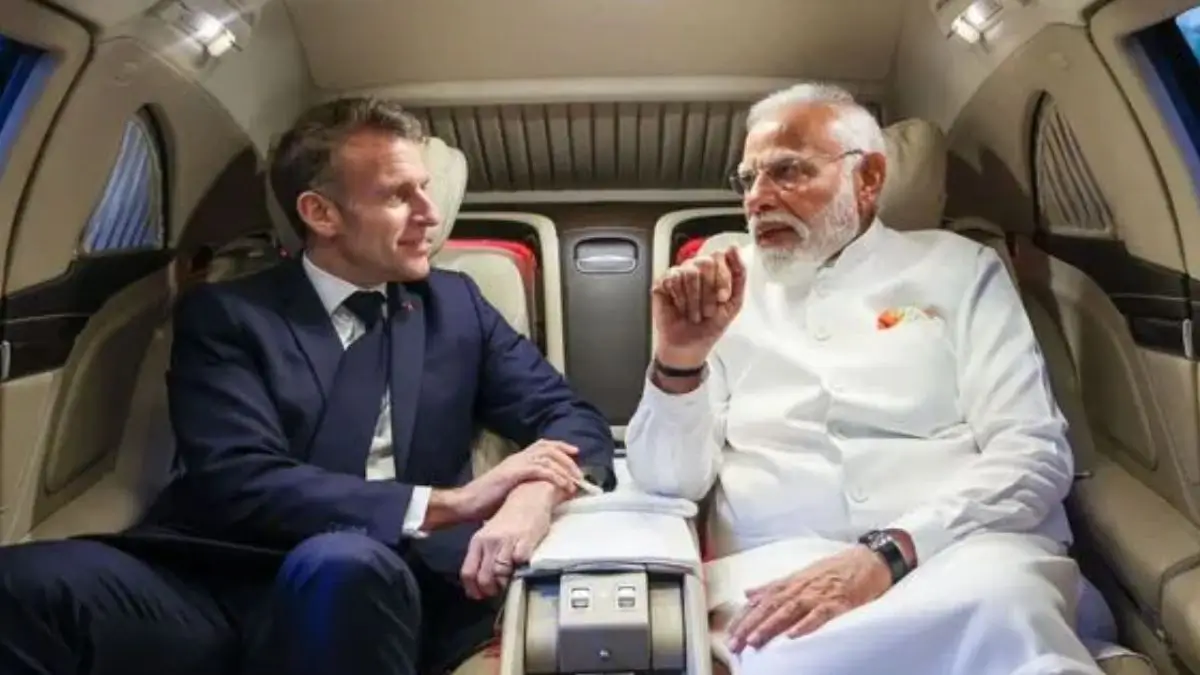
Prime Minister Narendra Modi and French President Emmanuel Macron have launched the India-France Year of Innovation 2026 during Macron’s three-day visit to India from 17 to 19 February. The initiative aims to deepen cooperation in artificial intelligence, defense, digital technology, and the Indo-Pacific. The visit reflects strong strategic alignment between the two countries amid changing global geopolitics. Both leaders are expected to review progress in the India-France Strategic Partnership and expand collaboration across innovation and economic sectors.
India-France Year of Innovation 2026 Launched by Modi and Macron
- Prime Minister Narendra Modi and President Emmanuel Macron officially launched the India-France Year of Innovation 2026.
- The initiative aims to institutionalise collaboration between start-ups, researchers, and technology leaders.
- It reflects the growing strength of the India France Strategic Partnership 1998, which has expanded into defense, AI, climate action, and Indo-Pacific cooperation.
- The Innovation Year will focus on emerging technologies, digital infrastructure, and joint research programs.
AI Impact Summit and Technology Partnership
- A major highlight of the visit is joint participation at the AI Impact Summit.
- Earlier, both leaders co-chaired the AI Action Summit in France, promoting ethical, safe, and human-centric artificial intelligence governance.
- The India-France Year of Innovation 2026 will strengthen AI cooperation, digital public infrastructure, and technology capacity-building for developing nations.
- Both sides aim to bridge the global AI divide and support inclusive digital growth. Artificial intelligence remains central to bilateral innovation efforts.
Defense Ties: Rafale Fighter Jets and Strategic Cooperation
Defense cooperation continues as a core pillar of the India-France relationship. India’s Defense Acquisitions Council has approved a proposal to procure 114 Rafale fighter aircraft.
The Rafale jets are manufactured by Dassault Aviation. Out of the 114 aircraft,
- 18 will arrive in flyaway condition.
- The remaining jets will be manufactured in India.
India already operates 36 Rafale jets in the Air Force and has ordered 26 naval variants. The expanded fleet will significantly enhance India’s air combat capability and boost defense industrial collaboration.
Indo-Pacific Cooperation and Global Alignment
- The India-France Year of Innovation 2026 also strengthens Indo-Pacific cooperation.
- France is a resident Indo-Pacific power due to its overseas territories such as Réunion Island.
- Both countries support multilateralism, strategic autonomy, and reform of the United Nations.
- France has consistently backed India’s aspiration for permanent membership in a reformed UN Security Council.
- The leaders will also review regional security, supply chain resilience, and maritime cooperation in the Indo-Pacific.
Question
Q. The India-France Strategic Partnership was launched in which year?
A) 1995
B) 1998
C) 2001
D) 2005







 Trump Signs Russia Sanctions Bill, India...
 Luke Lindberg Appointed New World Food P...
 Trump Announces Permanent US Security De...