
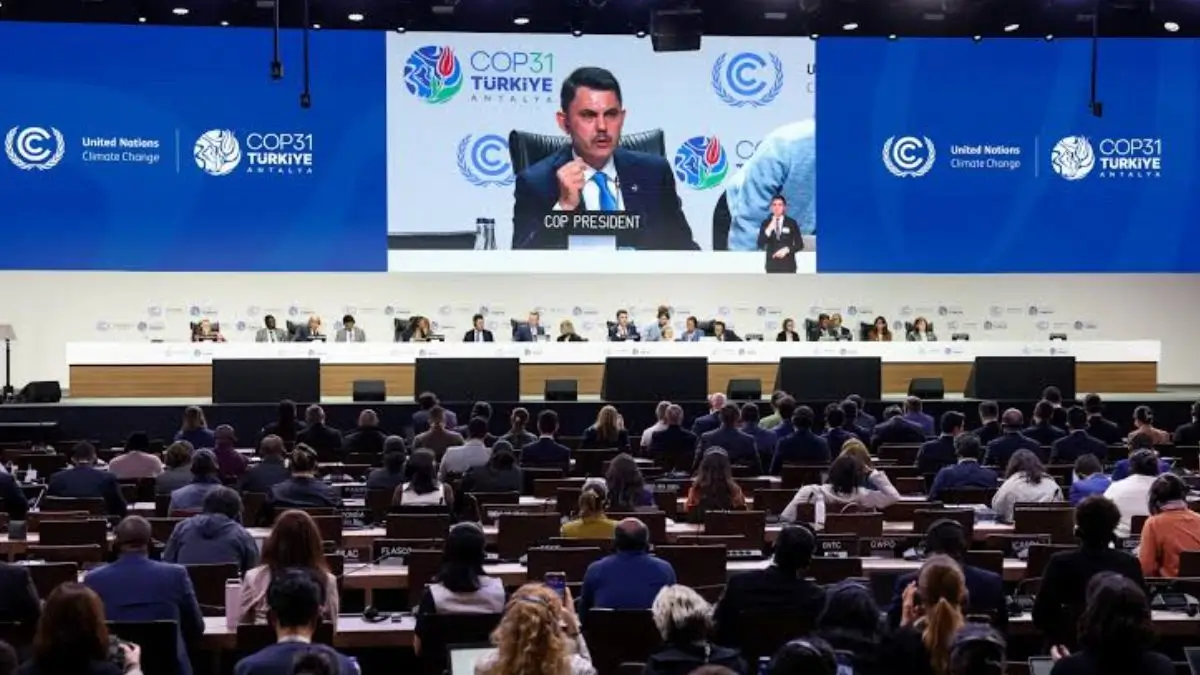
There was no overall agreement reached at COP31. Countries could not agree on whether fossil fuel sources (coal, oil and natural gas) should be included in the outcome document. The European Union and vulnerable countries did not agree with the outcome document as fossil fuels were not explicitly mentioned. However, oil-producing countries (including Saudi Arabia and Russia) did not agree with the inclusion of fossil fuels. Disagreements arose on climate funding and carbon capture.
Key Details About COP31 Outcome
- COP number: 31 (UN Climate Change Conference)
- Date: 9th – 22nd November 2026
- Location: Antalya, Turkey
- Host Country: Turkey
- Chair: Murat Kurum
- Chair Negotiations: Chris Bowen (Australia)
- Key Issue: Dispute Over Fossil Fuels
- Overall Outcome: No overall agreement.
- Next COP: COP32 (Ethopia) 2027
The COP ran for two extra days (9 th – 22 nd November) as consensus could not be reached. This means it was the longest ever UN climate meeting.
Reasons for Failure
- Disagreement over fossil fuels: The European Union and vulnerable countries did not agree with the outcome document as fossil fuels were not explicitly mentioned, and there was no clear direction given on how countries should phase out coal, oil and gas.
- Saudi Arabia and other oil-producing countries (including Russia) did not agree with the inclusion of fossil fuels in the outcome document.
- Climate Funding: Developing countries were concerned that there was insufficient funding for adaptation to climate change.
- Carbon Capture Technologies: There was support for the increased use of carbon capture and storage. Some people believed this was an appropriate solution to climate change, whilst others felt that it may mean fossil fuels can still be used, and therefore slow the transition to renewable energy sources.
Representatives from Europe commented that the deal not mentioning fossil fuels was not enough to sufficiently tackle the climate crisis. As consensus could not be reached on the final proposed deal, no overall agreement was reached.
Reasons for Fossil Fuel Dispute
Fossil fuels are coal, petroleum and natural gas. Burning fossil fuels causes emissions of greenhouse gases (particularly CO 2 ), contributing to global heating.
At COP28, held in Dubai in 2023, countries agreed to move to phase out fossil fuels. However in later climate conferences, fossil fuels were not explicitly mentioned.
At COP31, there was disagreement over whether the commitment to phase out fossil fuels should be strengthened in the new outcome document.
This reflects differing views between countries who wish to rapidly move to renewable energy sources, and those who prioritize energy security, economic interest or other technologies such as carbon capture and storage.
Other Proposals
Despite no overall agreement at COP31, there was a range of proposals discussed,
- Increasing electricity: A target was set to increase the share of electricity in global final energy consumption to 35% by 2035.
- Carbon capture and storage: Expansion of technologies that capture CO 2 emissions and store them.
- Funding for adaptation to climate change: Developing countries wanted clearer commitments, and funding to prepare for climate change.
- Just Transition: Progress was also made on decisions to ensure a fair transition to a low-carbon economy.
Although key decisions from the presidency were not agreed upon, progress was made on certain issues within COP31, such as just transition. This was said by UN climate change Executive Secretary Simon Stiell.
Significance of the COP31 Failure
The failure demonstrates challenges in reaching global consensus regarding climate action due to differing energy needs and economic priorities.
It raises concerns regarding the effectiveness of reaching consensus within the United Nations on climate change.
This means that if countries cannot agree on key decisions, individuals or groups of countries can block consensus.
The failure occurred at a time of increasing concern that global warming will exceed 1.5 degrees, as aimed for in the Paris Agreement.
UN Secretary-General António Guterres was disappointed with the outcome and has called for quicker emission cuts, increased climate funding and a fair transition from fossil fuels.








 SCO Civilisational Dialogue Forum Issues...
 PM Narendra Modi Inaugurates First SCO C...
 India and Japan Unveil Logo for 75 Years...