
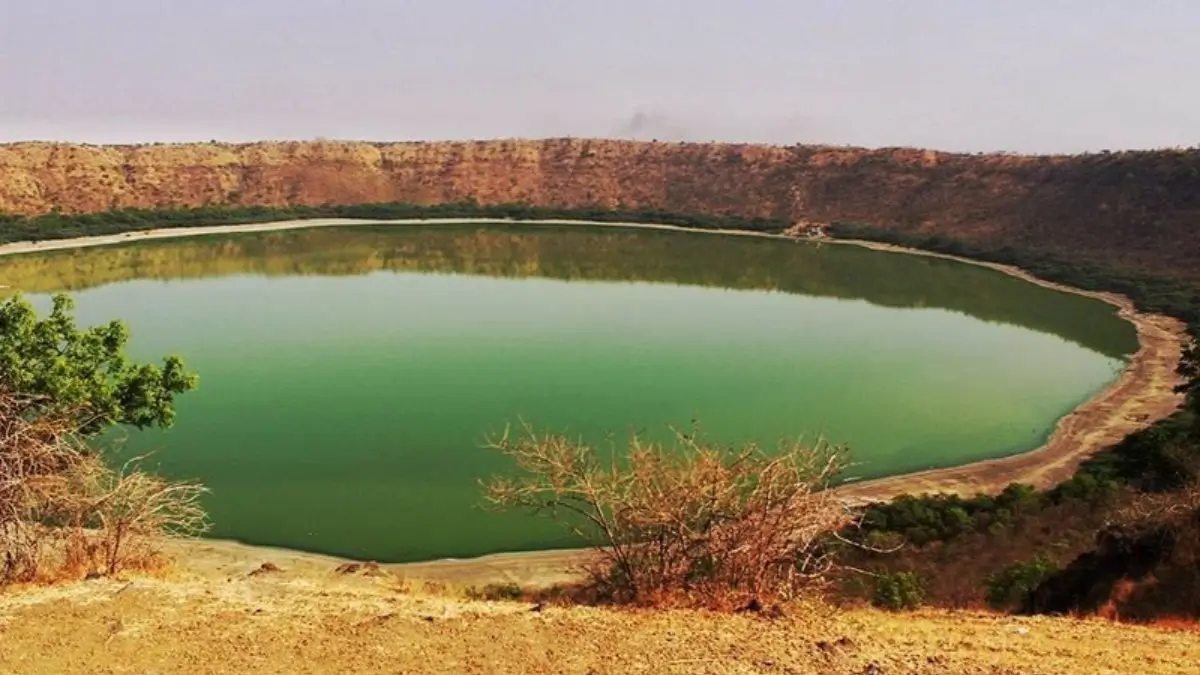
Lonar Lake, Buldhana District, Maharashtra has been included in the Third 100 List of IUGS Geological Heritage Sites. This highlights the unique geological significance of the 12,000 year-old impact crater. The site was nominated by the Geological Survey of India (GSI). This impact crater is one of the few impact structures in basalt on Earth.
What are the IUGS Geological Heritage sites?
Sites across the world with significant geology have been identified as Geological Heritage sites by the International Union of Geological Sciences (IUGS).
These sites have great scientific significance. The initiative encourages global collaboration within earth sciences.
Three lists have been released so far,
| List | Year | Location |
| First 100 | 2022 | Zumaia, Spain |
| Second 100 | 2024 | 37th International Geological Congress, Busan, South Korea |
| Third 100 | 2026 | Internationally recognised in 2026. |
The Third 100 sites are located in 47 different countries.
Lonar Lake
Location: Maharashtra, Buldhana District.
Lonar Lake is an impact crater created by meteorite impacts approximately 12,000 years ago. It is one of the youngest and most intact bowl-shaped, super-high-velocity impact structures on Earth.
- Location: Maharashtra, Buldhana District
- Formation: Meteorite impact
- Age: ~12,000 years
- Diameter: 1.88km
- Location within larger geological feature: Deccan Traps
- Type of lake: Saline Alkaline
- Nominated by: The Geological Survey of India.
Significance of the Inclusion
This site is of particular geological significance as it is one of only 5 super high-velocity impact craters in basalt, on Earth.
Within the site there are many features indicating the meteorite impact. These include,
- Exposed basalt layers on the sides of the crater.
- Broken up rock layers below the surface.
- Outwardly dipping rock layers.
- Mounds of debris and widespread ejecta.
Impactites, including impact glass, spherules, and melt rock. Understanding the physical and geochemical processes caused by high-velocity meteorite impacts can be investigated by scientists using these features.
Relationship with Deccan Traps
The Lonar Crater is found within a large geological feature called the Deccan Traps, which formed around 65 million years ago.
They stretch across large portions of West and Central India.
Lonar is unusual as it was created when a meteorite hit the basalt rock of the Deccan Traps. This has created a well-preserved impact crater. Within the centre of the crater is a saline and alkaline lake, giving the location unique geological and ecological characteristics.
Role of GSI
The Geological Survey of India (GSI) have nominated Lonar Lake into this list to raise awareness and preserve geological heritage in India.
This designation increases awareness of the site globally. It emphasises how important the site is for research, education and preservation of geological features.
Locations in the Third 100 List
The 100 sites in the third list are located in 47 different countries.
| Region | Number of Sites |
| Europe | 34 |
| Americas | 22 |
| Asia Pacific | 22 |
| Africa | 11 |
| Middle East | 6 |
| High Seas | 3 |
| Antarctica | 2 |
| Total | 100 |
Other internationally recognised sites in this list are Mount Fuji (Japan), Fjords (Norway), San Andreas Fault (USA), Mount Aconcagua (Argentina), and Chocolate Hills (Philippines).








 PM Modi and Nepal PM to Set to Flag Off ...
 India's Cheetah Population Rises to 62 a...
 India Administers Over 1 Crore HPV Vacci...