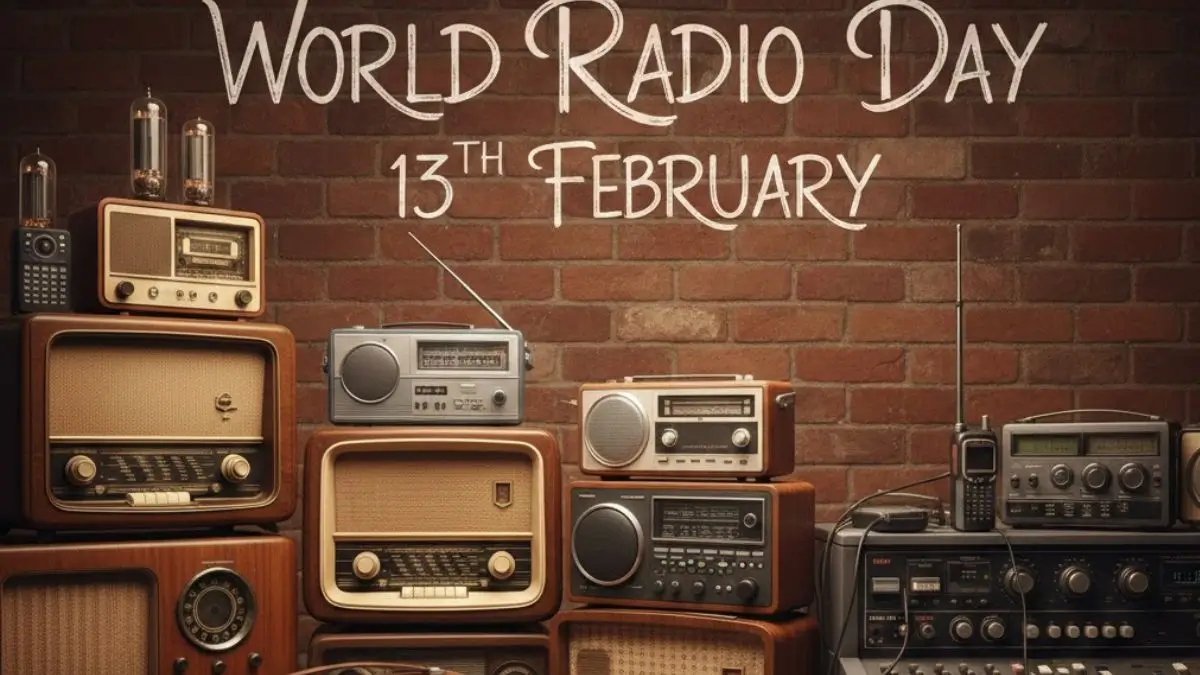
World Radio Day 2026 will be observed on February 13, celebrating radio as a powerful public service medium. The day commemorates the establishment of United Nations Radio in 1946. This year’s theme, “Radio and Artificial Intelligence: AI is a tool, not a voice,” highlights how technology can support broadcasting without replacing the human touch. In India, from All India Radio (AIR) to community radio stations, radio continues to inform, educate and connect millions across urban and rural regions.
World Radio Day 2026: History and Significance
- World Radio Day 2026 traces its origins to a decision by UNESCO during its 36th General Conference in 2011.
- The United Nations General Assembly later adopted it in 2012, making February 13 an official international observance.
- The date marks the launch of United Nations Radio in 1946, which symbolized global cooperation through information sharing after World War II.
- Radio has historically played a defining role in shaping public opinion.
- In India, the midnight announcement of Independence on August 14-15, 1947, broadcast on radio, united millions in a shared national moment.
Theme of World Radio Day 2026: Radio and Artificial Intelligence
- The theme of World Radio Day 2026 “Radio and Artificial Intelligence: AI is a tool, not a voice” underlines the growing role of AI in broadcasting.
- Artificial Intelligence can assist in content production, archiving, translation, accessibility, and audience analytics.
- However, UNESCO stresses that AI must remain a support tool, not replace the human voice, editorial judgement, and credibility that define radio.
- Ethical AI usage is essential to preserve trust.
- The theme encourages broadcasters to adopt innovation while safeguarding authenticity and community connection in the digital era.
All India Radio (AIR): India’s Public Service Backbone
- All India Radio, also known as Akashvani, was established in 1936 and operates under Prasar Bharati.
- With the motto “Bahujan Hitaya, Bahujan Sukhaya”, AIR serves nearly 99.19% of India’s population and covers about 92% of geographical area.
- AIR runs 591 broadcasting centres, delivering programmes in 23 languages and 182 dialects.
- Its content includes news, agriculture, education, disaster alerts, music, and public awareness campaigns.
- During cyclones like Fani (2019) and the COVID-19 pandemic, AIR ensured timely communication, especially in regions with limited internet connectivity.
Community Radio in India: Strengthening Grassroots Voices
- Community Radio is the third tier of broadcasting in India.
- The policy was introduced in 2002, and the first station was inaugurated on February 1, 2004, by Lal Krishna Advani.
- A major milestone was the launch of Anna Community Radio in 2005.
- Currently, India has 528 Community Radio Stations (CRSs).
- These stations focus on health, education, agriculture, and social welfare. They broadcast in local dialects, preserving folk traditions and empowering local communities.
- Community radio has become a vital communication tool in remote regions like Uttarakhand, Kutch, and border areas.
Mann Ki Baat: Radio in the Digital Age
- Mann Ki Baat, launched on October 3, 2014, by Prime Minister Narendra Modi, reflects radio’s enduring relevance.
- Broadcast through AIR and multiple platforms, it has completed 130 editions.
- The programme highlights grassroots innovations, citizen initiatives, and social campaigns.
- Despite the dominance of social media, the choice of radio ensures reach to remote populations without internet access.
- It demonstrates how traditional broadcasting can seamlessly integrate with digital platforms.
Ram Singh Bouddh: The Radio Man of India
- Ram Singh Bouddh from Amroha, Uttar Pradesh, earned recognition from Guinness World Records in 2025 for owning 1,257 radios, the largest collection globally.
- His museum preserves the evolution of radio technology in India.
- His achievement reflects radio’s emotional and cultural significance.
- From wooden receivers to transistor sets, his collection showcases how radio shaped India’s communication journey.
Question
Q. World Radio Day is observed on which date?
A) February 15
B) February 13
C) February 12
D) February 14








 International Tiger Day 2026: Date, Them...
 World Nature Conservation Day 2026: Hist...
 World Hepatitis Day 2026: Theme, History...