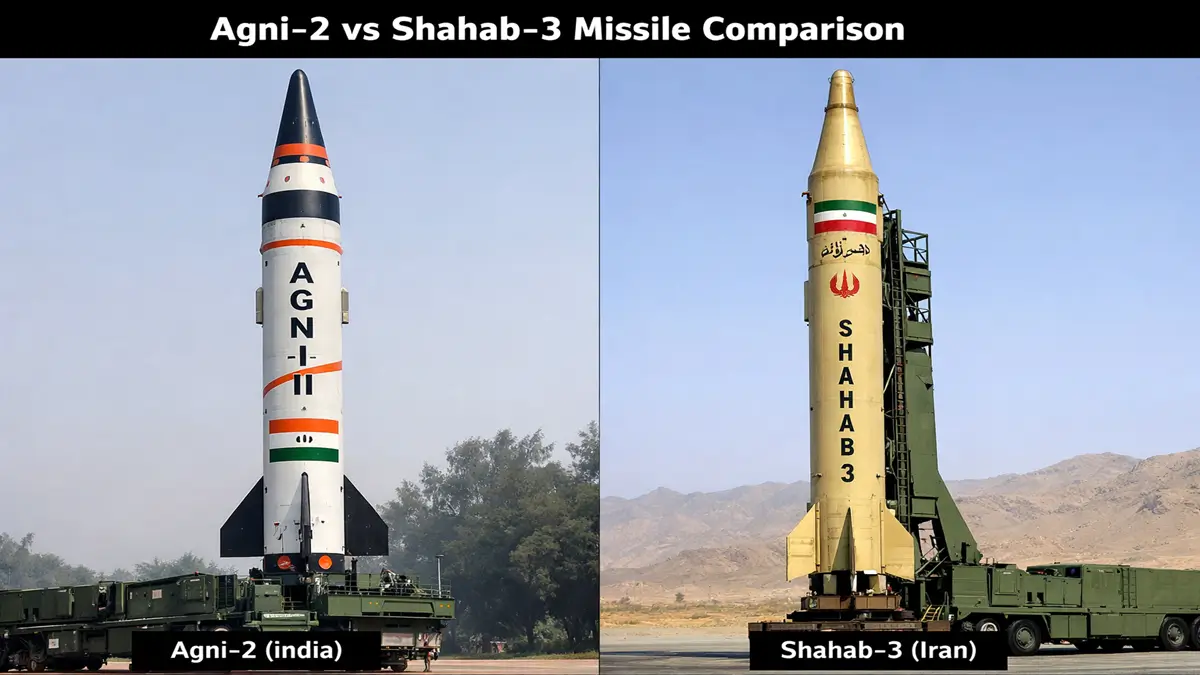
Ballistic missiles play a crucial role in modern military strategy, providing countries with long-range strike capability and strategic deterrence. India and Iran both possess medium-range ballistic missiles capable of targeting distant regions with precision.
India’s Agni-2 missile is part of the Agni missile series developed by the Defence Research and Development Organisation (DRDO), while Iran’s Shahab-3 is one of the most well-known missiles in the Iranian arsenal.
This article compares the Agni-2 and Shahab-3 missiles in terms of range, speed, payload capacity, technology, and overall military capability.
Overview of Agni-2 Missile (India)
The Agni-2 is a medium-range ballistic missile developed by India as part of its strategic nuclear deterrence program. It is designed to strike targets at long distances and is deployed by India’s Strategic Forces Command.
Key Features of Agni-2
- Type: Medium-Range Ballistic Missile (MRBM)
- Country: India
- Developer: DRDO
- Range: 2,000–3,500 km
- Speed: Around 3.5 km/s (over 14,000 km/h)
- Payload: Up to 1,000 kg
- Fuel Type: Solid fuel
- Launch Platform: Road-mobile launcher
- Warhead Capability: Conventional and nuclear
The missile uses solid fuel propulsion and advanced guidance systems, which allow faster launch readiness and improved accuracy.
Overview of Shahab-3 Missile (Iran)
The Shahab-3 is one of Iran’s most important medium-range ballistic missiles and is believed to be derived from North Korea’s Nodong missile technology.
Key Features of Shahab-3
- Type: Medium-Range Ballistic Missile (MRBM)
- Country: Iran
- Range: Approximately 1,300–2,000 km
- Payload: Around 700–1,200 kg
- Fuel Type: Liquid fuel
- Launch Platform: Mobile launcher
- Warhead Capability: Conventional or potential nuclear payload
Shahab-3 allows Iran to strike targets across the Middle East and surrounding regions.
Agni-2 vs Shahab-3 Missile Comparison
| Feature | Agni-2 (India) | Shahab-3 (Iran) |
|---|---|---|
| Missile Type | Medium-Range Ballistic Missile | Medium-Range Ballistic Missile |
| Range | 2,000–3,500 km | 1,300–2,000 km |
| Speed | ~3.5 km/s | ~Mach 7 |
| Payload | Up to 1,000 kg | 700–1,200 kg |
| Fuel | Solid Fuel | Liquid Fuel |
| Launch Platform | Road-mobile TEL | Mobile launcher |
| Warhead | Conventional / Nuclear | Conventional / Potential nuclear |
Key Differences Between Agni-2 and Shahab-3
1. Range Advantage
Agni-2 has a longer strike range, reaching up to 3,500 km, while Shahab-3 typically reaches around 2,000 km.
2. Fuel Technology
Agni-2 uses solid fuel, which allows faster launch readiness and better mobility. Shahab-3 uses liquid fuel, requiring longer preparation time before launch.
3. Speed and Technology
Agni-2 benefits from modern guidance systems and higher speed, making it more advanced in terms of strike capability.
4. Strategic Role
- Agni-2: Part of India’s nuclear deterrence strategy against regional threats.
- Shahab-3: Key component of Iran’s missile force capable of targeting regional adversaries.
Strategic Importance
India
The Agni missile series forms the backbone of India’s credible minimum nuclear deterrence strategy, ensuring the ability to strike distant targets if necessary.
Iran
Iran relies heavily on ballistic missiles like Shahab-3 due to limitations in its conventional air power, making missiles a central part of its defense doctrine.








 DRDO Successfully Tests Quantum Key Dist...
 Indian Navy to Commission Indigenous Mul...
 Indian Army Launches Bharat Rice for Tro...