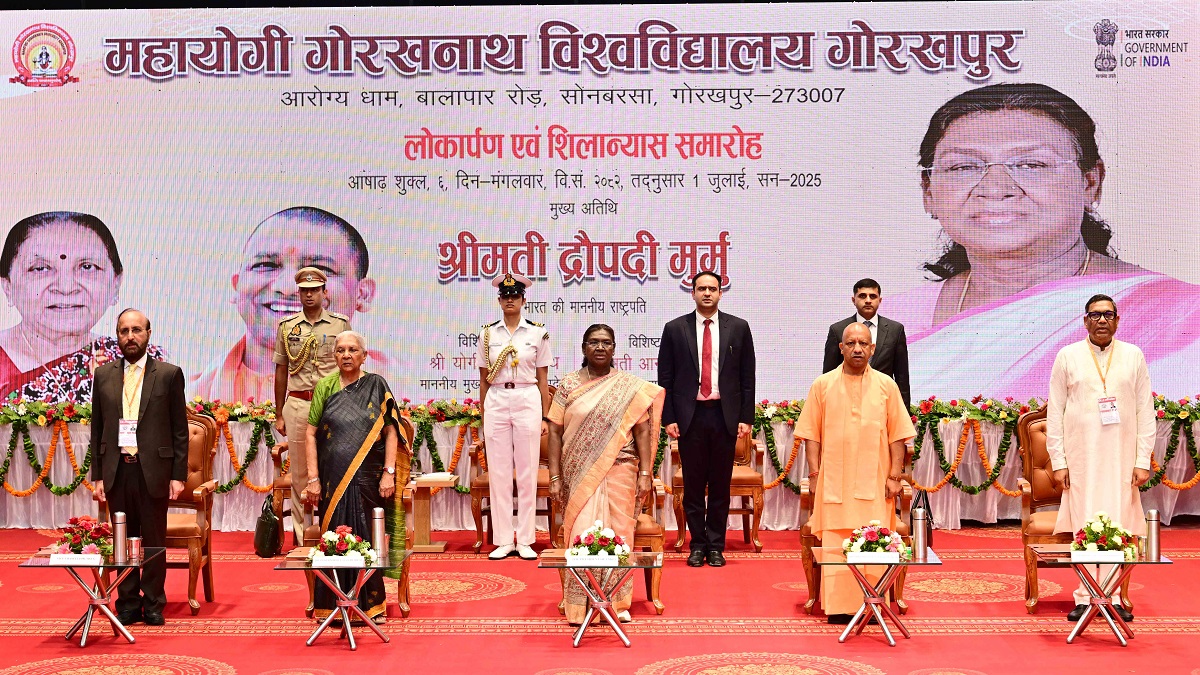
The President of India, Smt. Droupadi Murmu, visited Gorakhpur, Uttar Pradesh to take part in a special event. She inaugurated and laid the foundation stone for several important projects at Mahayogi Gorakhnath University. This visit was a significant moment for the people of eastern Uttar Pradesh, especially for those connected to education and healthcare.
During the event, the President officially inaugurated the new Auditorium, an Academic Block, and a special Panchkarma Kendra. She also laid the foundation stone for a new Girls’ Hostel building, which is expected to help many young women in their pursuit of higher education.
Promoting Holistic Medical Education
While speaking at the function, the President praised the University’s efforts in combining modern (Allopathy) and traditional (Ayurveda) systems of medicine. She appreciated how the University is offering education and treatment in both Allopathy and Ayurveda through its Medical College, Ayurveda College, and associated hospitals.
She also mentioned that the Shri Gorakshanath Medical College Hospital and Research Centre is building a new 1800-bed hospital. This large facility is expected to offer better healthcare to thousands of people in the region. It also highlights the University’s commitment to serving society in both education and health.
Supporting the Goals of National Education Policy 2020
The President spoke about the role of private universities in nation-building, especially under the National Education Policy (NEP) 2020. She said that private higher education institutions working with the goal of public welfare and philanthropy will play a key role in India’s education system.
She also pointed out that Mahayogi Gorakhnath University is the first private university in Gorakhpur and surrounding areas. Even though the university is only four years old, it has already become a strong centre for higher education and job-oriented learning in the Purvanchal region of the state.
A Special Step Towards Women’s Empowerment
The President said that while she was happy to open the new university buildings, she was especially proud to lay the foundation stone for the Girls’ Hostel. She believes that education is the most powerful tool for empowerment.
Many girls in India still face problems in going to college due to lack of safe housing. This hostel will provide secure accommodation for female students, making it easier for them to attend college and complete their studies. The President described this project as a very important step for women’s education and congratulated the University for taking this big initiative.
The Vision for a Healthier, Educated Uttar Pradesh
In her address, President Murmu shared a broader vision. She said that when the people of Purvanchal become more educated and healthier, then the whole state of Uttar Pradesh will grow faster. Since Uttar Pradesh has the largest population in India, its development will help push the entire nation forward.
She called this kind of progress “inclusive growth“, where every section of society benefits — especially in remote and less-developed areas. By supporting both modern learning and traditional values, Mahayogi Gorakhnath University is helping to build not just good students, but also responsible, patriotic citizens.








 India Notified Semicon 2.0 With Major Se...
 Indian Standard Time Rules 2026 Notified...
 India Records Nearly 80% Drop in Malaria...