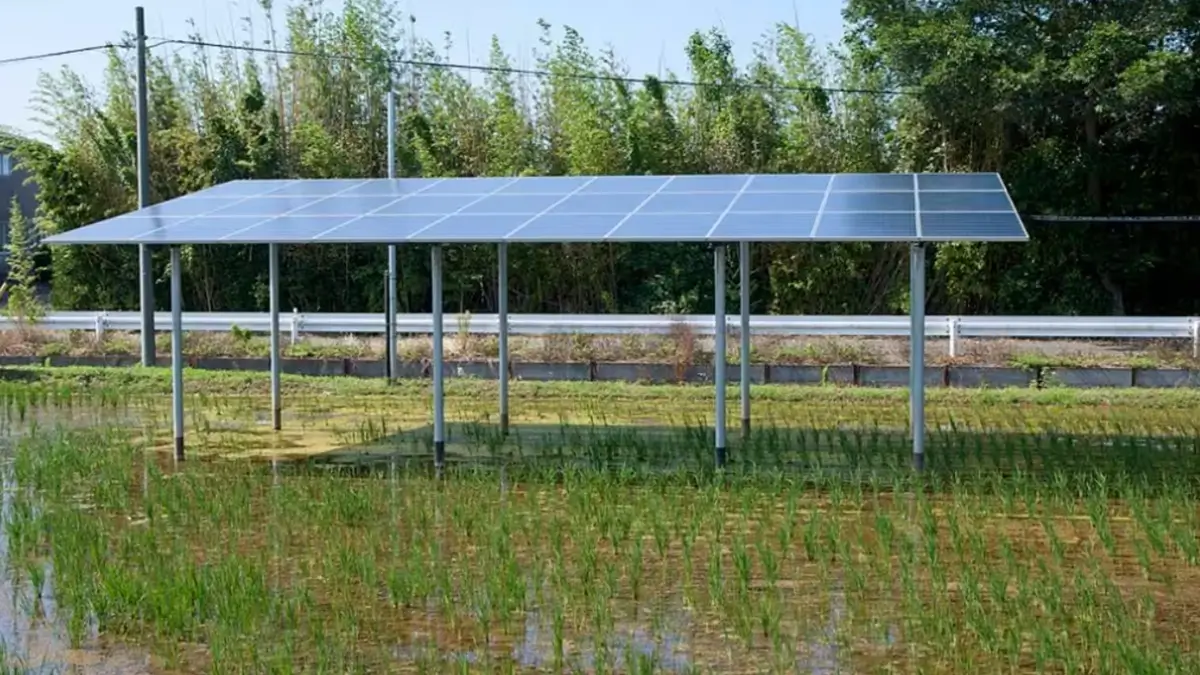
The old proverb “Don’t put all your eggs in one basket” means that depending on only one source of income can be risky. A six-year experiment in Japan has shown how this idea could apply to modern farming.
Researchers from the University of Tokyo studied an agrivoltaic farming system in Chikusei, Ibaraki Prefecture, from 2018 to 2023. The experiment combined two activities on the same farmland: growing rice and generating solar electricity.
The results revealed an important trade-off. Solar panels reduced rice production, but the electricity generated by those panels added a significant new source of value.
Solar Panels Reduced Rice Yield
During the six growing seasons, rice cultivated beneath the solar panels produced an average yield of about 6.5 tonnes per hectare.
By comparison, rice grown in the nearby open-field control plot produced approximately 8.5 tonnes per hectare.
This means rice production under the panels was about 23% lower.
The reason was relatively straightforward: the solar panels reduced the amount of sunlight reaching the rice plants.
The researchers also observed lower biomass and fewer panicles—the structures that eventually produce rice grains.
Interestingly, the effect was not identical every year. The yield reduction was particularly noticeable during wetter growing seasons, suggesting that weather conditions and shading interact in determining crop performance.
The Panels Changed More Than Just Yield
The proverb may say, “Don’t put all your eggs in one basket,” but in this experiment, the farmer was effectively putting two activities on the same piece of land.
The solar panels did not simply reduce sunlight. They also changed the microclimate around the rice.
Maximum daytime air temperature beneath the panels was approximately 0.8°C lower than in the open field, while minimum temperatures remained relatively similar.
The researchers also found changes in rice quality.
Shaded rice had:
- More chalky grains
- A lower proportion of whole rice after milling
- Higher protein levels
- Higher amylose levels
These changes are important because agricultural success cannot always be measured simply by the number of tonnes harvested. Quality matters too.
When Less Rice Meant More Value
Here comes the most interesting part of the Japanese experiment.
If the researchers had looked only at rice production, the solar-panel system would have appeared to be the weaker option.
But the agrivoltaic field was doing two jobs simultaneously.
It was growing rice and generating electricity.
When researchers combined the economic value of the rice and electricity, the agrivoltaic system produced a gross return roughly 14 times higher than the rice-only comparison used in the study.
That does not mean every rice farm installing solar panels will earn 14 times more.
The result depended on the particular experimental design, electricity generation, crop production, panel arrangement and economic assumptions.
Instead, the finding demonstrates the basic principle of agrivoltaics: the value of farmland can potentially come from both agricultural production and renewable-energy generation.
What Does “Don’t Put All Your Eggs in One Basket” Mean Here?
The experiment offers a modern interpretation of the proverb.
Traditional farming depends primarily on the crop.
Agrivoltaic farming introduces another source of output:
Food + Electricity = Multiple Sources of Value
However, this does not mean there is no downside.
The Japanese study clearly showed that reduced sunlight affected rice growth and yield. The crop also experienced changes in grain quality.
Therefore, solar panels cannot simply be placed over every agricultural field with the assumption that production will remain unchanged.
Panel height, spacing, crop variety, climate, farming practices and the amount of shade can all influence the final result.
Six Years Provided a Bigger Picture
One of the strengths of the experiment was its six-year duration.
A single growing season can provide misleading results because weather conditions vary considerably from year to year.
By observing the field from 2018 to 2023, researchers could examine how the system performed under different growing conditions.
The results showed a consistent pattern:
Less sunlight could reduce rice production, but electricity generation created an additional economic opportunity.
That is the central lesson of the experiment.
The Bigger Lesson for Agriculture
The Japanese experiment does not prove that solar panels are automatically better than conventional farming.
Instead, it highlights a difficult but important question:
Should farmland be evaluated only by how much food it produces, or by the total value it can generate?
In this case, rice production fell by around 23%, while electricity generation added another revenue stream.
And that brings us back to the proverb:
“Don’t Put All Your Eggs in One Basket.”
For modern agriculture, the basket may not have to contain only rice.
It could contain rice, renewable energy and additional income—all produced from the same piece of land.
The Japanese experiment suggests that the future of farming may not be about choosing between food and energy, but finding carefully designed ways to produce both.







 Elon Musk to Rename SpaceXAI as SpaceXSI
 Kerala Develops AI-Based Dengue Early Wa...
 SpaceX Starship Reaches Orbit for First ...