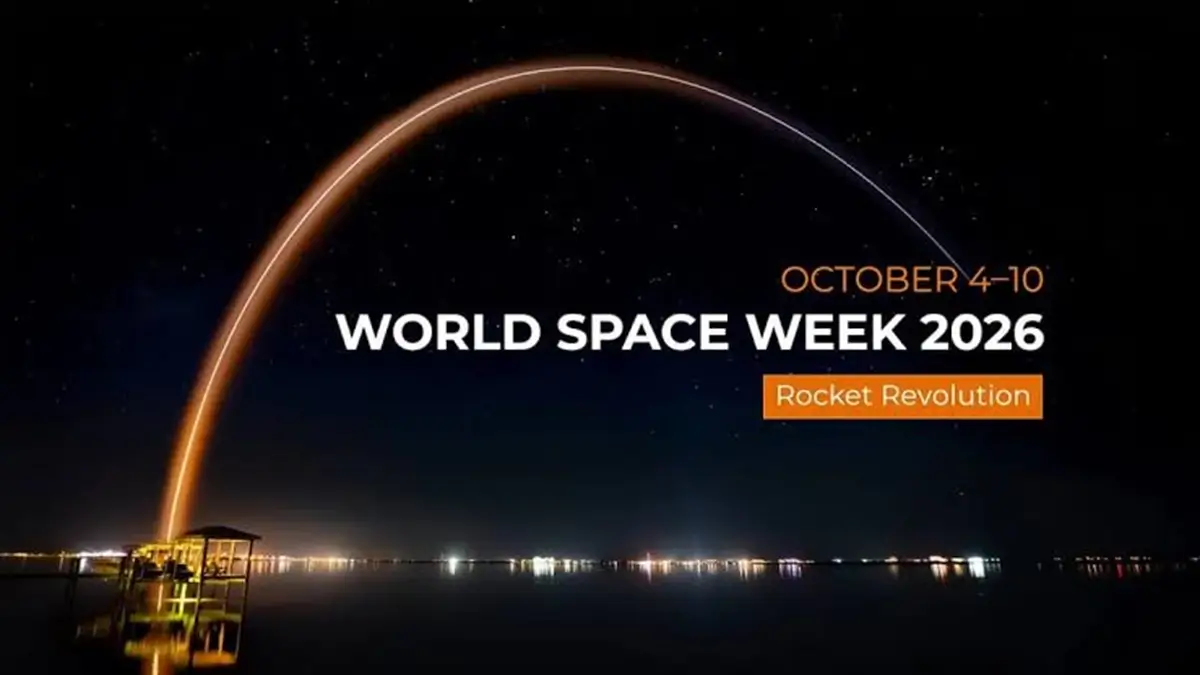
World Space Week 2026 is being observed from 4 October to 10 October 2026 across the world. The annual celebration highlights the contribution of space science and technology to human development and encourages greater international cooperation in space exploration.
The theme for World Space Week 2026 is “Rocket Revolution.” It focuses on the rapid transformation taking place in launch technologies, particularly the rise of reusable rockets, private space companies, startups and new spacefaring nations.
The theme also reflects how falling launch costs and advances in rocket technology are making access to space more affordable and opening new opportunities for scientific research, satellite deployment and human exploration.
Why is World Space Week Celebrated from October 4 to 10?
The dates of World Space Week commemorate two important milestones in the history of space exploration.
On 4 October 1957, the Soviet Union launched Sputnik 1, the world’s first artificial satellite. The successful launch marked the beginning of the Space Age.
The week concludes on 10 October, marking the date in 1967 when the Outer Space Treaty entered into force.
The treaty established important principles for the peaceful exploration and use of outer space and remains one of the foundations of international space law.
World Space Week Declared by the United Nations
The United Nations General Assembly declared World Space Week in 1999.
Its purpose is to recognise how space science and technology contribute to improving human life while encouraging education, innovation and international cooperation in space-related activities.
Every year, governments, space agencies, educational institutions, companies and scientific organisations conduct programmes and awareness activities during the week.
Theme 2026: “Rocket Revolution”
The theme “Rocket Revolution” highlights major changes taking place in the global launch industry.
Traditional expendable rockets are increasingly being complemented by reusable launch systems, which can significantly reduce the cost of accessing space.
The space sector is also witnessing greater participation from:
- Private space companies
- Technology startups
- Commercial satellite operators
- Emerging space powers
- New launch-service providers
These developments are helping to make space increasingly accessible for scientific, commercial and national missions.
How Many People Have Travelled to Space?
Using the 100-km Kármán Line as the boundary of space, at least 746 people from 52 countries have travelled to space.
This includes professional astronauts and cosmonauts as well as private and commercial space travellers.
Among the major contributors:
| Country/Group | People Sent to Space |
|---|---|
| United States | 369 |
| Soviet Union/Russia | 138 |
| China | 29 |
China became the third country to independently send humans into space, after the Soviet Union and the United States.
Women in Space
Women continue to represent a smaller share of global space travellers.
Out of approximately 746 people who have travelled to space, around 112 are women, accounting for about 15%.
Valentina Tereshkova of the Soviet Union became the first woman in space in June 1963.
Sally Ride became the first American woman in space in 1983.
The growing commercial spaceflight industry has also increased opportunities for women to participate in private space missions.
New Era of Human Space Exploration
Human spaceflight is entering another important phase with renewed interest in missions to the Moon and beyond.
NASA’s Artemis programme aims to return astronauts to the lunar region and establish capabilities for future deep-space missions.
China is also working towards a crewed lunar landing around 2030, highlighting the growing competition and cooperation in human space exploration.
India and the Gaganyaan Mission
India is also preparing to expand its role in human spaceflight through the Gaganyaan programme.
India’s maiden crewed Gaganyaan mission is planned for 2027. If successful, India would become the fourth country to independently send humans into space, after the Soviet Union/Russia, the United States and China.
The programme represents a major step in India’s long-term human spaceflight ambitions.
Why World Space Week 2026 is Important
World Space Week 2026 highlights how the global space sector is moving from a government-dominated model towards a broader ecosystem involving national agencies, private firms and startups.
Reusable rockets and commercial launch services are reducing barriers to entering space, while countries are increasingly investing in lunar missions, satellites and human spaceflight programmes.
The theme “Rocket Revolution” therefore captures a major shift in how humanity accesses and uses outer space.








 World Cerebral Palsy Day 2026: Theme, Si...
 National Wildlife Week 2026 Observed fro...
 World Habitat Day 2026: Theme, History, ...