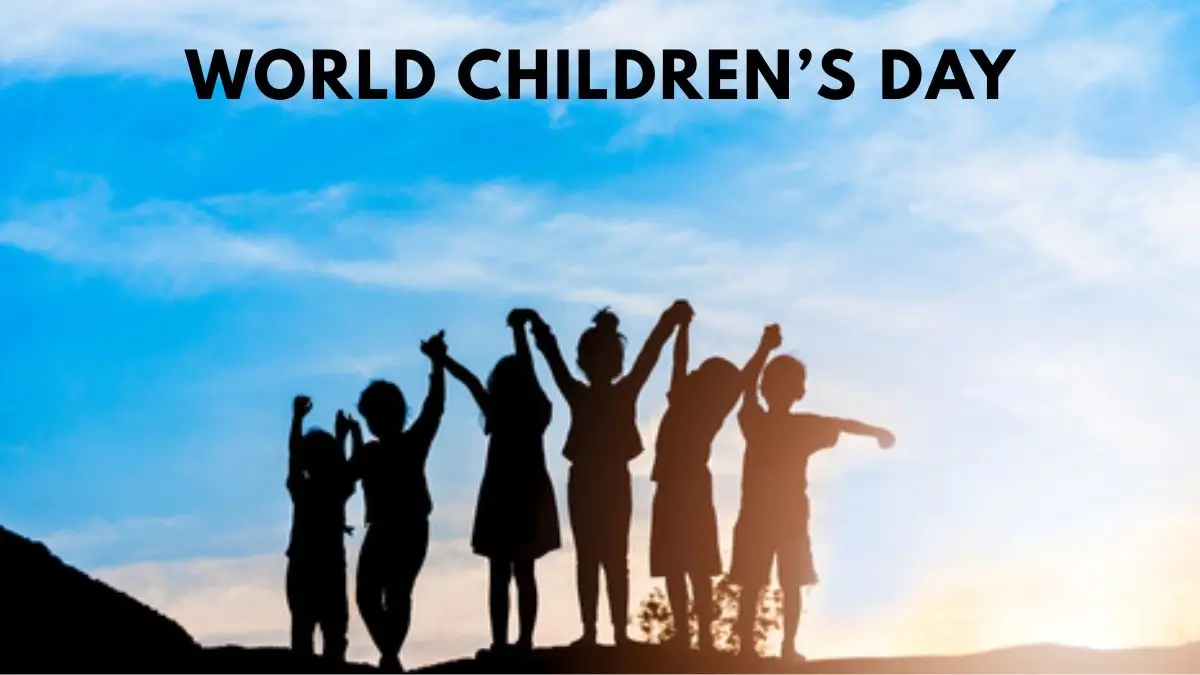
World Children’s Day is celebrated on 20th November 2026. It aims to raise awareness of children’s rights, empower children and encourage governments and communities to protect children’s rights. 2026’s theme is ‘My day. My rights. My future’. This date is significant as it marks the 60 th anniversary of the Declaration of the Rights of the Child (United Nations), and the 30th anniversary of the Convention on the Rights of the Child (United Nations).
World Children’s Day 2026 Date
This day is celebrated annually on the 20th of November.
On the 20th of November 1959, the Declaration of the Rights of the Child was adopted by the United Nations General Assembly (UNGA). On the 20th of November 1989, the Convention on the Rights of the Child (UNCRC) was formally adopted.
The event is led by UNICEF so that awareness of children’s rights is raised. Encouraging people to act to better support and protect children.
World Children’s Day Theme 2026
Theme for this year is My day. My rights. My future.
This theme focuses on empowering children to be heard in decisions concerning their future.
It encourages Governments, institutions and communities to listen to children’s concerns.
UNICEF encourages children to be in influential positions in media, politics, business, sport and entertainment. Landmarks and buildings are also lit in blue to show support for children’s rights.
Background of the Day
World Children’s Day has emerged from international efforts to ensure children’s rights are properly protected.
| Year | Event |
| 1924 | League of Nations adopted Geneva Declaration of the Rights of the Child. |
| 1954 | Resolution 836 (IX) adopted by UNGA. Suggested a Universal Children’s Day be created. |
| 1959 | Declaration of the Rights of the Child adopted by UNGA on 20 th November. |
| 1989 | Convention on the Rights of the Child adopted by UNGA on 20 th November. |
| 1990 | The UNCRC came into effect on the 2 nd September. |
In 1954, resolution 836 (IX) encouraged countries to create a spirit of brotherhood between children and to hold events to improve children’s welfare. Therefore, 20 th November became very significant in creating international standards on children’s rights.
United Nations Convention on the Rights of the Child (UNCRC)
The United Nations Convention on the Rights of the Child (UNCRC) is an international human rights agreement adopted by UNGA on 20th November 1989.
The convention recognises children’s civil, political, economic, social and cultural rights. Within this convention, a child is defined as anyone under the age of 18 years of age, unless otherwise stated by applicable law.
Key aspects of UNCRC
- There are 54 articles within the UNCRC.
- Children are recognised as individuals with their own rights.
- Governments are expected to protect and allow children to realise their rights.
- Children’s rights to education, health, protection, identity, familial relationships and participation are all covered.
- Decisions regarding children must be made with their best interests in mind.
UNCRC’s Four Guiding Principles
| Principle | Explanation |
| No discrimination | All children must be able to have their rights without discrimination |
| Best interests of the child | Decisions made on children must prioritise the best interest of the child. |
| Right to life, survival and development | Children should have the opportunity to develop physically, mentally and socially in a healthy way. |
| Respect the views of the child | Children have a right to be heard. Their opinions should be considered in line with their maturity/age. |
Important Child Protection Laws in India
India has put many laws in place to prevent children from being exploited, abused, neglected or having their basic rights ignored.
| Law | Year | Explanation |
| Prohibition of the Child Marriage Act | 2006 | Aims to prevent child marriage and includes legal solutions and punishments. |
| Right of Children to Free and Compulsory Education Act | 2009 | Ensures free education of children between the ages of 6-14. |
| Protection of Children from Sexual Offences (POCSO) Act | 2012 | Protects children from sexual abuse, sexual harassment and pornography. The law includes child-friendly methods when dealing with children in legal cases. |
| Juvenile Justice (Care and Protection of Children) Act | 2015 | Ensures children receive care, protection and support to reintegrate into society. |
| Child and Adolescent Labour (Prohibition and Regulation) Act | 1986 (amended in 2016) | Prohibits employing children under the age of 14 (with some exceptions). It also prevents adolescents (aged 14-18) from undertaking dangerous processes. |
National Commission for Protection of Child Rights (NCPCR)
The National Commission for Protection of Child Rights (NCPCR) is a statutory body formed under the Commission for Protection of Child Rights Act 2005.
The commission aims to protect children’s rights, and ensures important laws regarding children are followed correctly. These laws include the POCSO Act, Juvenile Justice Act and Right to Education Act.
Significance of World Children’s Day
World Children’s Day is important to remind us that children deserve to be protected and empowered within society.
Key aims are,
- Promote children’s rights: Raising awareness of children’s civil, social, economic and cultural rights.
- Protect children: Encouraging action to protect children from abuse, exploitation, trafficking and child labour.
- Better education: Ensuring people can get a good standard of education and equal learning opportunities.
- Improved health and well-being: Encouraging good nutrition, healthcare, well-being and a safe environment.
- Empowerment: Allowing children to voice their opinions on matters which affect them.
- Accountability: Encouraging governments and institutions to implement policies and laws to protect children.








 Rani Lakshmibai Birth Anniversary 2026: ...
 World Toilet Day 2026: Theme, History, S...
 International Men's Day 2026: Date, Hist...